


I’ve been studying three-act structure again and trying to get a better understanding of it as it is applied in actual stories. As a result, I’ve plotted out a number of films with the act structure called out. And I have a more detailed 8-point plotting model.
Three-act structure is the method by which most modern stories are plotted in order to produce a series of satisfying dramatic moments. There are other ways to plot a story (Shakespearean five-act structure, for example), but three acts is generally thought of as the simplest useful way, and five-act and other structures can pretty easily be mapped onto it.
One of the more obvious aspects of three-act structure is that it is really four-act structure, because the crisis at the half-way point completely changes the direction of the story. And four equal-sized acts make more sense than talking about the “first half of the second act”.
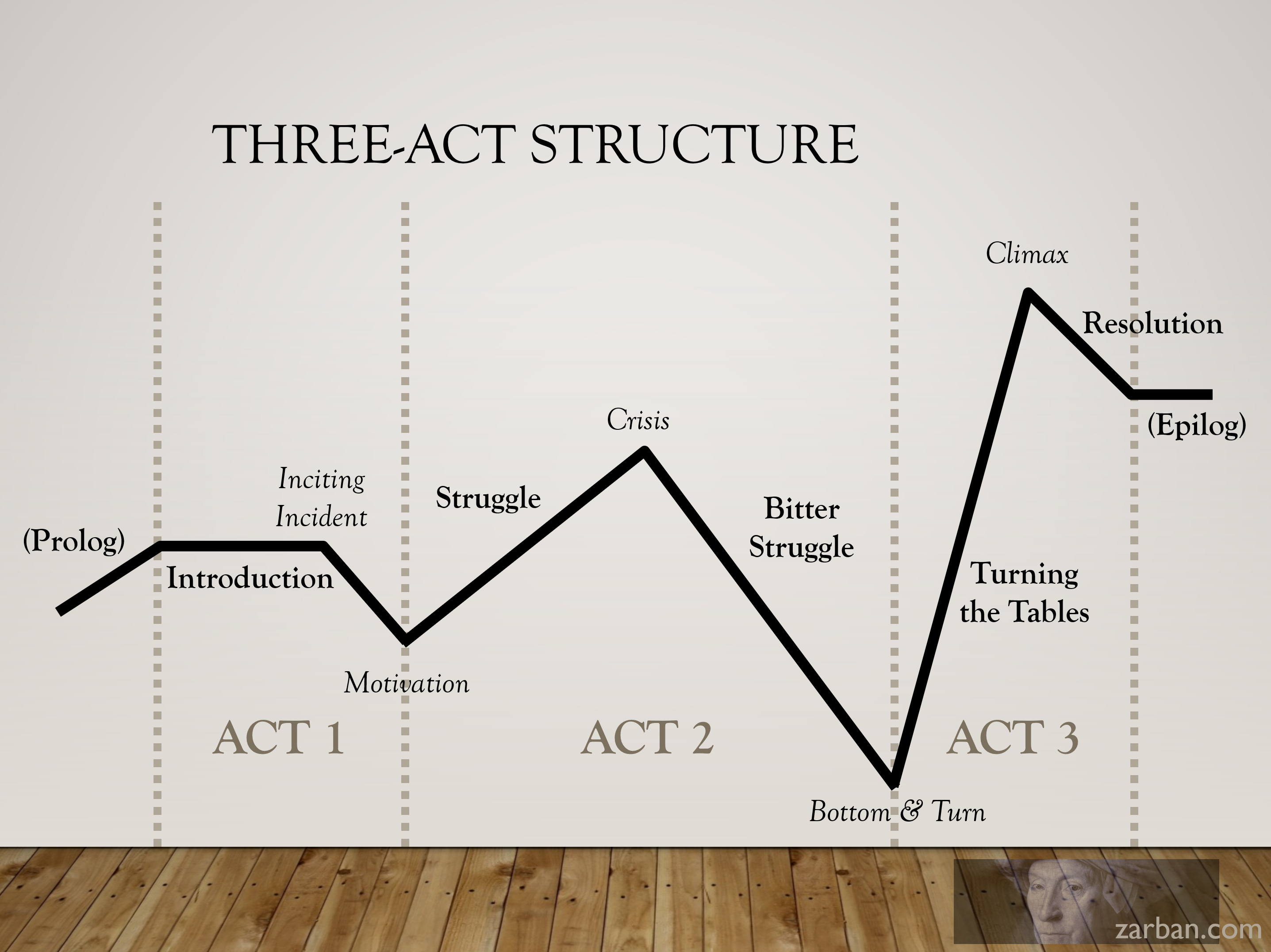
In this diagram, we see the emotional state of the hero rising and falling with triumphs and setbacks. The first act is one quarter of the length of the story (including the prolog, if there is one), the second act is half the story, and the third act is the final quarter (including the epilog, if there is one).
Act 1 – Setup & Launch
The introduction to the conflict and the motivation to resolve it.
Prolog
This is a brief, optional opening that sets up the story, often with action that hooks the audience with action or mystery (often without the hero), or just a printed legend or narration over a montage. If the hero is here, it’s typically shows the hero’s life getting to where it is “today” or else an example of the hero’s past adventures that usually has relevance to the story to be told.
It may show the inciting incident occurring in secret, to be discovered only later, such as the crime in a mystery or the villain’s origin or first act of antagonism toward the hero.
The Introduction
We are introduced to the setting and most of the main characters, especially the heroes. This establishes the ordinary world the heroes live in, the type of character the heroes are, what the heroes want or need, and so on. These introductions lasts thruout the first act.
The Inciting Incident
Then an extraordinary event occurs–or, if it happened in the prolog, is discovered to have occurred. This is the inciting incident. It is typically mysterious, but may be personal or literally earth-shaking.
Then the central conflict is introduced: a villain or circumstances, related to the inciting incident, threaten the heroes or their loved ones or the whole world. The villains want something, but the heroes stand in their way, or vice versa, or both.
Still, the heroes are often reluctant to get involved and refuse the call to action.
If there is a catch (a problem that has to be remedied before the heroes can resolve the central conflict), it may get introduced here; perhaps the heroes don’t know who the villain is or where he or she is, and this may contribute to the heroes’ reluctance.
The Motivation
Circumstances force (or promised rewards convince) the heroes to accept the call to action. Often, there may be a disaster if they don’t take action. This is the motivation, the thing that thrusts the heroes into the extraordinary world.
Act 1 ends one quarter of the way thru the story with the heroes thrust into the conflict, but not necessarily committed to resolving it.
Act 2 – Complications Along with Way
The struggle to resolve the conflict and a crisis and apparent failure.
The Struggle in the Extraordinary World
The heroes start out with cautious optimism to explore the extraordinary world and investigate the inciting incident or resolve the conflict. Here is where the game is afoot, the chase is on, etc. (but they might be the hunters or the hunted).
Soon, the heroes leave what was a place of relative safety in the new extraordinary world and venture into the wilderness. The heroes may get a pointed warning or else encounter the villain’s chief henchman or even the villain himself in a social setting or as a social superior, perhaps without knowing that he or she is a heavy. The heroes may also encounter a character who becomes a mentor, who may give them a special tool, clue, or weapon to help them.
There may be a moment for the heroes to catch their breath and explore or enjoy the wonders of their new world, often actually sleeping.
Thruout this part are one or more complications from happenstance and one or more confrontations with heavies. There may be a subplot here that introduces a secondary conflict. Secondary conflicts should be resolved before the primary conflict, but catches, by definition, must be.
The Midpoint Crisis
Just when things seem to be going pretty well, a crisis develops half-way thru the story that threatens to ruin the heroes’ chances and/or raises the stakes. The scene about it ends right at the 50% point, just like the act 1 break ends right at the 25% mark and the act 2 break ends right at the 75% mark.
A member of the heroes’ team may die or be captured. The villain may slip thru the heroes’ fingers. In a murder mystery, a second murder may be committed. Or perhaps a catch is introduced here. Or circumstances (such as a storm or wrong-headed authority figure) constrain the heroes’ progress. If there is a subplot, it should have its own crisis around the same time as the main crisis for the central conflict.
Whatever it is, this is the moment the heroes say, “This is going to be harder than we realized.”
The Bitter Struggle
The heroes continue struggling with complications, plot devices, and bigger confrontations, such as a betrayal, a chase, the death of an ally or the mentor, and/or a fight. The complications of the struggle were hard, but now people are dying.
Typically, somewhere in here, the heroes dedicate themselves to resolving the conflict, whereas before they may have been merely investigating the inciting incident out of curiosity.
Often, a ticking clock is introduced to ratchet up the tension. The villain succeeds in part of his or her plan, the hero’s boss gives him or her a deadline, or some catastrophe has been uncovered that now has a clear time limit. It becomes an all-out race against time!
The Bottom
Things don’t go well, and the heroes are reduced to the bottom: their lowest point emotionally and perhaps physically, often with a particular moment where all seems lost.
Act 2 ends three-quarters of the way thru the story with the heroes at a physical and perhaps emotional low but committed to resolving the conflict once and for all.
Act 3 – Climax & Resolution
The final struggle before achieving success and resolving the conflict.
The Turn
But then there is a turn. Perhaps an expert or mentor provides some aid, or the heroes resolve the catch or secondary conflict, possibly by figuring out where the villain is or what the real villain’s identity is. Or a clue makes previously confusing pieces of the puzzle fall into place.
Note that some people consider the turn to be a separate plot point from the bottom and to be the beginning the third act, but they can occur so close together they are practically the same event (discovering a betrayal but resolving the catch of who the villain is). The bottom can last a substantial amount of in-universe time, with the heroes essentially giving up or spinning their wheels until they get a break or otherwise recommit to achieving a resolution.
Turning the Tables
The heroes turn the tables on the villain and put their (new) plan into action. Or, if the heroes have been hunting the villain, the villain turns the tables on the heroes and begins hunting them. There are still complications in the form of henchmen to battle or confirmation of the clues to be done, but the heroes’ actions are now swift and confident (or terrified and desperate).
However, there can often be a setback here, with the heroes getting captured or wounded or having to convince authorities they aren’t crazy. This is usually very brief.
The Climax & Final Challenge
At the climax, the heroes end up in a final confrontation with the villain (“So, we meet again…”) and win the day (or lose).
Often, there is one last challenge or twist before success (or failure). Here is where the heroes might have to sacrifice something to resolve a conflict or perhaps there is a betrayal, but these things have quick (if not easy) solutions. Often, the heroes have some trick or device for overcoming the last hurdle. If the hero has had reason to doubt himself, here is where he proves himself.
Epilog – The Resolution
In the end, the heroes are successful (or dead). They may return triumphant with their shields (or on them). Either way, the conflict is resolved, and the heroes settle into a new, higher emotional state (but not as high as the climax).
Any loose ends are tied up, such as the heroes getting their reward, professing their love, or getting married; injured heroes and allies getting medical aid; dead ones getting mourned; and bothersome authorities getting their comeuppance. This is often very brief.
The End
A common mistake here is carrying on with story after the central conflict has been resolved because there are loose ends (subplots or mere questions) that weren’t resolved earlier and can’t be resolved quickly. It’s dull, because the audience is rapidly losing interest now that the point of the story–resolving the central conflict–has been reached.
The opposite is also a common mistake: leaving the story “open” or presenting an ending that is ambiguous, meaning the central conflict is never actually resolved.
Of course, not all open or ambiguous endings are mistakes. Audiences expect certain characters to go on to further adventures, for example, and that not every ending leaves the characters entirely happy. The middle story in a trilogy, for example, typically ends with villain winning the day and the heroes mourning their loss (conflict resolved in favor of the villain); this is the end of the second act of the trilogy as a whole.
 zarban.com