


I continue to read up on Dungeons & Dragons and watch homebrew rule videos for D&D and other systems. I’ve been reading both the 4th Edition (which I never played) and 2nd Edition (which I played extensively) books, and I marvel at the fact that Wizards of the Coast has never solved the falling damage problem.
When D&D was first created, Gary Gygax set falling damage as 1d6 per 10 feet for each 10 feet fallen. By this he meant 1d6 for the first 10 feet, 2d6 for the second 10 feet on top of the first 1d6, etc. But it was edited to “1d6 per 10 feet fallen” and universally played that way, even after he publicly wrote about the error. Bizarrely, this rule was codified, and–despite many editions and great expansion of hit points*–it remains.
* Fighters only had d8 hit dice in early editions.
They could have at least changed it to 1d6 per 5 feet. You can be quite injured falling off a 5-foot platform, and most platforms, pits, traps, ditches, and ravines are going to be 5-, 10-, or 15-feet, not 10, 20, or 30.
Some people have even made memes and videos lampooning it, such as one depicting a character deliberately jumping off a cliff, safe in the knowledge that he can survive a 50-foot fall. After all, that’s only 30 hp damage at most, and just 18 on average.
Meanwhile, real-life people who work on roofs and ladders attest that falls that cause “life-changing injuries” start around 15 feet. Worse, characters in adventure movies are always depicted as falling into awnings or a cart full of straw or something as an explanation of why they aren’t turned to scrambled eggs by a big fall.
What Are Hit Points Anyway?
I solved the falling damage problem the same way I solved the overall hit point problem. Traditionally, hit points are thought of primarily as your body being physically injured. The rules said they weren’t, but you healed at a rate of just 1 hp per day, which sure seemed like physical healing.
Originally, every session was a discreet town-to-dungeon-to-town adventure, because Gygax & Arneson never knew who’d show up. So your character got 1 hp per calendar day since your last session.
But in newer editions, you get all your hit points back overnight, which means they can’t represent real injury but just getting tired. But actually, that nicely explains why heroes can keep fighting all the way down to 1 hit point.
And since that mechanism has worked for decades, I say: let’s embrace it.
First, you need to know that, in my house rules, you start with more hit points at low level but have substantially fewer at high level. Also, most skill checks and saving throws are allowed a recovery roll. That is, you make the same roll again and maybe this time succeed, but only partially–my way of making so-called “save or suck” mechanics more dramatic.
This creates a new definition of hit points. Hit points up to 10 represent your physical durability and fortitude. Those above 10 represent your fighting prowess, stamina, and resilience.
Let’s see how this fits into the new injury rule….
Getting Injured
Losing hit mostly represents fatigue, cuts and bruises, and perhaps getting the wind knocked out of you.
Half Hit Points: Bloodied
At half hit points, you’re bloodied. It’s just cuts and bruises, but it’s noticeable. Solo monsters must check morale at this point, and beasts will always try to flee.
Five Hit Points: Injured
When your hit points are reduced to 5 or less, you’re injured. It’s minor and doesn’t entirely stop you, but you now make attacks and physical skill checks (attacks, strength, and dexterity) at disadvantage. If a creature’s hit points are normally 5 or less, then it’s bloodied and injured after taking any damage.
Zero Hit Points: Seriously Injured
If you’re reduced to zero hit points, you’re seriously injured. You fall down and drop anything you’re carrying. Attacks against you get advantage. If you take additional damage, you die immediately.
On your next turn, you must “dice with Death”. Check difficulty class 14 using your constitution modifier.
- If you succeed, you’re stable and should survive. You can even crawl but are unable to attack or cast spells–but you can drink a potion.
- If you fail, you’re unconscious. When an ally renders you aid at your side, make a recovery roll—with a -1 penalty for each round it took before you got aid. If you succeed, you’re stable & regain consciousness, but you can’t even crawl.
- If you fail both rolls (or no ally rendered aid within 10 rounds), you died. If an ally got to you in the same round you went down, you regain consciousness enough to speak some last words or, better still, drink a potion they offer.
It’s not necessary to dice with Death for every monster, but heroes might occasionally leave creatures for dead only to find they barely survived.
Hit Location
Now, getting reduced to 5 hit points means you got a wound but can soldier on. Getting reduced to zero means you got a sword in the gut, an arrow in the shoulder, or an ax to the leg–a wound that you might survive, but you’re done fighting for now.
In fact, you can use a hit location table for it. Hit location tables were popular for awhile in the 1980s, but it was soon evident they were too cumbersome to use on every successful attack. But since PCs don’t get reduced to zero hit points often, it works fine here and provides great flavor.
Roll 1d6:
- 1=leg
- 2=left arm
- 3=right arm
- 4-5=torso
- 6=head/face
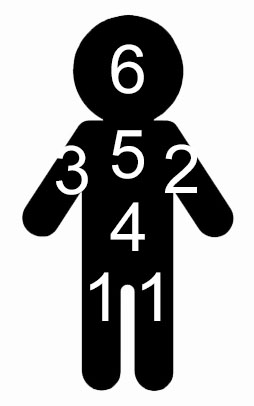
That’s it. Now you know where the scar is going to be, if you survive. If you like, you can even use it for the wound you get when you go below 6 hp.
Beasts & monster can take pretty serious wounds & keep on coming, so just say those blows landed on whatever body part was closest—body, limb, tail, head, other head… whatever.
If you play an OSR game and want more grit, you can reduce the checks at zero hit points to a single constitution check.
At last, this lets us solve falling damage.
Falling Damage
When you fall more than 5 feet onto a hard surface, make a check using your constitution modifier. The difficulty is half the distance fallen in feet. (So a fall of 18 feet would have a difficulty class of 9).
- If you succeed, you take 1d4 hp bludgeoning damage per 5 feet fallen.
- If you fail, you are reduced to zero hit points.
If either of those reduces you to zero hit points, you are seriously injured. See Zero Hit Points, above. You can get creative with the location roll. If you hit your head, you have a concussion. If the location is the torso, you’ve broken some ribs.
Many potential falls should allow a dexterity check first to see if the hero catches the edge of the pit or a plant root or branch and doesn’t fall at all.
If the fall was not voluntary (jumping) but rather the result of a shove, the floor giving way, or something similar, the fall occurs after the character’s next turn.
Resting
The last piece of the puzzle is recovering your hit points. As stated above, the old-school rules allowed only 1 hp per day. This was because, at Gygax and Arneson’s tables, they tracked real time between sessions. So, if you showed up to play one day and got injured then turned four days later, you got 4 hit points. This worked, because the heroes always returned to town at the end of the session. They thought that, if people who bought their game played once a week, their characters would get 6 or 7 hp back between sessions. They didn’t count on GMs stopping the game mid-dungeon and picking up where they left off.
5th Edition allows short rests and long rests that return far more hit points–too much, even when we think of it as mostly resting instead of healing from significant wounds.
My solution is to allow a good night’s rest to be nicely restorative but not just catching your breath. Sleep at least 6 hours to regain 2 hp per level (or, if disturbed by attack or alarm, 1 hp/lvl) and all “once a day” abilities. A good night’s rest means you pitch camp with a tent and bedroll or stop at an inn. As long as you get 6 hours sleep total, you may even take a turn at sentry duty.
You might also allow a short rest: 1 hp for resting 20 minutes, to a maximum of 1 hp per level per day–and it triggers a wandering encounter check. This is not just catching your breath; you can’t combine resting with searching a room. During a short rest, the heroes bind their wounds, tend to damaged equipment, eat some food, etc.
 zarban.com