

On the Dungeons & Dragons OSR (old-school renaissance) subreddit, someone asked for everyone’s house rules, so I wrote up mine for 2e. The idea (mine, not the original poster’s) was to fix the game by filling in holes, modernizing certain aspects, and generally making it faster and more fun in as short a space as possible. I managed to keep my D&D 2nd Edition house rules to four pages, but I’ve expanded since.
- old Google Docs version
- Cool-looking GM Binder version
- Expanded GM Binder version that includes choice among features and a complete skill system.
2nd Edition D&D was a great game, but there was a clear imbalance. Spellcasters got access to a new level of spells every odd-numbered level. Other classes didn’t get anything nearly so exciting.
The only features fighters got were weapon specialization, extra attacks, and elevation to lordship. Thieves similarly lacked advancement, apart from regular improvements to the same old skills. And neither had much they could do in combat apart from attack.
So I set out to create some simple tactical options for combat and a few carefully chosen extra features, mostly for fighters and rogues. They’re short enough that I decided to post them here as well in somewhat expanded format. They include versions of some rules I’ve posted here previously.
Ability Scores
Roll 4d6; drop the lowest die. This is your charisma. Roll 5 more times the same way and assign these to abilities as you like. If no score is at least 15, raise your second highest score to 15. You can then add +1 to any score under 17. You can swap charisma with another score to make charisma higher but not lower.
Strength gets attack and damage bonuses at lower scores, but adventurers do not get percentile strength. These modifiers only apply for dexterity instead of strength (never both) when using a weapon with the DEX trait.

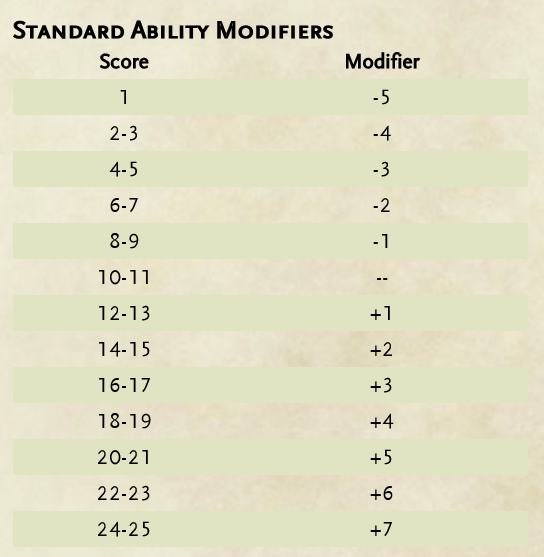
All abilities get standard modifiers similar to modern D&D.
Advancement
PCs start at 2nd level (or 1/1 for dual-class). Hit points per level are: warriors 5, wizards 3, priests 4, and rogues 4. Characters also get their CON bonus hit points at odd levels only.
Attack bonus (20 – THAC0) replaces THAC0.
Experience points are awarded for successful adventures (96% of the difference between levels) and 1 XP per gold piece spent above 100 gp (only large purchases count). There is no XP bonus for high prime ability scores.
At 4th level, the new experiences of adventuring boost your lowest ability score (one only) by +1. At 9th level, you gain +1 to any ability. At 18th level, you gain +1 to INT, WIS, or CHA.
Priest Classes (Clerics & Druids)
- Favor: You gain 1 point of luck each morning.
- Minor Miracle: You can spend a point of luck to find–or suddenly recall packing–one item or a few small items of a mundane sort, such as chalk or candles.
- Divination: Spend a point of luck make a successful wisdom check to ask the GM a simple question about the wisdom of a proposed action. The GM should answer honestly but briefly.
- Clerics get a degree in tradition and reading skills and two other skill degrees.
- Druids get a degree in nature lore and reading skills and two other skill degrees.
Wizard Classes (Mages & Sorcerers)
- Cantrip: You can cast Cantrip at will.
- Sorcerous Channel: In place of mundane spell components, you carry a custom-made staff, wand, or other sorcerous channel. Without it, you can only cast cantrips.
- Fireball does 3d6 hp damage +1 hp/level of the caster.
- Wizards get a degree in arcana and reading skills and one other skill degree.
- Sorcerers replace illusionists and specialists.
- You can swap a spell you’ve memorized with another you know, but you must save vs spell or suffer a minor wild magic effect.
Sorcerer Features (New Wizard Class)
- You don’t have to memorize spells. You can cast any spell you know, as long as you have a slot for it.
- The maximum number of spells you can learn per spell level is 3 plus your intelligence modifier. You can swap 1 between adventures.
Rogue Classes (Thieves & Bards)
Thieves and bards gain the skills and spells listed in the Player’s Handbook.
Rogues get a degree in stealth skill and three other skill degrees.
Lucky: At 2nd level, you start every adventuring day with 1 point of luck.
Rogues pick up their skills somewhat randomly. At 3rd, 5th, 8th, 11th, 14th, 17th levels, the DM should offer a choice between two random features you don’t already have:
- Coup de Grace: If maximum damage from your backstab could kill a bloodied opponent, you can spend a point of luck, and, if you hit with a normal attack, kill the opponent.
- Dagger Fighting: As the feature for fighters.
- Disguise/forgery: You are adept at disguising yourself so as not to be recognized and even, given time and access, impersonating another person. You can also forge official documents. In both cases, you must make a skill check for each close encounter or examination by someone who should be able to tell.
- Evasion: When you are hit in melee but before you know the damage, you can spend a point of luck to evade the blow, but you end up several feet away (Random square around your starting point.)
- Hide in Plain Sight: If you are with at least two humanoid allies, creatures with low to high (5-14) intelligence will generally not target you in combat, unless you are doing something conspicuous (about to attack, starting a fire, etc.).
- Insight: Spend a point of luck to ask the GM a simple question about an adversary relevant to the current combat, negotiation, reaction roll, or skill check. The GM should answer honestly but briefly.
- Read Languages: You can read bits of writing in a language you don’t speak, if it’s not magical or a lost language. Roll 1d6 plus your intelligence modifier and multiply times 10 to see what percentage of the document you understand. Roll for each document.
- Silver Tongue: With time (30 minutes or so), you’re so persuasive that you effectively have the ability of Charm Person by spending a point of luck. If successful, it lasts 1 day, after which the person is merely friendly (unless cheated).
- Specialist: You get a bonus of +3 to one of any of your starting rogue skills.
- Swashbuckler: Daring feats only cost you 1 point of luck instead of 2. You can also spend a point of luck to tuck and roll after a fall (up to 15 feet) to avoid falling damage.
- Uncanny Agility: Get advantage on agility-based checks. If you have acrobatics, you can climb most walls, cross roofs, and catch hand-holds as parkour; on a failed check, you must get down. (1d6 damage on a natural 1.)
- Viper Strike: You can perform a backstab-like attack face-to-face, as long as it is the very first attack of a combat encounter. You create your own surprise.
Thief features
- Jack-of-all-trades: Twice when offered a rogue feature, you can instead choose a fighter or warrior feature of equal or lower level.
- The Big Score: At 20th level, you get a shot at the score of a lifetime. You define it.
Bard features
- You can cast Cantrip once a day per level.
- Your 5th-level feature is automatically Silver Tongue.
- Jack-of-all-trades: As for thieves, but only once, starting at 8th level.
Warrior Classes (Fighters, Paladins, & Rogues)
Warriors get a degree in monster lore skill and two other skill degrees.
Fighter Features
At 1st level, you can choose one of these:
- Archery
- Shield Bearer
- Weapon Specialization
At 3rd and again at 4th level, you can choose one of these or one above:
- Animal Friendship
- Battle Cry
- Dagger Fighting
- Howling Fury
At 5th level, you gain Horde Bane and can choose one of these or one above:
- Quick Reaction
- Lucky Blow
- Evasion
At 6th level, you gain Steely Nerve.
At 7th level, you can choose one of these or one above:
- Marksmanship
- Multiple Attack
- Sense Unseen
At 9th level, you can choose one of these or one above:
- Defiant Spirit
- Volley
At 11th, 13th, 15th, 17th, and 19th levels, you can choose one of these or one above.
- Epic Feat
- Grand Charger
Paladin Features
Paladins still must be lawful-good and adhere to their chivalric code.
At 1st level, you can choose one of these:
- Archery
- Shield Bearer
- Weapon Specialization
At 2nd level, you are blessed to be immune to all forms of natural disease.
At 3rd level, you gain Undead Slayer and can choose one of these or one above:
- Battle Cry
- Quick Reaction
At 4th level, you can choose one of these or one above:
- Warhorse
- Dagger Fighting
At 5th level, you gain Steely Nerve and Divine Strike.
At 6th level, you gain Horde Bane.
At 7th level, you gain Detect Evil and can choose one of these or one above:
- Lucky Blow
- Multiple Attack
- Sense Unseen
At 8th level, you gain Aura of Protection.
At 9th level, you gain Mysticism.
At 11th level, you can cure any form of natural disease (once per week) and can choose one of these or one above.
- Defiant Spirit
- Epic Feat
- Grand Charger
- Evasion
At 13th, 15th, 17th, and 19th levels, you can choose one from the lists above.
Ranger Features
At 1st level, you gain Animal Friendship and can choose one of these:
- Archery
- Shield Bearer
- Weapon Specialization
At 2nd level, you gain Tracking proficiency, which improves at +1 per three levels (5, 8, 11, 14, 17, 19).
At 3rd level, you pick your species enemy, and you can move silently and hide in shadows per Table 18 of the PHB.
At 5th level, you can choose one of these or one above:
- Dagger Fighting
- Steely Nerve
- Evasion
- Lucky Blow
- Marksmanship
At 6th level, you gain Horde Bane.
At 7th level, you can choose one of these or one above:
- Multiple Attack
- Quick Reaction
- Sense Unseen
At 9th level, you are made a forest warden and begin attracting followers, one per level, starting with a Grand Charger.
At 11th, 13th, 15th, 17th, and 19th levels, you can choose one of these or one above:
- Defiant Spirit
- Volley
- Epic Feat
Class Feature Descriptions
Animal Friendship
You have a natural affinity for animals. Livestock, pets, and even guard dogs are automatically friendly if you are friendly to them. You can make a pet of a tiny beast on a check of difficulty 10 using charisma, but it will hide rather than fight during times of danger.
Two levels later, you can try to befriend a beast you encounter (difficulty 10 for non-ferocious beasts; 12 for raptor birds and ferocious plant-eaters; 14 for meat-eaters) once per day. Checks use charisma. The creature will be friendly and even helpful (especially in exchange for food) and will alert you of danger or lead you to water but will flee if combat occurs. The creature will stay around you for 1d4 days or until dismissed.
Another two levels later, you can add +3 to the befriending roll, and befriended beasts will stay around for 1d4+2 days. Also you can request the befriended beast act as a mount, if it is suitable to ride (elk, reindeer, bison, buffalo, aurochs, bear, giant wolf, giant goat, giant badger, etc.). It will fight with you (but not independent of you).
Archery
If you are proficient in the short bow or longbow, your abilities now include:
- Take aim: You can choose to forego one bow attack you would normally get in order to get advantage on another and do +3 precision damage.
- Archery in Motion: You can move your full movement rate and still take two shots in the same round, readying another arrow while moving.
Aura of Protection
You are surrounded by an aura of protection with a 10-foot radius. Summoned and evil creatures within that space attack at -1 (any opponent). They recognize you are the source of their ill luck.
Battle Cry
You develop a battle cry that, when shouted as you close for melee, gives heart to yourself and any ally within 30 feet, so you each get advantage on your next attack in the current combat. You can do this only once in a given combat.
Defiant Spirit
You have found how to draw on your personal spirit to fight back against both arcane magic and mystical forces. You cut the duration of such effects (on you personally) in half. You make all checks against magical effects (including recovery) with advantage.
You also do not suffer disadvantage to attacks and checks from being noticeably injured.
Detect Evil
You can detect evil intent at a distance of 1 foot per level.
Divine Strike
When you make a successful attack with a melee weapon, you can spend one point of luck to do 1d4 hp lightning damage per level as paladin in addition to the weapon’s damage.
Dagger Fighting
You are practiced in melee with a dagger in one hand and another one-handed weapon in the other (no shield). You must attack the same opponent with both weapons. You are also proficient at throwing daggers and knives. As you gain an additional attack, you do not get an additional attack with both weapons.
Epic Feat
When you make an attack, you can spend a point of luck to try to perform an epic feat. If the attack is successful, you achieve a heroic maneuver that has some effect relevant to an encounter. For an opponent one size larger than “somewhat similar”, the DM may require an opposed strength check or a dexterity check.
- The attack automatically achieves a critical hit.
- You can perform a Daring Feat on a somewhat similar opponent (rather than only similar opponents).
- You climb on top of a much larger opponent, making further attacks automatic critical hits.
Evasion
You’ve learned to see a hard blow coming and get out of the way. After you are hit for damage but before damage is determined, you can check difficulty 12 using dexterity or spend a point of luck to evade the blow.
You end up several feet away in a random direction (1d12: 1 = DM chooses; 2-10 = clock points around opponent, 11-12 = you choose).
Grand Charger
You can go on a quest to find a fantasy mount. Good choices include a griffon, hippogriff, winged horse, or giant variety of lizard, panther, wolf, or other creature with semi-intelligent intellect and little to no magic powers.
The creature will sense your heroic aspect and, if approached carefully, will be open to friendship, if you’ve brought food. Check difficulty 11 using CHA to befriend the creature. This may be tried twice per day under most conditions. Success followed by spending one week bonding with the beast gives you the equivalent of horsemanship skill.
The grand charger will take simple orders and generally behave as a well-trained horse or dog, even guarding the company’s cart. When not needed for a time, as when you venture into a dungeon or a city, the grand charger will manage for itself (as when wild). You can sense one another at two miles in open ground, and the creature tends not to wander far. But it could get into trouble—such as eating a sheep from the local manor, which you will be responsible for.
This is a special bond, and if the creature is killed, you will mourn for a month but may then quest for another mount. However, you may suffer disadvantage to befriending checks if the creature senses guilt because the death was due to your own recklessness.
Horde Bane
Your weapon skills can make you a whirlwind of destruction when faced with multiple enemies. You can split your damage among as many creatures as you wish, as long as you have the movement to reach them all and your modified attack roll can hit their armor class. Each creature must receive at least 2 hp damage.
And you treat all 1st-level creatures as if they had just 1 hit point. Two levels later and again two more levels later, this extends to 2nd- and 3rd-level creatures.
Howling Fury
When using a melee weapon in combat, you can go into a berserk rage and gain a +2 strength, 2 points of luck, and hit points equal to your level. You become immune to abilities and spells that charm.
If you roll a natural 1 on an attack, you mistakenly attack an ally within range, if any. At the end of combat, you lose your immunity to charm, your strength returns to normal, and you lose half your remaining hit points due to fatigue. You cannot muster the same ferocity again until you get a good night’s rest.
Lucky Blow
When you roll a natural 19 for an attack, you can spend a point of luck to turn it into a critical hit.
Marksmanship
If you already have Archery, your marksmanship progresses to include:
- Deadeye: Your skill reduces the effectiveness of the opponent’s armor or hide and so gains +1d3 damage.
- Shoot into Melee: You can shoot into melee without fear of hitting an unintended target. Any misses merely go astray.
Multiple Attack
You get an additional attack each round with your current weapon, which can be a melee weapon or missile weapon that is not a crossbow. However, the extra attack is at disadvantage. If you already have an attack with disadvantage (due to Weapon Specialization feature, for example), then—instead of the extra attack—that attack is as normal instead of at disadvantage. You cannot have more than one attack at disadvantage.
- 1 normal attack
- 1 normal and 1 at disadvantage
- 2 normal attacks
- 2 normal and 1 at disadvantage
- 3 normal attacks
Four levels later, the extra attack becomes a normal attack without disadvantage.
Mysticism
You are blessed with favor of your deity. You can begin casting spells as a 1st-level cleric and gain the features of a cleric of the faith (healer, oracle, or war). As you advance as a paladin, you also advance as a cleric.
Pass Unseen
If you are wearing medium armor or less, you can pass unseen thru woodlands as long as you are at least 30 feet from creatures and also leave no trace, except if there is snow on the ground. You get +3 to stealth checks in wilderness.
You can also move at your normal speed thru difficult terrain, such as rocky ground, wet mud, and tangled undergrowth, and remain alert to danger.
Quick Reaction
You can always choose to act first in an action round, after readied actions, regardless of who wins initiative. This is not an extra attack. If you have multiple attacks, you can still take your additional attacks when you would normally act, based on initiative. If you prepare an action, you can still act first after others’ readied actions.
Sense Unseen
Your well-honed senses are heightened. You can detect creatures within 20 feet that are invisible or otherwise naturally or magically hidden—including incorporeal undead—and attack and defend against them as if they were visible.
Shield Bearer
If you use a shield, you can spend a point of luck to block an opponent’s successful melee attack on you or another creature within 5 feet of you. You can make the decision after learning the amount of damage the blow would do.
Or, without spending a point of luck, you can sacrifice your shield to block the blow. The shield must make a check (see Equipment) or become broken (handle or strap, etc.) and useless.
Steely Nerve
You have developed a grim resolve that makes you immune to non-magical fear, phobia, and morale problems. Any situation that would normally cause panic, you only suffer shock. You gain advantage to checks for magical fear and similar effects.
This also gives you an air of authority. You can tell NPCs of 5th level and below what to do. If they know you, aren’t sure of themselves, and might do it anyway, they will try to do it. If it is questionable, check difficulty 12 using charisma and your hero die. Failure means the person becomes hostile (“I don’t take orders from you!”).
Undead Slayer
When you make a successful attack with a melee weapon against an undead or fiend, the attack does +1d6 hp damage.
Volley
If you are proficient in the short bow or longbow, you can spend a point of luck to find the opportunity to turn one archery attack into three. You grab three arrows and shoot them in rapid succession at up to three targets in the same general direction.
You can also ready three arrows as a prepared action and shoot a volley in place of one archery attack without needing to spend luck.
Warhorse
You have vision of a fine warhorse in a nearby location you must seek out. Claim it as your divinely gifted steed.
Weapon Specialization
You are a master of one particular melee weapon (long sword, battle-axe, cutlass, etc.—not all swords). You get +2 to attacks and +2 to damage with that weapon. You also get one extra attack each round at disadvantage. If you already have an attack with disadvantage (due to Multiple Attack feature, for example), then—instead of the extra attack—that attack is as normal instead of at disadvantage. You cannot have more than one attack at disadvantage.
You can choose this feature multiple times, but each time for a different weapon.
Skills
In the full version, there is a whole compact skill and skill check system, with skills like:
- Appraisal
- Contacts
- Deception
- Gambling
- Monster Lore
- Persuasion
- Search
On a natural 1, as any d20 roll, the GM gains a point of danger.
Hero Dice
Adventurers earn a hero die that advances with them. Add the hero die to certain rolls in combat. If the hero die roll is 3 or more, you get a point of luck.
| Warrior Lvl | Cleric/Rogue | Wizard | Hero Die |
|---|---|---|---|
| 1 | 1 | 1 | |
| 2 | 4 | 5 | +1 |
| 5 | 8 | 10 | d3 |
| 8 | 12 | 15 | d4 |
| 11 | 16 | 20 | d6 |
| 14 | 20 | d8 | |
| 17 | d10 | ||
| 20 | d12 |
Luck
The DM can award points of luck for good role-playing; and you gain it when you roll a 3 or better on your hero die.
- Spend 1 point to reroll a die roll (keep either roll).
- Luck resets to zero at the end of the adventuring day (upon reaching a place of safety).
- The DM gets luck (“danger”) when a player rolls a natural 1 on any d20 roll.
- The DM can take a point by announcing an ominous sign (wolf howl, flurry of birds, crack of thunder, spooky noises, etc.). The DM’s danger never resets.
Equipment
Armor class is ascending from 7 for none (the old 10 AC).
| AC | Description | Encumbrance |
|---|---|---|
| 7 | none (old 10) | |
| 9 | leather or padded (old 8) | |
| 10 | studded leather or ring mail (old 7) | |
| 11 | brigandine, scale mail, or hide (old 6) | |
| 12 | chain mail (old 5) | 1 |
| 13 | splint mail, banded mail, bronze plate mail (old 4) | 1 |
| 14 | plate mail (old 3) | 2 |
| 16 | plate (old 2) shield provides no bonus | 2 |
| +2 | small shield | 1 |
| +3 | large shield | 2 |
The DM should roll 1d12 near the end of an adventure for meals, water, torches and lamp oil to see what was used, ruined, or lost. On a 1, that item is down to 2 uses (2 torches, 2 arrows, 2 meals, etc.)
Encumbrance
You can carry:
- Your strength score in “items” without being encumbered.
- Double your strength score with light encumbrance. You get -2 to attacks and dexterity checks and disadvantage on strength checks. You get -10 to your movement rate.
- Triple your strength score with heavy encumbrance. You get no attacks and automatically fail dexterity and strength checks. Your movement rate is limited to 10.
So, if your strength is 16, you can explore with 16 items, trudge around with 32, or plod heavily with 48 items.
Most equipment is 1 item, including packs of small items, like 4 torches or 12 candles. Medium armor is 1 item, as is a small shield. Heavy armor is 2 items, as is a large shield. Most one-handed weapons are 0 items; most hand-and-a-half weapons are 1 item; and most two-handed weapons are 2 items.
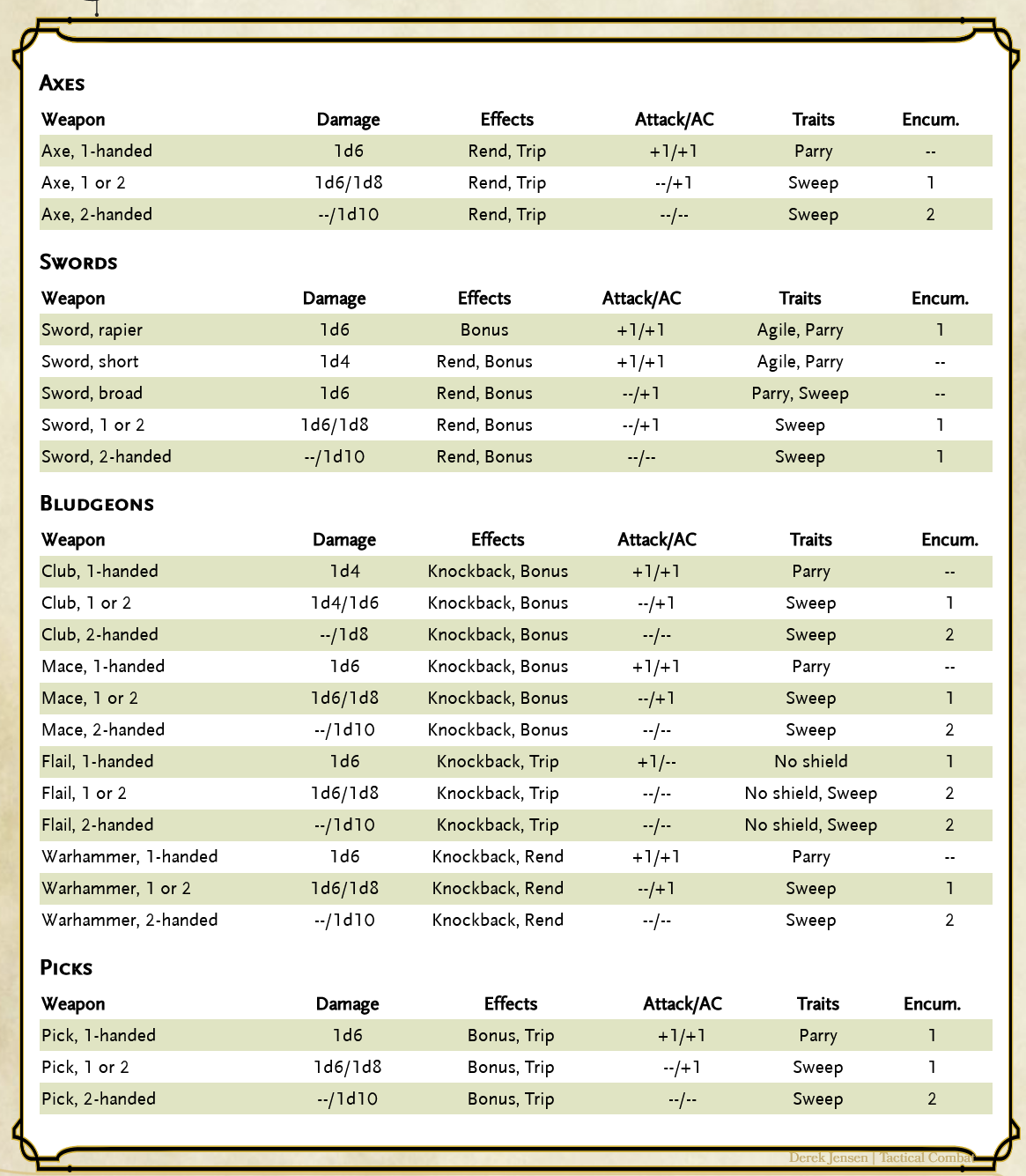
Weapons

Daring Feats
At 4th level, you can spend 1 point of luck (warriors) or 2 points (all others) and, on a successful hit, perform a daring feat, such as:
- Swap: You put yourself between an opponent and either an ally or something they are protecting.
- Mount: You do half damage but get the opportunity to leap onto a rock or piece of furniture and fight from the high ground. Or you leap onto the opponent, if larger than you, where your blocked attacks count as hits for damage.
- Target: You do half damage but hit a specific body part (such as the hand) that is not typically a target (like the head).
- Spoil: You do half damage but spoil an opponent’s next attack or attempt to chase you by throwing sand or dirt, knocking over barrels, toppling a brazier, etc.
- Demoralize: You display skill at arms that rattles same-sized or smaller opponents and causes them to make a morale check (describe the display).
Initiative
If one character in particular starts a combat, that character has seized the initiative, and there’s no need to roll. If the sides have squared off and both are ready, then each side rolls 1d20. The DM might give a bonus to one side, if it has significantly more characters, are of significantly higher level, or are better prepared.
Deal with readied actions first, then a character chosen by the winning side, then a character chosen by the other side, alternating until all characters have gone thru all their available actions.
The DM may group some monsters together (three goblin slingmen all going at once, for example), and may decide when extra characters and non-combatants act.
Initiative is not rolled each round. However, if a spellcaster casts an area-effect spell or if there is some other disruption, the DM may decide it causes the combatants to pause–ducking for cover or shading their eyes–and call for initiative again.
Surprise
If one side manages to ambush the other (or some similar one-sided surprise scenario), then all the creatures on that side get to act without the other side acting. Then, the surprised side automatically gets initiative in round 2. This should not be like the old method of rolling to see if one side or the other is surprised; it should only be for cases where one side is deliberately lying in wait for prey.
Combat
Each round, you can attack as an action and either move half your movement rate or perform a daring feat (or, if using a bow or other ranged weapon with no loading requirement, make a second attack with it).
- move half your movement rate and attack or vice versa
- attack and perform a daring feat or vice versa
- move your full movement rate
- attack with a ranged weapon with no loading requirement (such as a longbow) twice
Attacks
When you attack, you can choose a fighting tactic:
- Cautious: Add your hero die to your attack roll.
- Aggressive: Add your hero die to your damage roll. If you hit for damage and your opponent doesn’t, you can force an opponent back 5 feet, if they’re no more than 1 size larger.
- Defensive: Add your hero die to your armor class. If you also fall back 5 feet, hits from in front of you do half damage; you’re not also forced back by an aggressive attack.
- Sweep: Your hero die +1 determines how many opponents you can hit for half damage with one attack roll, as long as you hit their AC and can move to reach them.
To attack, roll 1d20, add attack bonus and other modifiers; the result is the AC you can hit. If you fail to hit AC 7, your attack misses entirely, otherwise a misses means your attack was blocked or glanced off the opponent’s armor or hide. Damage is the weapon die + strength bonus die and any other relevant modifiers.
A natural 1 is always a complete miss, and–for ranged weapons–the arrow, bolt, dagger, etc. is lost or broken; mark it off your inventory. As with any natural 1 on a d20 roll, the GM gains a point of danger.
A natural 20 is a critical hit: weapon and strength dice do maximum damage (but not hero die, if you’re attacking aggressively).
On a natural 19 or 20 attack roll, you can perform a free hand-to-hand combat maneuver (in addition to the regular attack) or choose an effect based on your weapon type. Effects:
- Knockback: Knock a similar-sized opponent back 5 feet; a smaller opponent also falls prone. If there is a wall there, the opponent takes 1d4 hp damage.
- Rend: Rend the opponent’s armor or hide for -2 AC (or chops off a tentacle, tendril, tail, etc.). Armor can be repaired during a short rest.
- Bonus: +2 damage.
- Trip: Same or smaller size opponent takes half damage but falls down or is unhorsed.
Great Blow
If you kill a creature with an attack that does 10 or more points of damage, you chop off its head, crush its skull or spine, or pierce it thru the heart or throat, etc., as appropriate for the weapon.
Hand-to-hand Combat
As an attack (or as a free maneuver from a natural 19 or 20), roll 1d20 against the target listed for the maneuver you attempt. Strength attack bonus applies. For creatures one size smaller, you get advantage. For creatures one size larger or with more than two legs, you get disadvantage. (You can’t fight creatures more than one size larger or smaller hand-to-hand.)
- Tackle: On a 6 or better, you tackle your opponent and go down together; you automatically have the opponent in a grapple. Fail: only you go down.
- Plow: On an 8 or better, you plow your opponent back 5 feet and go with them. Fail: only you move.
- Grapple: On a 10 or better, you get hold of your opponent (if you have one hand free). The next round, you can make an opposed strength check to cause 1d6 hp damage plus strength bonus or (if you’re standing) move the opponent 5 feet in any direction. Failure means the hold is broken. (Biting monsters get an automatic hit with the bite instead.)
- Shove: On a 12 or better, you shove or kick your opponent back 5 feet. Smaller opponent is also knocked prone.
- Knockdown: On a 15 or better, you knock your opponent prone.
Injury
Bloodied: At half hit points, you are bloodied (noticeably injured); monsters must check morale when bloodied.
Injured: When reduced to 5 hp or less, you are injured and get disadvantage on attack rolls and physical skill and ability checks. Roll 1d6 for the location on the table below.
Seriously Injured: When reduced to zero hp, you are seriously injured–you’ve actually taken a sword in the guts or an arrow in the eye. Roll for hit location. Check difficulty 14 using CON.
- On a success, you’re stable at zero hp and can crawl if conscious.
- On a failure, fall unconscious until allies aid you, then roll recovery with a penalty of -1 per round until you got aid.
- If you succeed, you are stable at zero hp but cannot crawl.
- If you fail, you’ve died from your wounds.
If you take more damage at zero hp, you die immediately.
When seriously injured in combat or a fall, roll 1d6 for the location and effect. Adjust according to the situation. If you survive, you’ll have a scar there. If you are conscious, you can crawl.
| 1d6 | Legs | No Legs | Effect on Seriously Injured Character |
|---|---|---|---|
| 1 | Leg/Hind leg | Tail | Conscious |
| 2 | Left arm/Foreleg | Torso | Conscious |
| 3 | Right arm/Foreleg | Torso | Conscious |
| 4-5 | Torso | Head | Conscious |
| 6 | Head | Head | If no helmet, unconscious for 1d4 rounds |
Monsters at Zero Hit Points
Monsters of 5th level and above can avoid the damage of one attack that would reduce it to zero hit points by instead taking a major scar or suffering the loss of a limb (including a tentacle). Except for undead, such creatures will almost always try to flee.
Falling Damage
If you fall (involuntarily) more than 5 feet, you can immediately take an action. If you land on a hard surface, save vs half the height in feet (so, 10 for a 20-foot fall). If you succeed, take 1d4 hp damage per 5 feet.
If you fail, you’re reduced to zero hp by a serious injury (broken bone). See Injury, above for effects of being reduced to zero hp.
If you tumble down a steep slope, you take 1d4 hp per 10 feet and don’t need to make a save.
Resting and Healing
If you were seriously injured and survived, you remain injured until you rest overnight, unless magically restored to full hit points.
Otherwise, you can bind wounds and sleep at least 6 hours to regain all once-a-day powers and 2 hp per level (or, if sleeping in heavy armor or interrupted by attack, 1 hp/lvl).
Magic Items
Potions have a short shelf life. If a potentially fresh one is found, check difficulty 8 or it’s spoiled. On a natural 1, it’s just starting to spoil and so doesn’t stink yet; it works but you get a minor wild magic effect. Drinking a potion while under the effects of another potion also causes a minor wild magic effect. (A healing potion doesn’t count; it’s effect only “lasts” a few seconds.) All potions spoil between adventures.
- 1st level: 40 gp
- 2nd level: 80 gp
- 3rd level: 150 gp
- 4th level: 300 gp
- 5th level: 600 gp
- 6th level: 1,200 gp
- 7th level: 2,500 gp
- 8th level: 5,000 gp
- 9th level: 10,000 gp
Other magic items are worth 5x their XP value in gold pieces. They can’t be bought, but, by pursuing rumors (offered by the DM), a player find one on the next adventure (in place of the equivalent value in gold). Rumors can be confusing, of course, but donating half the value of the item to the church will earn a divine vision with good information about the whereabouts of the item (but only one of the items from a rumor).
Also, a powerful specialist wizard can give a weapon a +1 for 1000 gp (maximum of +3) or add a known magic weapon’s effect to yours by paying half its value for the materials and labor to collect them and perform the enchantment.
 zarban.com