

I dislike technology in my fantasy fiction and gaming. I prefer straight medieval fantasy with swords and sorcery and no firearms, explosives, ray guns, or magic that emulates them. I’m particularly annoyed when people metagame by “inventing” technology, like rifles or a radio or chlorine gas or a train or, yes, a nuclear bomb.
In the Forgotten Realms setting, gunpowder simply doesn’t work. But I would say to take that further: people in the Middle Ages believed magic was real, and in fantasy RPGs it is. So, what else did they believe?
Disease & Madness
In the Middle Ages, people believed that a person’s health was determined by four substances (called “humours”) in the body: yellow bile, black bile, phlegm, and blood. You can make that canon. Instead of real-world medicine curing someone’s illness, characters can bleed a patient to make them better.
But disease and especially madness weren’t merely the effect of germs or chemical imbalance. They were usually caused by evil spirits. You can make disease the effect of an evil fiend’s attack that infuses the victim with evil spirit. And curing it requires exorcism and possibly even fighting the spirits that are driven out of the victim.
Things that can drive you mad may be surrounded by invisible evil spirits that await the foolish choice of reading the dark grimoire or viewing the eldritch horror to enter your body and leave you gibbering or cowering.
But there may be ways to ward off evil spirits as well! Perhaps scribing a magic circle or pentagram on the floor ensures that you can’t be possessed by the evil spirits of the grimoire.
How would you deal with evil spirits? I like to think of them as incorporeal but susceptible to fire, so they could be fought with torches, firebrands, and fiery spells as well as turned like undead. Perhaps 1 hit die each but with an ability to possess on a failed save, allowing them to turn adventurer against adventurer. Suddenly, the party has to try to subdue or knock a fellow adventurer out to avoid killing them.
Superstition
Medieval folk also believed in bad luck brought on by a black cat crossing your path and so on. And good luck could be had by crossing your fingers. So why not allow a character to improve another character’s skill check using the “helping” rules by crossing their fingers?
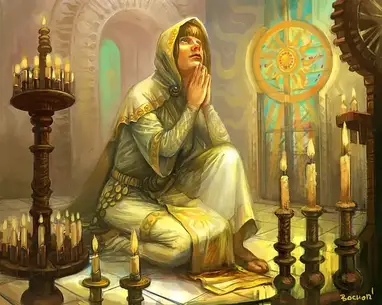
Bad luck–acquired as a curse from some of the usual places, like breaking a mirror or walking under a ladder–gives the character -2 on skill checks for a couple of days. Touching wood while you perform a check may allow a bonus.
Peasants should have all kinds of odd beliefs and ceremonies:
- Passing cattle between two bonfires frees them of evil spirits and fae influence.
- Throwing a shoe over your house to land in the road at midnight will point the way to fortune and glory (but also sadness, if it lands sole-up).
- Making a sacrifice of ale to the gods (then drinking the rest) will ensure a good grain harvest.
- Leaving food and ale outside around your home on a certain night will appease restless ancestors.
- Throwing a valued weapon in a body of water as a sacrifice to the gods will bring you good fortune.
The Flat World
Altho scholars knew the world to be round since ancient times, that would likely be news to most medieval commoners. They couldn’t read, after all, so they knew little more than what they learned by first- or second-hand practical experience.
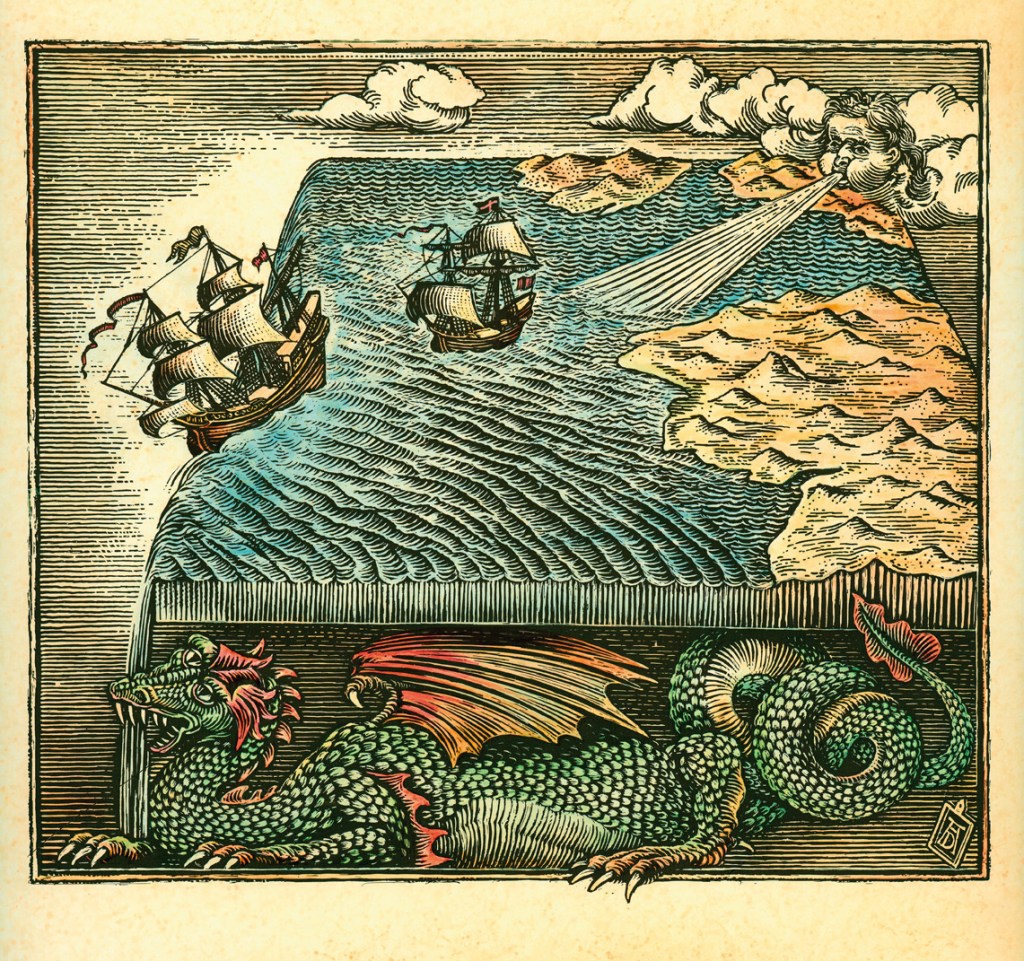
But your world really can be flat. Or bowl-shaped, with a ring of steep mountains around it. Or upside-down-bowl-shaped, with a curve that leads to an underside that is a bowl-shaped netherworld. Perhaps this is where the spirits of the dead go. Perhaps it is completely flat and square-shaped, so that your world really does have four corners, like a map.

The stars were once thought to be fixed in a solid dome of crystal in the sky that turned each night. In your world, it really can be, with stars just 40 feet across which light up each night. One may fall to earth and be found and kept as a strange artifact of the heavens or a lamp for an underground city, acting as an artificial sun.
Perhaps also it has an underworld: Sheol, Tartarus, Hades, or Hel, where intrepid adventurers could travel and find eldritch horrors and/or demons and/or the spirits of the dead. Such a place cannot be entered into lightly. There may be a guardian like Cerberus and a boatman like Charon, or a trickster goddess, a series of puzzles and traps, or monsters beyond sanity.
The Silver Standard
Some OSR (old-school renaissance) games already use the silver standard rather than gold, but those that don’t might be converted. Thru most of the Middle Ages, England had one coin: the silver penny. They often talked about shillings (12 pence) and pounds sterling (20 shillings, or 240 pence), but there were no coins in these values; they were just units of account.
I don’t see the word “penny” as a fun fantasy coin, tho, so I’m inclined to change it to “silver bit”, a small, thin coin one-tenth the heft of a shilling.

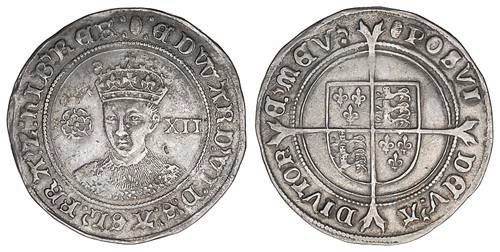
The “silver shilling” (introduced as a coin in the 1500s) becomes the silver piece. The value was 20 to the pound sterling.
The gold noble was introduced in 1344 and was the right mass to be the traditional D&D gold piece (9 grams, or 50 to the pound of weight). It had a value of 1/3 of a pound sterling, or 80 pence. I prefer to call it a “gold crown”, because it features the monarch.
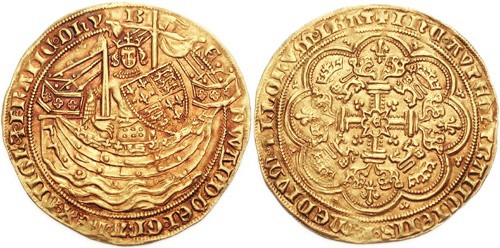
Now, instead of 12 pence to the shilling and 6 shillings 8 pence to the noble, we can simplify it to 10 bits to the shilling and 10 shillings to the crown and ignore pounds sterling altogether. Forget all other metals (electrum, platinum, copper, and bronze). Then just convert all “sp” and “gp” values in the game to “bits” and “shillings”.
The shilling and crown can be the same diameter, but the shilling needs to be twice as thick to also be 50 to the pound of weight, as silver has just over half the density of gold. (The large, thin noble may be the origin of the test of a gold coin by bending it with your teeth.)
The nice thing about doing away with copper coinage is that you can say a treasure is 200 shillings with the understanding that some of the coins are silver bits rather than shilling coins. Since it’s all silver, 10 bits weigh the same as 1 shilling. Then the adventurers don’t have have to concern themselves with conversion and making change; you just assume that their money consists of both.
 zarban.com