

There may be times in your RPG game-mastering that you need something to happen eventually, but you want it to be a surprise to you as well as to your players. The thing in question might be a wandering monster, a guard on patrol, the rain, a war, or any other thing on any timescale: rounds, minutes, hours, days, or adventures.
You can’t just roll a d4 or d6, because that makes the thing a bit too likely to happen right away, but a d8 or d10 may make it not happen for a very long time. Here is where a countdown timer helps.
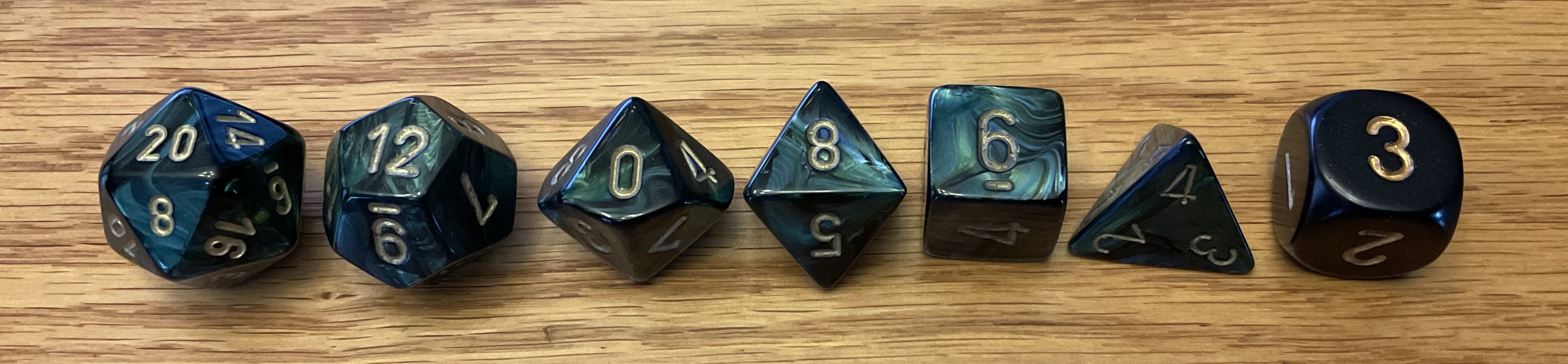
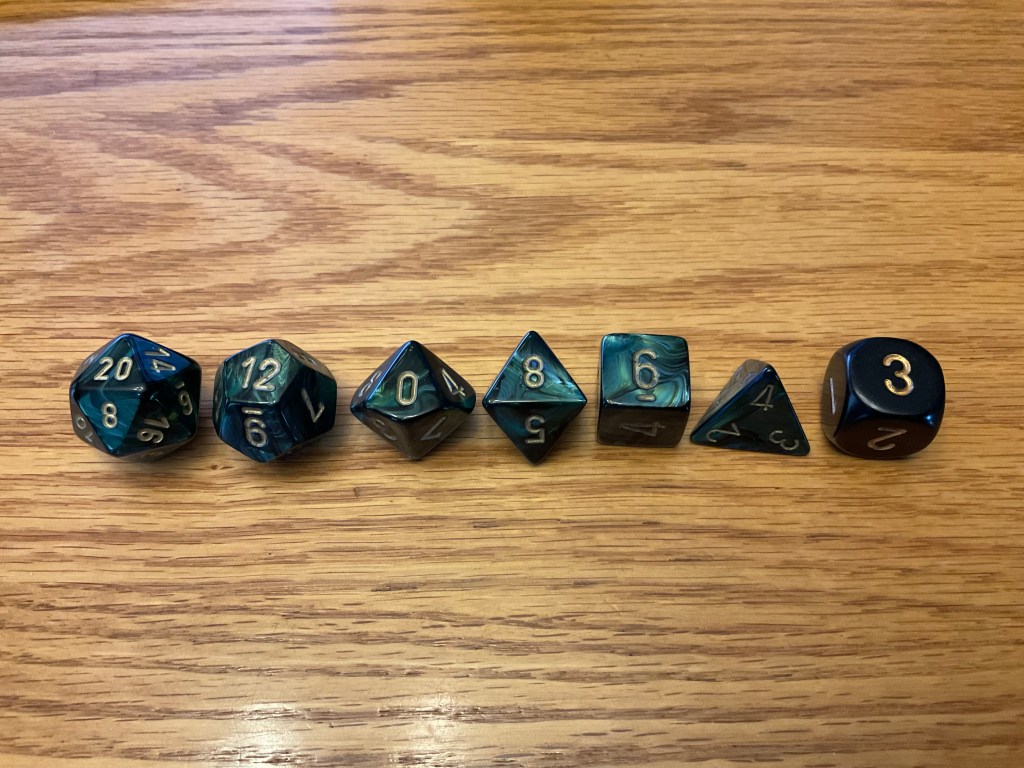
The countdown timer typically starts with a d12. If you roll a 1, the thing in question happens. If you roll anything else, it doesn’t happen… yet. The next time it could happen, you roll a d10, then a d8, d6, d4, and (if you have one) d3. Obviously, it becomes increasingly likely that one of these rolls will result in a 1. If it doesn’t, then it happens the next time after the d3 roll. (We call that “the d1“: it always rolls a 1.) That guarantees it in no more than 7 opportunities.
Statistically, this means the event has an 8% chance of happening immediately, then 10%, 13%, 17%, 25%, 33%, and then 100%. If you want to stretch it out a bit, start with a d20 instead. If you want it to happen sooner, start with a d10. If you want it to be unlikely for a while but much more likely as time goes on, use d20, d12, d6, d3, and d1, so it’s guaranteed in no more than five opportunities.
This sort of mechanic is particularly good for random encounters you want to eventually happen but don’t care exactly when.
Trap Triggers
Also some traps should be triggered by the first character to come across it, such as a trip wire or pit covered by an illusion, others are more variable. Maybe the first couple of characters in the marching order don’t happen to step on the flagstone pressure plate. You could just roll d4 and say it gets activated on a 1, but then it’s possible none of your heroes get smacked in the kisser. So instead use a d6, d4, d3, d1 timer. The first hero gets the d6, the second the d4, the third the d3, and—if none of the others hit the trigger—the fourth one definitely does.
Simple Weather
You can also manage weather without a table (even a simple one) by using a dice countdown timer to determine when the weather turns nasty.
Normally, the weather is seasonal, but on a roll of 4 or less, tomorrow’s weather is unpleasant (light precipitation or high winds). On a 1, there will be a storm (thunderstorm, blizzard, or–in a desert–a sandstorm).
Start with a d12. The next day, roll a d10 then d8, d6, d4, d3, and d1 (that is, there is definitely a storm). Then, the dice start going up again from d3 to d4, d6, d8, d10, and d12, then back down. With this method, you can have basic weather every day for a long journey, just cycling from high to low and back again. And it creates a spate of bad weather with the low rolls that can produce two storm days in a row.
Since you’re always rolling a day ahead, on a 1, you can have today’s weather turn dark and windy and warn the ranger or druid about the storm to come. And just the knowledge of which die is next to be rolled gives such characters a good clue about the weather to come.
Simple Hex Crawls
If you want to let the heroes wander aimlessly across your map, you can use the dice timer to determine when they find a point of interest, like a ruins or monster lair or just have a random encounter (not necessarily a combat).
Start with a d20 when they get away from town and into the wilderness. When they enter a new hex, roll a d12. And so on, until you roll a 1, determining they’ve found something. You can then decide or roll on your own table to determine what it is. In the meantime, you can give them terrain trouble and innocuous wilderness encounters.


