


Dungeon Masters often like the idea of adding politics to their campaign but have no idea how to go about it. It’s a very different animal from regular adventures, but it doesn’t have to be daunting, and a little goes a long way anyhow.
You can choose to add politics at any level, so consider the obvious three:
- The Royal Court
- A Noble Court
- A Shire Court
Regardless of what level of politics you choose, a court should be an excellent place to learn fairly specific information about where certain monsters live, what sort of treasure might be found where, and who might have a dungeon map to sell.
The Royal Court Summons
Give the players each a noble NPC to play who gets summoned to the royal court by the monarch to consult and advise (this was how parliament got started). Briefly describe the palace, the city that serves it, and so on. Describe a dinner and entertainment, such as acrobats or dead monsters being shown off. Have various important nobles and courtiers participate in discussions. This would be a good opportunity to introduce a central tension for the campaign like an impending war or a looming otherworldly menace.
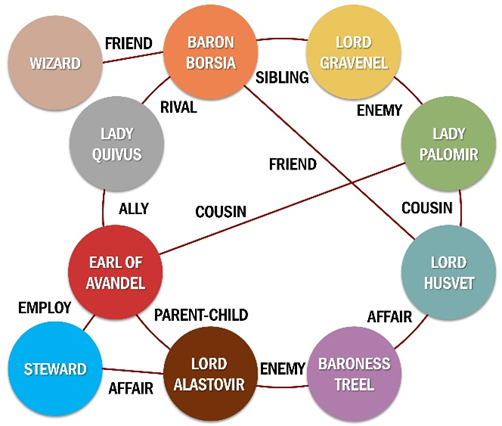
Each noble should have a goal, an asset, and a weakness. Playing them well scores points–points that can transfer to the player’s adventurer characters in some way (as luck or XP, etc.).
- A goal is something the character wants badly (and getting it should score perhaps 10 points), such as the hand of the princess in marriage, help defeating pirates, money to pay debts, the recovery of an heirloom, the regaining of a birthright, etc.
- An asset is something the character has that others want or fear, such as money, knowledge of some secret, men-at-arms, ships, etc.
- A weakness is something the character needs to fix or keep secret (winning 3 points), such as a foul goal, crippling debts, a dark secret, etc.
You can generate politics just by making these pair up or form triangles. Consider:
- Lord Gothian has men-at-arms he needs to pay; Lady Sabrian needs help against pirates harassing trade on her coast; these two should talk. Give each information on how much money would be a great deal (10 points), a good deal (5 points), and a barely acceptable deal (2 points). If you make their figures only overlap at “barely acceptable”, it will be a hard negotiation. If they overlap a lot, one could get a great deal that the other considers barely acceptable. This becomes much harder if other nobles have something one of these two needs but there is no overlap in their positions, so negotiations are fruitless.
- Lord Venaster wants the hand of the princess in marriage (10 points); he can offer up to 50 knights for the king’s foreign campaign and, if pressed, his foreign brother-in-law’s 35 knights as well, altho that will make him beholden to the brother-in-law (reducing the win to 5 points). But the princess prefers Lord Kin (10 points), who is limited to 65 knights and a more respected lineage but really needs the dowry the king will pay (-3 if it comes out). The king (the GM) doesn’t need to make a decision immediately.
- Lady Evral is secretly in league with the foreign prince the king wants to wage a campaign against (-5 if it comes out). Lady Bracwell has learned this and would like to expose her to the king (5 points) but is herself in league with a faction of raiders that is currently delaying the king’s campaign (-3 if it comes out), and Lord Hather knows it; but he has something he wants from Lady Evral (5 points)….
- Lord Cavernass has wheat but needs wine; Lady Mink-Habitt has wine but needs meat; Lady Tholian has meat but needs wheat. These three need to find each other and figure out how they can mutually benefit–and who among them gets the best deal. You can create a payout matrix that tells how how many points they get for getting what they need of both (you can’t afford to trade all your wheat for wine) but having a bit extra vs only ending up with the minimum they need makes the difference in the payout.
Then, when you have the players create their characters, they now have a good idea of what the campaign setting is like, what problems there are in the realm, and what they might want their characters to do in the way of adventures. In fact, you can insert adventure hooks into the drama, so the players don’t have to learn about them from “rumors in a tavern”.
You can translate the points scored into advantages for the player characters during creation. An extra ability score point might cost 10 noble points; a fine family background might only cost 3; an extra 100 gp starting money might cost 5. Don’t make them too advantageous, of course, or you could wreck the campaign early on. PCs shouldn’t get magic items, for example.
Between adventures, you can have the players play the nobles again, trying to further their interests in these ways, now with new twists to their goals, assets, and weaknesses. New developments can benefit the players’ adventurer characters in new ways, like experience points or information on the whereabouts of a coveted magic item.
Noble Courtier Intrigue

If royal court seems too distant, you can have the players temporarily play lady and gentleman courtiers in attendance to the local noble family (footman, courier, handmaid, spymaster, steward, stablemaster, bailiff, captain of the guard, etc.). Perhaps an important event takes place that kick starts the campaign:
- An envoy from the king arrives.
- A messenger from a far corner of the realm arrives with news of a monstrous uprising.
- A transfer of power upon the death (or assassination) of the current monarch or noble.
- A monster attacks.
- An evil overlord makes himself known.
- A prophesy is delivered by a powerful oracle.
Here is an opportunity to introduce political factions, secret organizations, tensions between nobility and church, etc. Each courtier should have some motivation to drive his or her personal action and advice. These should be of a smaller scale than the royal court example:
- Tonus Leatherwaist wants the baron to intervene for a relative who has been arrested.
- Menta Pimporil wants her secret lover, a commoner, knighted.
- Vast Shinebridge wants to be made spymaster and the current spymaster executed.
- Helois Tem wants to be put in charge of the kitchens–because she’s a spy who wants to poison the baron.
- Ravel Nasterbrew wants the baron’s son sent to a college of magic instead of being trained as a knight, because that’s what the boy wants but can’t bear to tell his father.
Perhaps a noble edict will result that will solve some problem, and courtiers will rush out to put it into effect. Then have the players create their characters to answer the call. The players’ role-playing in this scenario should earn them points of luck their PCs can use. This may be a regular event, and the players can return to play the same NPCs in between adventures, even reporting on the PCs’ actions, perhaps resulting in a dinner invitation.
The Manor & Shire Court
At the local level, the players should know the local lord and city officials, at least by name and reputation. A town should have a bailiff (who is also guildmaster) and constable (who runs the town watch). If the heroes are based in a sizeable city, it will be the home of the shire court and include the sheriff and a couple of judges or justices of the peace.
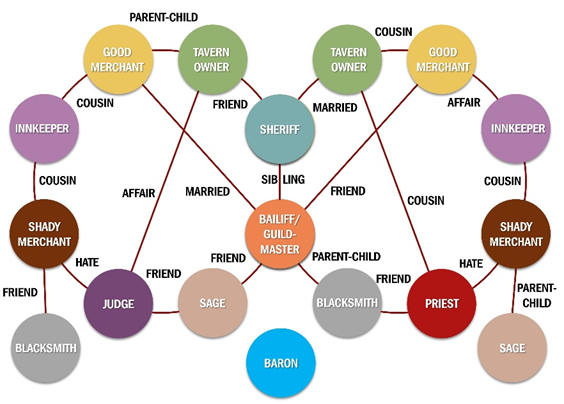
These people will all have ideas about what they and the city need and what their assets and weaknesses are. Since these NPCs interact directly with the PCs, it’s best for the GM to play them and play those goals and assets off the heroes. Then the heroes themselves become players, with goals, assets, and weaknesses of their own.
These interactions and the results of the heroes’ adventures can then allow them to rise to the next level and take part in the machinations at the nobles’ court. It’s even possible that they heroes could rise all the way to the royal court as nobles themselves, when they reach high level. At each of these stages, it helps for them to know something about the courtiers and nobles, altho circumstances would surely change enough that the goals, assets, and weaknesses the players knew when they were playing the nobles will have changed a bit.
 zarban.com