


When a D&D party is traveling in the wilderness, you as the DM should consider the terrain they’re navigating. Sure, getting them lost is fun, and attacking them with wandering monsters is better, but what do you do in between? Challenging terrain.
Wandering monsters not tied to the adventure can be a waste of time. Random encounters should tend to be minions of a faction that plays some role in your campaign or scouts of the local humanoid tribe, etc.
Tracking Travel
Exploration thru terrain is best on a 1- or 3-mile hex map. Market towns are only 6 to 12 miles apart in settled lands, so you can fit a few on a 30×40-mile map, and there can be one minor point of interest between them (abandoned mine, cave lair, bandit hideout, ruined manor house, etc.).
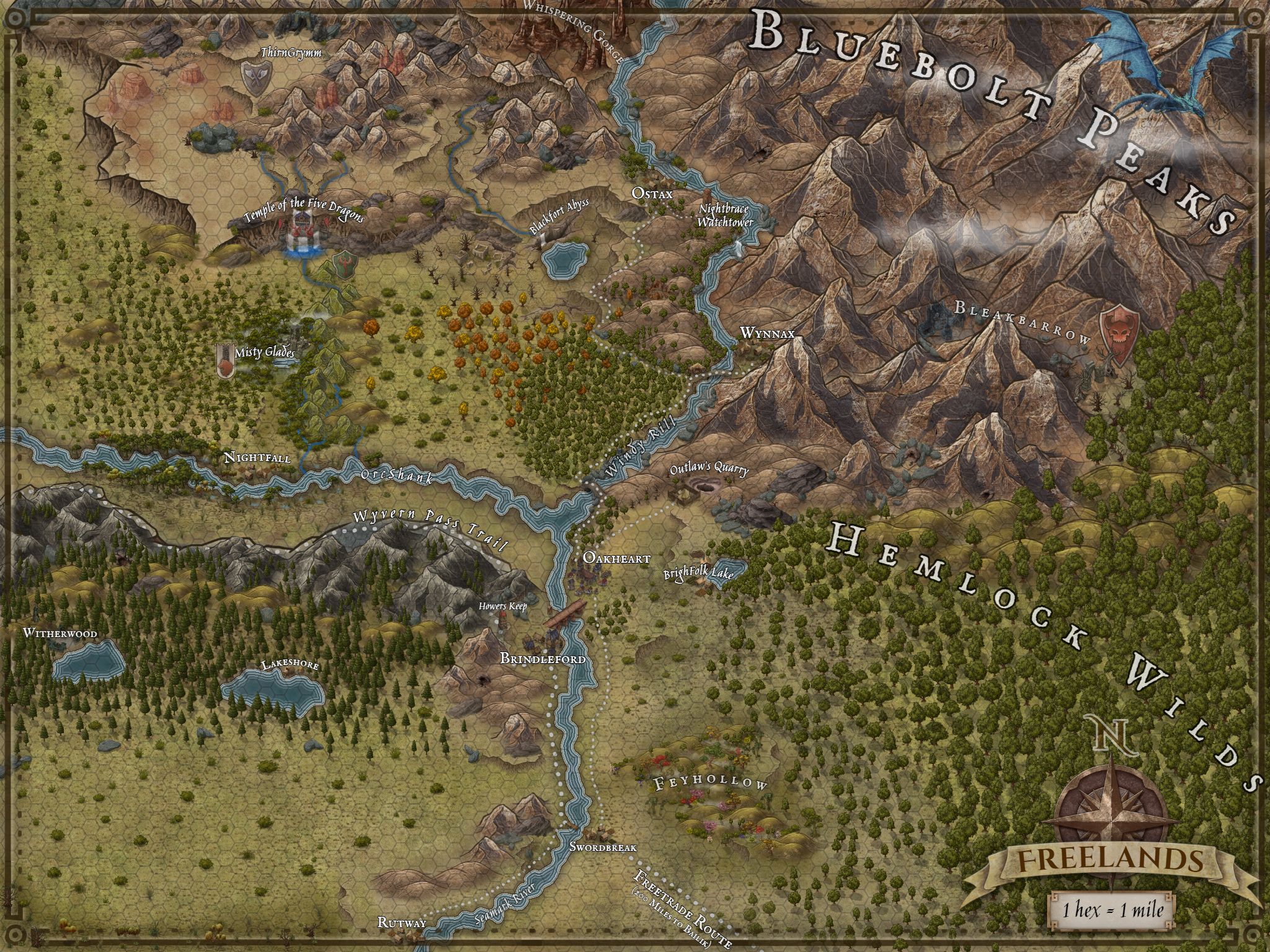
A simple way to track travel is to say the heroes get “travel points” they spend to cross hexes with cost that depends on the terrain.
Difficult Terrain Checks
When the heroes encounter difficult terrain in a hex, they should make a check using constitution or dexterity modifier (their choice) or lose 1 hp per level due to fatigue or mishap. If a hero is reduced below 10 hp (and you’re using my injury system), he or she has suffered a minor injury, such as twisting an ankle, falling and spraining a wrist, etc.
You can determine the difficulty of a hex on the table below either by merely selecting it based on your judgment of the terrain in the hex the heroes are currently in or by rolling something like 2d10-2 (commonly challenging) or 3d6-4 (mostly tricky). Darkness makes all terrain +2 more difficult, except for those with your system’s version of dark-vision.
| Difficulty | Description |
|---|---|
| No roll | Easy-going: flattish, fairly clear (common on roads, woodland trail, moor, plains) |
| 2-6 | Tricky: wet, sloping down, uneven, dry sand, vegetation (common in moor, plains, forest, scrub, mountain trail) |
| 7-9 | Challenging: hilly, muddy, rocky, marshy, slippery, dense vegetation (common in dense forest, hills, scrub, wasteland) |
| 10-12 | Difficult: very slippery, nearly climbing, ankle-deep snow or mud, knee-deep water, obstacles, being watchful for occasional hazards (common in swamp, jungle, mountains) |
| 13-15 | Hard-going: some actual climbing, waist-deep water, heavy snow, frequent or dangerous obstacles, hazards (common in steep mountains, canyons) |
Obstacles & Hazards
Examples of obstacles and hazards:
- Obstacles: brambles, boulders, stalagmites, hot rocks, streams or rivulets, depressions in wet ground, smoking vents
- Hazards: crevasses, hot vents, traps, quicksand, rock slides, avalanches, sinkholes, harmful plants, snakes and other creatures that are dangerous but not quite monsters
Mishaps & Choices
You may choose to say a natural 1 on the roll indicates a serious mishap, such as falling down a ravine or into a small river (large river crossings should be role-played as predicaments, but don’t forget to furnish your map with fords and bridges).
Sometimes, roll twice to give the players a choice of two difficulties, representing two routes. Taking the easier route costs them extra time (extra encounter roll, less progress in their travel). You can even build such route choices into the adventure and have different encounters planned for each route (an extra encounter on the longer, easier route).
None of this applies to travel on a road, of course, which by definition is either easy going or else tricky in muddy or snowy conditions. And that can be determined with the help of a simple weather system.
Innocuous Encounters
A good additional idea to enhance wilderness (and even road) travel is to pepper it with innocuous encounters rather than potential random combat that don’t add anything to the story. These are things that are interesting but not particularly dangerous or connected to the adventure as a whole.
You can make rolling on this table something that you do periodically (morning, afternoon, and evening) or else make it a high-frequency entry in your random encounter table. It’s important to make clear to your players that they can encounter things that “aren’t part of the story”.
| 1d20 | Encounter |
|---|---|
| 1 | You see a (random encounter table entry) in the far distance–easily avoided, if you wish. |
| 2 | You come across evidence of humans or humanoids, such as a camp site. |
| 3-4 | You see a random large beast common to the area (bear, deer, boar, panther, etc.) in the distance. |
| 5 | You see a huge flock of songbirds pass by overhead (or, at twilight, bats). |
| 6 | You see a random large beast common to the area in the sky (griffon, hippogriff, pegasus, giant bird of prey, wyvern, etc.). |
| 7 | You encounter a random animal carcass… (1d6: 1-2=being eaten by a large predator; 3-4=killed by a large predator; 5=killed by hunters; 6=having died naturally). |
| 8 | You come across a place of natural wonder, such as a pleasant pond, picturesque waterfall, or hill that affords a good view. |
| 9-10 | You encounter evidence (scat and/or tracks) of a large beast common to the area. |
| 11-12 | You encounter evidence (scat and/or tracks) of a (random encounter table entry). |
| 13-14 | You encounter a random small beast common to the area (snake, badger, skunk, etc.) that can be easily avoided. |
| 15-16 | You see another party of travelers/adventurers in the distance–easily avoided, if you wish. |
| 17 | You encounter another party of travelers/adventurers. |
| 18 | You encounter a human/humanoid carcass, the victim of a monster or bandit. |
| 19 | You see a mage (of some sort) pass high overhead on a flying carpet or else a flying ship or similar conveyance. |
| 20 | You see the greatly-feared dragon who hunts these lands flying high overhead. |
 zarban.com