


The major difference between gameplay styles of modern and old-school Dungeons & Dragons and other fantasy RPGs is old-school emergent storytelling versus new-school narrative campaign writing. In the former, your characters are typically nobodies who build up to greatness, if they’re lucky. In the latter, your characters are pretty powerful to start and often quickly become embroiled in major events of ongoing rivalries. If you’re not sure if you and your D&D players want to adventure in a sandbox campaign or an epic saga of honor and betrayal, you can always have a bit of both.
One of the best kinds of campaigns is one where the adventurers are free to follow up on rumors of treasure or threats of a shadowy menace. If they pursue treasure, they fight monsters and occasionally encounter minions of the shadowy menace. If they take on the minions of the shadowy menace, they often recover treasure and fight some monsters. They choose the focus.
Make sure they fight a dragon, a vampire, a beholder, and something they choose. Foreshadow those adventures. Plant rumors. Let them find or buy a map of the area. Make it personal. That dragon ate their dad. That vampire kidnapped their sister. That beholder killed their favorite NPC.
Scaling Up
Player characters in most old-school (OSR) fantasy RPGs in particular are too weak to engage with grand villains at first anyway. But before long, their occasional encounters with minions of the shadowy menace get the attention of the shadowy menace itself. It warns them off. It pressures their contacts and allies. Eventually, it sends its champions to kill them.

What foul conspiracy is the shadowy menace up to? Who among the party’s contacts and allies will betray the heroes? Who among their enemies will be redeemed by turning out to be working against the shadowy menace all along? This can happen organically, but the potential needs to be built in by first having a shadowy menace as well as contacts and allies.
If the heroes just want to do their own thing, the shadowy menace can turn out to be of modest power and can be defeated at middle levels. If they like the intrigue and politics, the shadowy menace can turn out to be virtually untouchable and to have spies and puppets everywhere. If you decide to make the menace of modest power, but the players find defeating it a bit anti-climactic, you can decide afterwards that it served a mysterious boss of much greater power….
But none of this possible (or at least easy) without the heroes developing relationships. If the heroes drift from town to town, never establishing allies and enemies, it’s much harder to create interpersonal drama. These can be a mix of individuals of some authority or power and members of factions of some importance.
Letting Them Pick Their Poison
Since the menace is shadowy, you might create three different potential menaces (a noble, a high priest, an archmage, a royal envoy, an otherworldly being, etc.), and the players can pick the “real” menace by which rumors they follow up on. Then the others turn out to be not as bad as the real menace, or simply neutral, or even potential allies. The players don’t know that the haughty Beragul Riders could turn out to be evil mercenaries of the Blood Priest (if the players hate them) or proud defenders of the realm (if the players hate the sneaky Gossium League more).
The heroes will need to get to know all the relevant VIP NPCs, at least by reputation. And that reputation can come from how their minions behave. Who is hampering trade (of the good or the evil)? Who is searching for a lost artifact (for good or ill)? Who is marshaling an army to take over the realm (for righteousness or tyranny)? This is the stuff of the local rumor mill, and the heroes won’t always know if the actions are good or ill (commoners often regard anything bad for them personally as evil, while powerful NPCs will usually claim their actions have lofty motives).
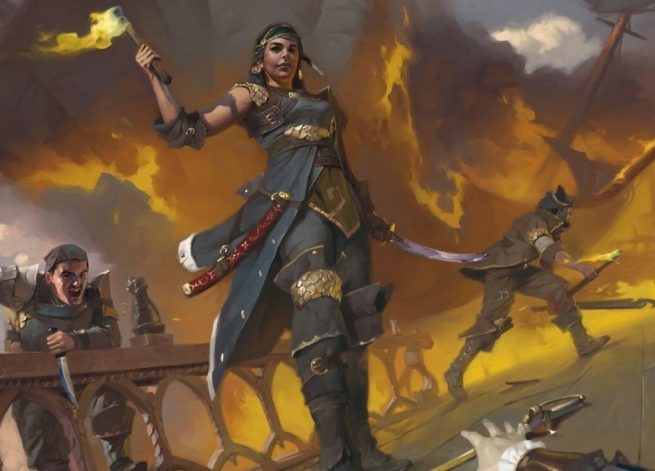
For example, the corsairs of Thrum could be cutthroat pirates harrying the honest people of the Vester Coast or they could be privateers harrying the ruthless merchants and smugglers who hold the Vester Coast in thrall. The heroes won’t know until they look into it and decide for themselves. Having some ambiguity at first makes the situation more interesting, and the players’ opinions can sway the development of the story.
The Children of Imbrus could turn out to be a human-sacrificing cult or a secret society of rogues who keep evil sorcerers in check. They could clash with the heroes when competing for some treasure but end up either fighting or teaming up with them in the end, depending largely on how the players perceive them in their encounters.
Of course, you may create such factions with a definite bent towards good or evil, but once the players have settled on one as an enemy, you can change the others a bit to make them less evil (or at least less powerful) or actually good (or at least more willing to work with the heroes for practical reasons).
If you need the players to like a VIP or faction, just have them do something for them, like give them information about the location of a magic item or an enemy they want to fight. And if you need for them to dislike a faction, have it oppose them directly or wreck something they already did. Human nature makes us assume the best or worst, as the case may be, about such people.
Don’t make the mistake of trying to make the heroes like an NPC by having the NPC beg them for help. You need them to like that NPC first, and that happens by at least hearing about the NPC doing something they like or doing something that directly benefits the heroes–even something like helping them get a coat of arms when another NPC opposed them.
Adding a Twist
But until you reveal the full and true intentions of an NPC or factions, there is always room for a twist.
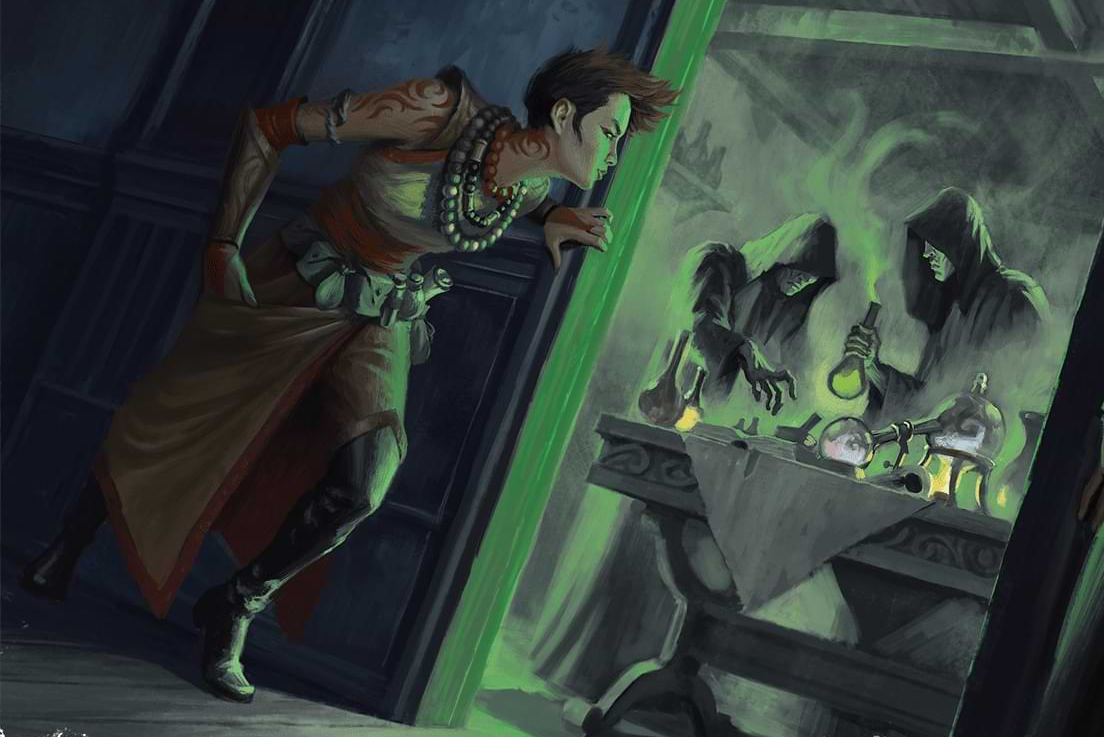
Imagine that moment when, facing off against the heroes, the Children of Imbrus ask “What do you intend to do with the Cauldron of Calixo?” When the heroes say “We want to give it to the oracle at Helvinus to end the flooding there,” the Children of Imbrus say, “Good. We wanted to use it against the necromancer of Odenne. If we let you have the cauldron, will you help us defeat the necromancer?” Suddenly, the group they thought was evil is shown not to be; the heroes’ world turns upside down!
Black & White Characters Are Still Gray
Of course, you can always create some NPCs and factions that are clearly good (because they freely help the heroes) or evil (because they do something awful in front of the heroes). These are useful for individual adventures, where you need the story to be clear and self-contained.
Your characters will automatically seem complex to the players if you don’t reveal (until quite late) what they really want and how far they’ll go to get it. But if you want a truly complex villain, just give them one good trait. Maybe they want to protect their own people from monsters, or they distribute much of the wealth they steal, or they are loving and loyal to friends and family. They are evil because they don’t care how much their actions to help people inside their circle hurt people outside their circle.
Shifting the Narrative
The players are likely to make their mind up about NPCs and mysterious factions very quickly, but there’s no reason they should always be right. You may want to think of the heroes’ opinions as about 60% “correct” at low levels and 80% correct at high levels and adjust your story and faction motives to match. That way, their judgment seems to get better, and yet there is always room for them to be wrong about some faction that turns out to be good or some NPC who turns out to be a traitor.
Part of the fantasy in medieval fantasy is personal drama:
- People love to be proven right about someone’s motives.
- People love to be betrayed by someone they trusted, whom they must now fight.
- People love getting revenge on someone who betrayed them.
Moreover, they’ll invent their own theories about why certain factions and NPCs are doing what they are doing. Often their ideas will be good. Why fight that?
This may seem to be shady, but the alternative is predetermining the nature and motives of NPCs and then working overtime to get the players to understand and accept them as they are. Some players simply decide they don’t like a certain NPC, and nothing will persuade them that they’re wrong. This is why mysteries are so hard to run: players leap to conclusions and refuse to let go.
Using this method, the players will feel they are captains of their own fate, they are smart and influential, but that they can still be fooled and therefor (delightfully) shocked. And you as the GM have less work to do both in setting up factions and NPCs and their machinations and in trying to guide the players to the “correct” answer you’ve predetermined. Just let them (usually) be right about their feelings about who needs to be stopped and who are potential allies. Then your sandbox becomes a saga, and your saga remains something of a sandbox.
Advancing Faction Goals
Many factions should have a specific goal, short- or long-term, and sometimes advance toward it. You might roll a die between each adventure to decide which faction advances their agenda (whether it’s with a specific step or just by growing their numbers).
 zarban.com