


Last year, in my research on gaming tables for board games and such, I came across the Game Garage channel on YouTube and discovered the way they make their own gaming tables. Sam and Bodie go thru their methods in detail in multiple videos and incorporate viewer feedback to enhance (and accessorize) them.
I was so intrigued by this easy and low-cost way to build a gaming table, I decided to make one for myself. I have just completed an arts workshop maker space and want to establish a game night for those interested in playing modern board games.
Game Garage Tables

The Game Garage table method consists of buying 1.5″ x 3″ extruded aluminum rails of the type used to build tables and frames for workshops and industrial use and adding a deck to the underside of the rails so the result is a table with a 1.5″ deep vault, similar to a poker table.
They later added legs to their table toppers so that resting it on a regular table isn’t necessary. This also keeps the table rails at normal table height.
Sam and Bodie use half-inch laminate flooring planks to create the decks of their tables. This gives them a beautiful, finished look with little effort.
The extruded aluminum has the advantage of built-in T-slots, which allow you to add accessories easily. It also results in a frame strong enough to stand on (just don’t stand in the vault).
My Table
I decided my table should have a 3′ x 5′ vault, which will take a common size of neoprene game mat. These are available from GameToppers and AllPlay, as well as others. FAT Mats doesn’t offer one in that specific size, but since their mats are not edge-stitched, you could cut down one of their inexpensive 3′ x 6′ mats. Edge stitching is less necessary when the mat edges are hidden by the vault walls. This technique would allow you to have a bigger vault, say 3.5′ x 5′, if you cut down a 4×6′ mat.
With that decided, the 3″ rails (1530 extrusions) will make the final table 42″ x 66″, suitable for 6 players to be comfortable–and could even fit 8 players for small-scale games.
I added legs made of 1.5″ x 1.5″ extruded aluminum (1515 extrusions). If these are 26″ long, the table will be 27.5″ high, plus whatever you add to top the rail. Dining tables are typically 30″ high, but card tables are more often 27 to 28″.
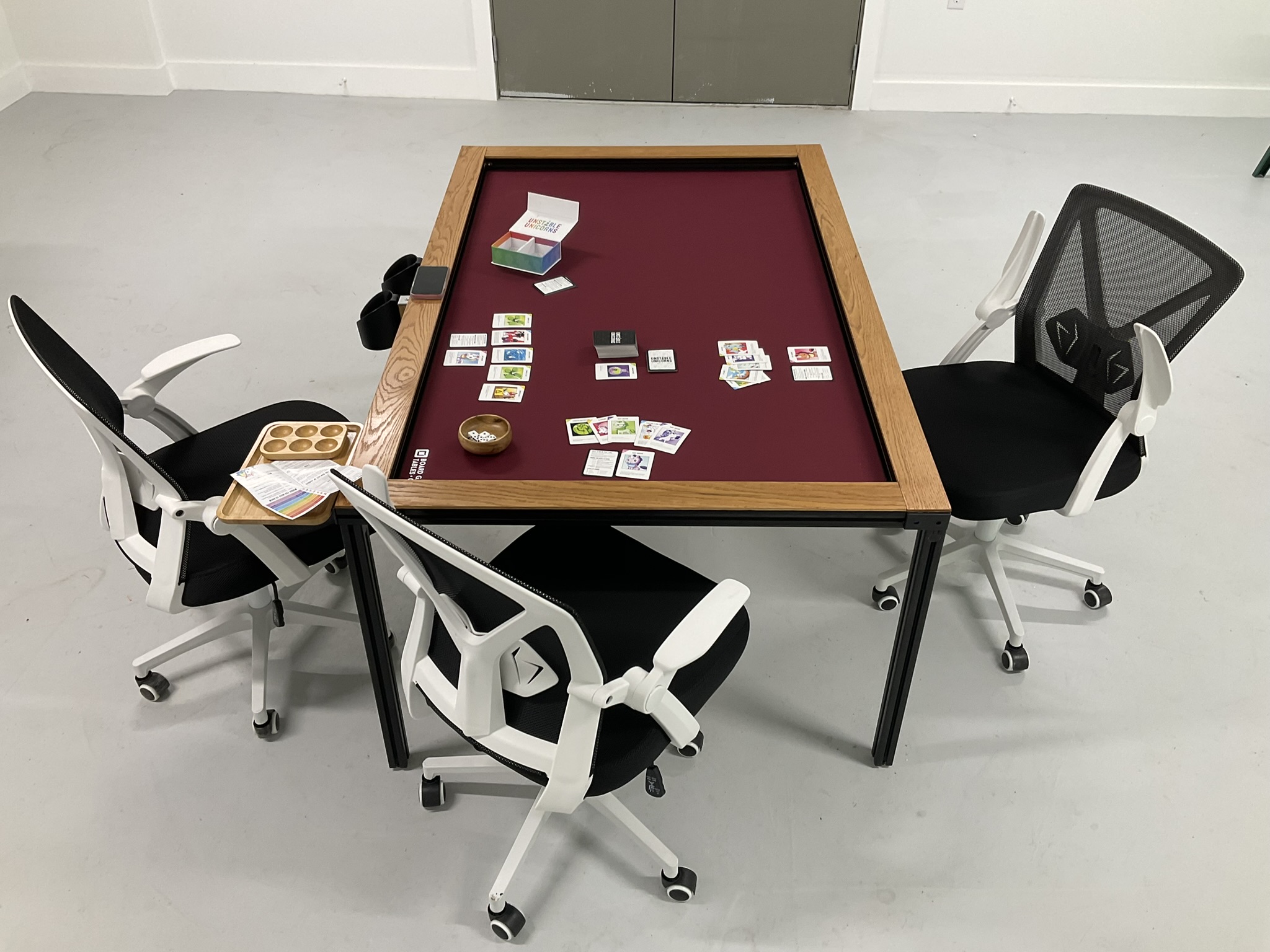
Basic Components
- Two 1530 rails (natural or black) at 39″
- Two 1530 rails (natural or black) at 63″
- Four 15 series corner connectors (inside-to-inside or inside-to-outside) Note that Sam prefers the beefier version (natural or black) for larger tables, even tho it protrudes in the corner. (Game mats fit under it, tho.)
- Four 1515 legs (natural or black) at 26″ – these need a 13/16ths counterbore on sides B & D; just select it from the options
- Four double-anchor leg fasteners (natural or black)
- Four end caps for 1530 rails
- Four foot caps for 1515 legs or adjustable feet (to make the table perfectly level; nice for tower-building games like Jenga, Rhino Hero, and Junk Art)
- Extra (super cheap) push-in fasteners for end caps (in case you need to remove a cap, which ruins the push-in fastener)
- Six cup holders

You can get all of this from Tnutz, which has much better prices than the industry leader, 8020. However, one piece you need that only 8020 offers is the roll-in panel mount bracket. You can get these from 8020 via Amazon. The shipping is quite pricey in either case, tho.
These brackets are the key to being able to pop a cup holder or small tray onto the rail anywhere you want. It’s kind of bizarre that more companies don’t make this bracket or, for that matter, accessories that hook onto the rail in the same way. (The cup holders normally attach directly to the rail with an Allen wrench bolt and T-nut that comes with them.)

A good way to create mini tables is to buy bamboo trays on Amazon (or even walnut ones) and bolt on the roll-in brackets. No woodworking required. These have very pleasing finishes and small raised edges that are great for keeping things from sliding off.
If you want to put your table on casters or adjustable feet, add a tap to the bottom end of the legs; this needs to match the casters or feet you use, so choose 5/16ths with 18 threading if your casters or feet have 5/16ths with 18 threading stems. (Note: “2-inch casters” refers to the wheel, so it probably raises the table 3″; most casters on Amazon specify this in a diagram. Reduce your leg length accordingly.)
Other Things You’ll Need
You’ll need a table deck, which can be laminate flooring like Sam & Bodie’s, half-inch MDF like mine, or even 1/8″ hardboard, if your table is small (3×4′) or if you add a support underneath it spanning the two long rails. If I make another table, I would use hardboard and get a 1×2″ and drill a hole at each end to run a bolt into a T-nut in the underside of the rails. This would be considerably cheaper, lighter, and wouldn’t need to be painted, because hardboard is a pleasing dark brown.
You’ll also want something to cover the top of the rails, which can get quite chilly (and crumbs tend to fall into the slots). I found a 3″ prefinished oak lattice molding in 8′ lengths at Menards for $20 apiece (I needed 3). I had to sand the sharp edges and re-stain, but it’s otherwise a practically ideal solution that greatly enhances the table. A cheaper alternative is to cut arm rests out of hardboard and spray paint them or instead cover the rails in 3×6″ peal-&-stick tiles or even peel & stick wallpaper. Don’t bother with the industry solution of strips of slot seal; that doesn’t cover the whole rail and isn’t even cheap.
And you’ll need 3M VHB tape, which is basically pressure-activated glue in convenient tape form. You’ll need enough to go around the perimeter of the vault (but you can leave substantial gaps) and a few pieces to stick down what you use for arm rests. (Or use carpet tape; full VHB strength isn’t needed.) Even covering the whole perimeter of my 16′ table (minus where the legs attach), I used less than a whole 15′ roll of VHB tape.
The Cost
My checkout price from Tnutz (with shipping), was $375, plus a bit for extra T-nuts to experiment with. My checkout price from Amazon was $190, which included 10 roll-in brackets, VHB tape, a neoprene gaming mat, and adjustable feet. My checkout price at Menards and Lowe’s was $72 for the oak molding and stain and $49 for half-inch MDF.
That’s an all-in, delivered price of $686. I already had black paint I used on the MDF, but a couple of rattle cans might cost $14, for a grand total of $700, with tax and shipping.
You could get off cheaper by:
- Choosing natural aluminum over black. ($20-30)
- Making the table 4.5 feet long (and using a cheaper 3×4 game mat). ($20-30)
- Reducing mini-tables, which use the pricey roll-in brackets. ($30)
- Getting only 4 cup holders (all you need for a 4-player table) and locking them directly to the rail instead of using the roll-in brackets. ($20)
- Using hardboard instead of MDF for the vault floor. ($30)
- Using hardboard instead of oak trim for the arm rests. ($72)
- Using 1515 rails and filling out the width with 2×2″ lumber on the inside. If you painted the 2x2s and still capped the rails with an arm rest, few people would even notice the difference from 1530 rails. However, good 2x2s are pricey, so this has to be contractor-grade stuff, which are hard to find decently straight. (about $90)
- Not getting legs and putting the table topper on your own table. ($90)
A price check for those ideas suggests you could make a 4-player table like this for as little as $375 with legs or $303 without legs, a big savings.
Accessories
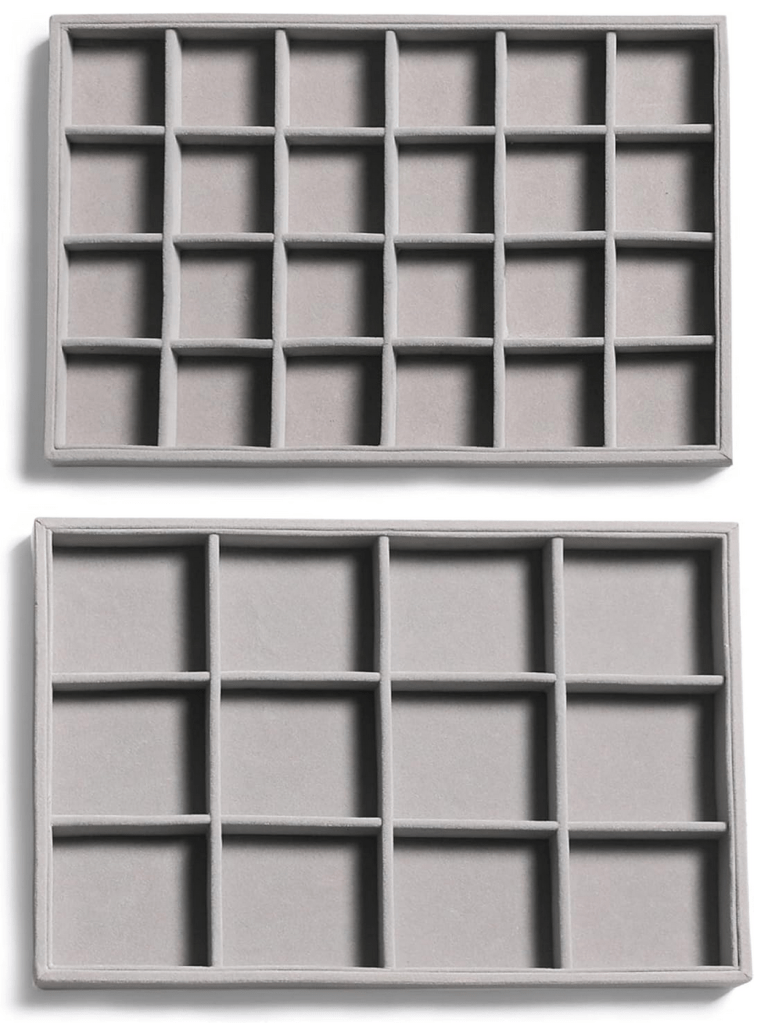
Apart from cup holders and mini-tables, you’ll probably want a few other accessories. Small trays and bowls are very helpful for keeping small game bits handy.
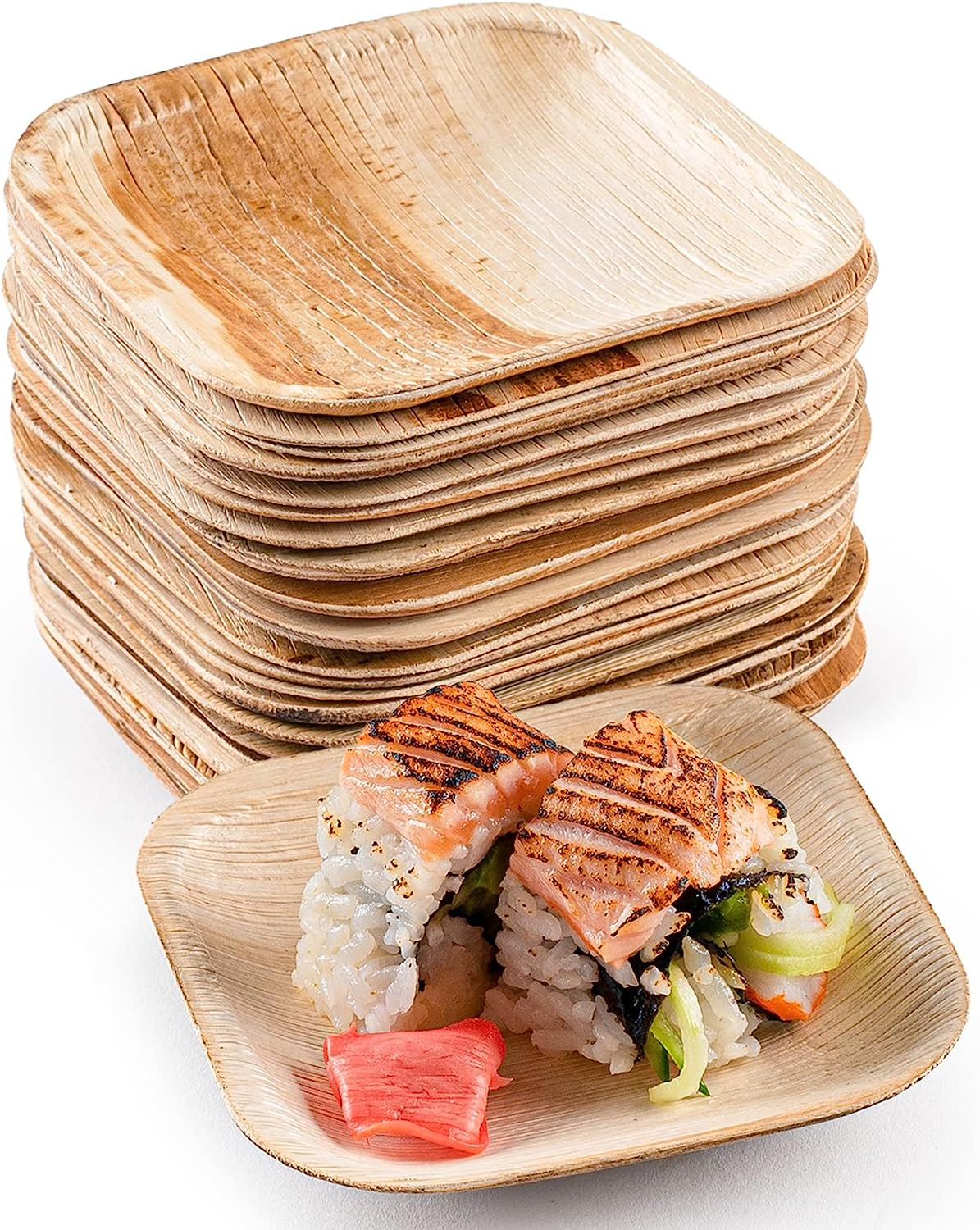
You can get a pile of them made from palm leaves for little money and have plenty to share with friends. You can also get heavier-duty ones made of beech or bamboo or acacia or khaya or even walnut. If metal is more to your taste, you can find them in stainless steel surprisingly cheap. If you prefer black, you can get some wood items that way or in cast melamine. Ceramic ramekins may be to your taste, as well. Another way to go is with padded jewelry trays and bowls.
Most of these are meant for dips and sauces, but some drink coasters of various designs work too. I find the 4-inch sauce bowls ideal for holding bits or dice and scooping them out, but the egg trays are good too. (You can even get super cheap plastic versions meant as artist’s palettes.)


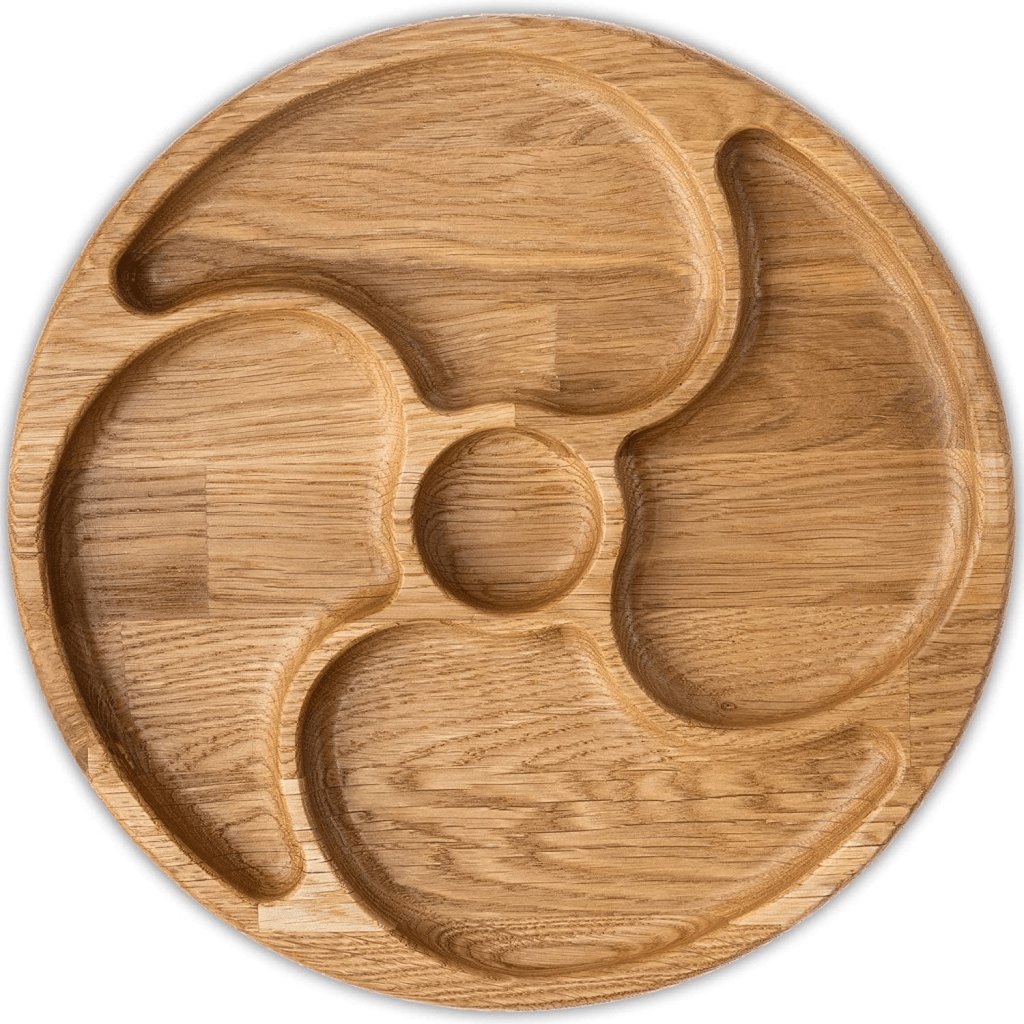
You may also want a larger compartmented tray to hold the “bank” of bits, the easier to keep them separate but handy. You can pick up the whole tray and offer some to another player or rotate it on a lazy susan. These come in a variety, like three-in-a-row, 2-by-2, spiral, and artsy. You might also try a with deeper-than-average wells or even ceramic artists’ palette trays, in circular or rectangular designs.
Alternative Tables
GameToppers makes their own aluminum rail toppers and tables, and AllPlay makes the Jasper wood table, both of which are affordable ($1000-1500) compared to alternatives I’ve found, such as Geeknson, Rathskellers, Game Theory, and Wyrmwood (starting around $2000 and going much higher).
At $700, my cost was still well below the cost of even the least expensive, Ikea-esque, gaming table. Of course, those other tables can be used as dining room tables and look good doing it, but the tops are an additional $400-500.
A decent lower cost solution is probably a poker table. They have a similar design, altho they tend not to be wide enough for modern board gaming. Amazon has a very inexpensive octagonal one that is nearly 4 feet across as well as an inexpensive round one that is nearly as big.
Update 18 months later
Nowadays, there are several Asian-made rubberwood flat-pack game tables that look like a bargain compared to what was previously available.
 zarban.com