

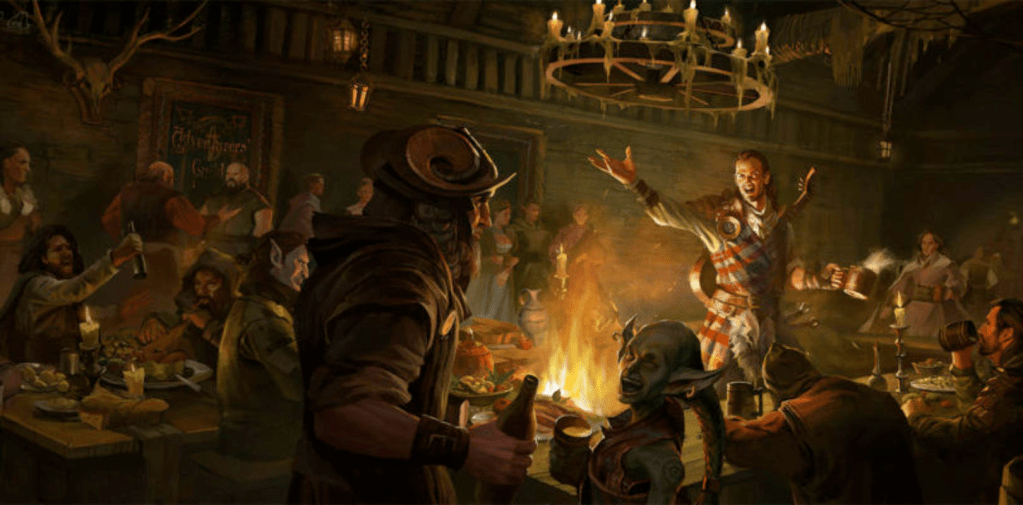
It’s common for adventures to be triggered or begun by heroes pursuing some rumor they hear in a nearby town. These are usually just handed out to players as the way to pique their interest in the adventure before them. But a better way to manage a campaign is to dole out rumors before you’ve even cooked up the adventure. And better still is to let the players decide for themselves what sort of thing to pursue.
Of course, you’ll need to give them some options, so taverns, inns, and public houses should have plenty of mention of orcs and ogres and eye-tyrants.
Talking to NPCs
Don’t bog down your game with multiple sessions spent in a city talking to NPCs. It’s fine to cut to the chase and just say the heroes are speaking to the bookbinder one minute and the sheriff of the shire the next. There is no need for charisma checks (except in unusual circumstances where they have to extract information the NPC would rather keep quite). And don’t have the heroes introduce themselves and make their case. Just jump to them asking their questions.
If players aren’t the acting type, don’t try to engage them in play-acting. That’s different from role-playing, in which they put themselves in the character’s position; they don’t need to actually pretend to be that character.
And don’t bother mapping the city to the degree that the players need to navigate it. There’s no fun in figuring out which street the bookbinder lives on. Just splash some color around by saying the bookbinder lives in the patrician part of the city, where scholars, clerks, officials, lawyers, and such live; it’s the oldest neighborhood and elegant and respectable but a bit shabby.
Open up Their Options
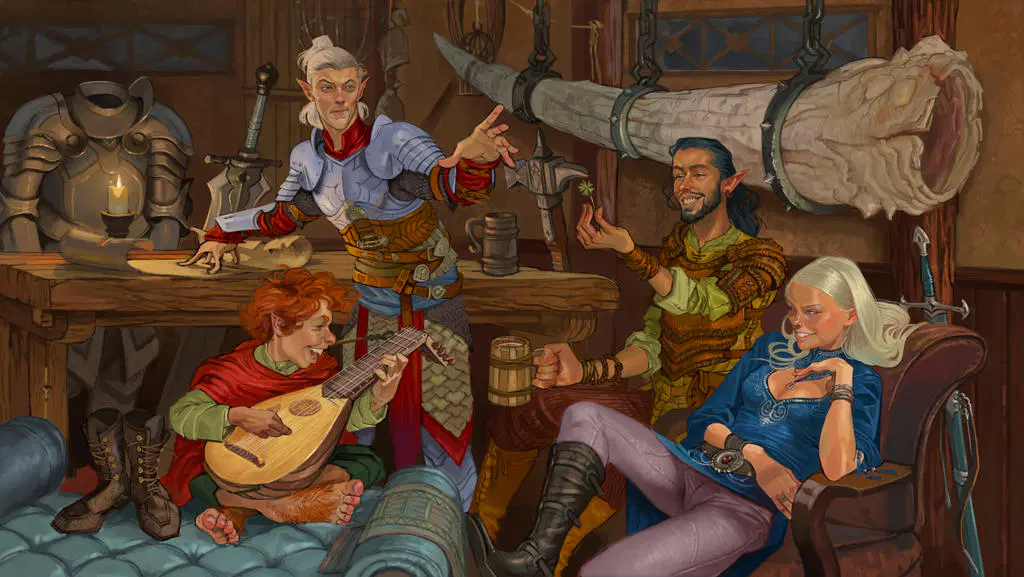
A big advantage to this method is that the DM can give the players all kinds of options by feeding them plenty of rumors and information about different kinds of things.
Some players will be motivated by the conflict or setting, some by the enemies they could fight, some by the treasure they could win, and some by the allies they could make. So you can create rumors and information that describe each of these.
- What trouble is happening.
- Who is causing the trouble.
- Where the adventure would take place (ruins, wilderness, or coastal waters).
- What kind of treasure might be gained (recovered or paid out).
A band of orcs is working with a pair of ogres and causing trouble to a community nearby and stealing trade goods. Some might know only about the travelers who have been killed or gone missing. Others will know about orcs, while others still know only of the ogres. And some might know more about the valuable goods being lost by travelers, including rich spices.
At the same time, bandits have kidnapped the daughter of the local lord. Some may know the lord is offering a handsome reward to stalwart adventurers for an urgent mission. Others may have heard that outlaws have gathered in the forest and have a valuable captive. Still others may describe the boots of speed a dangerous outlaw wears.
But also, a mad wizard working with a sorceress on a project to summon a demon has a band of foreign mercenaries gathering materials. Some may know about the foreign thugs roaming the area; others that a sorceress has been gathering strange materials. Some may know such materials could form a means of opening a portal to an evil plane. Others may have seen strange happenings around the wizard’s tower near the river. And still others may know that the sorceress has used a wand of lightning bolts.
Just three adventures could easily produce several rumors, and only a bit of investigation can sort out which ones go together. Who’s to say if the foreign mercenaries are working with the sorceress or if they kidnapped the lord’s daughter or if they are the ones waylaying merchants?
Note that you haven’t written these adventures. The players can decide which rumors to pursue and which adventure to undertake, perhaps by consulting a map. Then you create the adventure and serve it up in the next session.
The next adventures on offer could be one you already offered and two new ones. If one of the conflicts they didn’t choose before has a ticking clock–like rescuing a kidnapped NPC–you may want to have a different group of adventurers pursue it and get the accolades. This could create some jealously between them that becomes a rivalry that enhances the campaign.
Rumors That Aren’t Rumors
Not all rumors need to be word of mouth. Some can be sights the heroes see for themselves from a distance.
- Where: While dealing with goblins, they see that a ruined tower on a hill has smoke coming from the chimney.
- Who: While traversing some hills, they spot a small band of ogres crossing clear ground.
- What: Far down the road, they see a merchant’s cart lifted into the air by magical means and drawn into the nearby trees.
In these three examples, the heroes see something, but they only learn one piece of the puzzle. If they want to know more or decide to get to the bottom of the mystery, they’ll have to explore the tower, search for the ogres, or investigate the missing merchant.
Visual lures like this are sometimes called “weenies” in the video game industry, which borrowed the term from Walt Disney, who said they should establish landmarks visible in the distance to lure park visitors the way his dog, Lady, followed him around when he was eating a hotdog, because she knew he’d break down and share it with her.
 zarban.com