

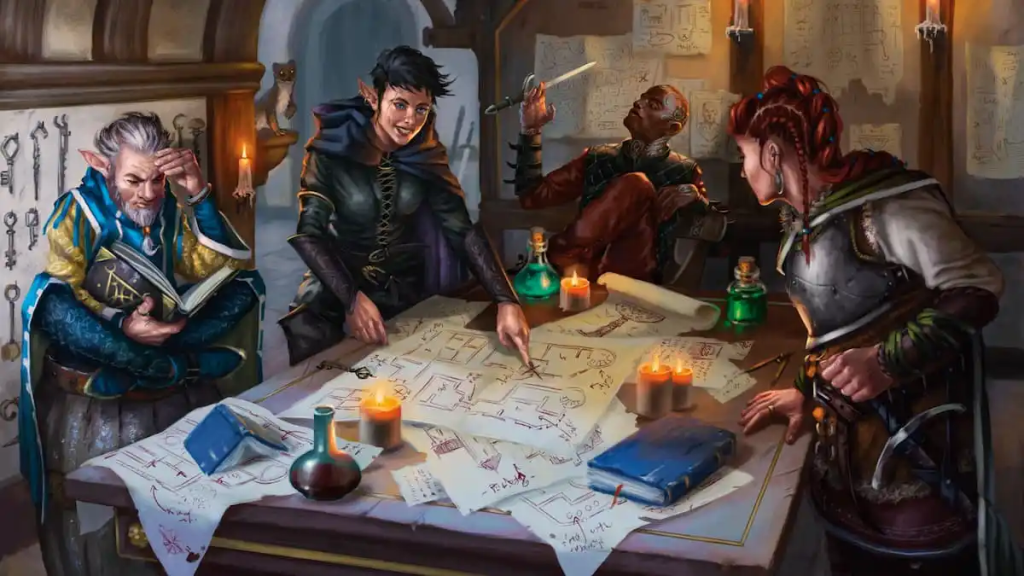
A common question among newer DMs is how to present the information about the physical space of a dungeon to the players. Make the players do it or draw it for them? And what’s the value of having the players make their own map?
In the early years of the game, players needed a map, because dungeons were huge and each session was a discreet adventure. They entered the dungeon at the beginning of the session and left to go back to town at the end. The next session might feature some different players, so they needed a map to keep track of where they’d already been and how to get back out.
Today, dungeons tend to be smaller, so players may not feel the need to map their way thru. (Altho you might point out that they could sell such a map for a good price.) Many DMs draw out the dungeon (or build it with tiles or model walls) and struggle with revealing only the visible parts as the heroes go. Here are some solutions.
Solution 1: Erasable Battle Mat
Using your master map as reference, draw out only the current chamber on a dry-erase battle mat (or build it with tiles) and make the players incorporate it into their complete map (on 1/4″ graph paper). This allows you to avoid tedious room descriptions*, but the players still get to discover loop-backs, trick rooms, potential missed chambers, etc.
* You still have to describe the furnishings of the room, but you can skip the stuff about its size and shape and where the stairs and doors are.

You can be sloppy and not follow the grid lines closely. And don’t count the exact squares, either. After all, who among us can tell if the dimly lit chamber we’re in is 35 feet or 40 feet when drawing a map on a piece of parchment with a quill pen by torchlight?
Solution 2: Grid Paper
You can also buy 1″ grid paper, which can fit a 55’x40′ chamber. That’s big enough for 99% of rooms, and you can tape a couple of pieces together for that enormous hall where the finale will take place.
I happen to like PowerPoint, and it’s pretty easy to draw each room on a slide at 1″ scale and print them out ahead of time or just display them on a monitor.
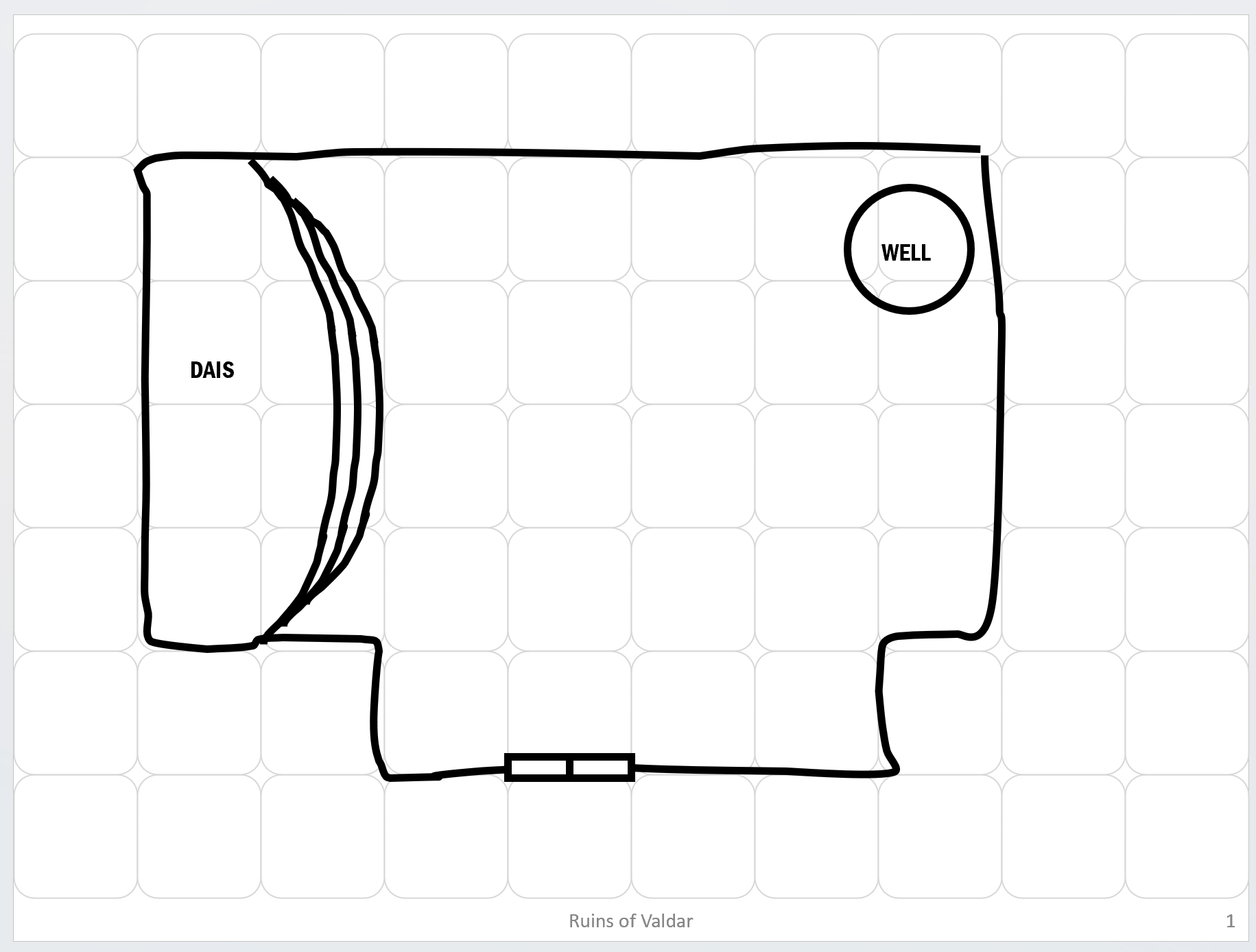
Then a couple rooms can be set next to each other (or drawn on the same page) to allow the players to see the relationship between the room they’re moving from and the one they’re moving into.
If the heroes walk back into a room they’ve left, the page can come back, and any notes they made are there–something that’s not true of a battlemat you’ve erased.
Solution 3: Player-safe Map
Another way to map, especially if your players really don’t want to draw their own, is to make a copy of your master map that doesn’t have secret doors and traps and such–something safe for your players to look at. Then cut a hole in another piece of paper that’s in scale with a torch’s light. As the heroes explore, you can show them the safe map and move the hole to reveal only those things they would be able to see.
To ensure the players can’t see into an adjacent room when their torch is close to a wall, you can have an extra piece of paper handy to block part of the hole. If you make the “fog of war” out of a piece of black cloth, you can just scrunch it up.
The Players’ Map
The players can draw their map on the same 1/4″ graph paper you use for your master map (unless you use DungeonScrawl or DungeonDraft or something). The challenge is no longer to interpret a verbal description but only to incorporate the DM’s battle mat sketch into the overall map when the door you entered by is on the wrong square or the length of the room is wrong.
In the end, the players will have created something they can be proud of and which gives them additional information that pure theater-of-the-mind play cannot: did we miss a secret chamber in this blank space? Why do these chambers seem to overlap? Is there a passageway that connects this deep chamber with one much closer to the entrance, allowing us to avoid the lava chamber on the way out?
Visual Aids
And, of course, visual aids are helpful. Find interesting photos or art and build an encounter around that. There are millions of interiors of taverns, inns, halls, castles, and such. (If you’re map artist, please stop drawing inns and taverns. We have enough now.)

Dungeon corridors and chambers don’t generally need an image, just a map.

 zarban.com