

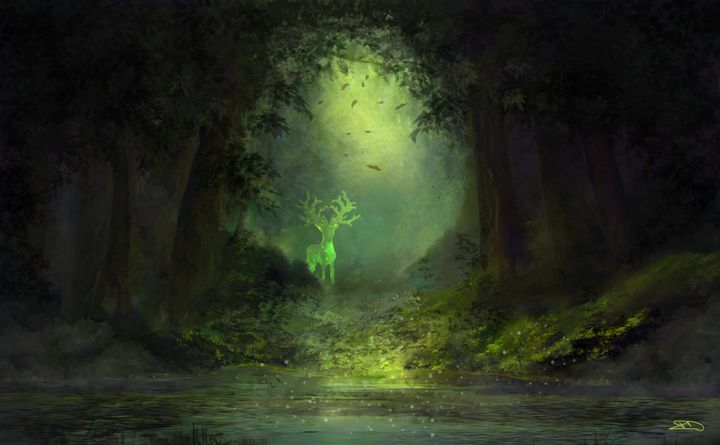
Apart from ghosts, you can have fun with spirits that haunt natural locations or buildings or which maliciously posses or infect people. Instead of monsters to be fought, such creatures are puzzles to be solved.
A few days ago, I posted part 1, which addressed spirits in general and ghosts in particular.
Sometimes, spirit energy crosses over from the ethereal plane by chance (lightning, volcano, powerful magic, earthquake, etc.) and becomes bound to a place or thing. These tend to inhabit places as nature spirits, buildings as hauntings, or infect people, causing disease and madness as evil spirits.
Essential Spirits
Essential spirits are those that never had benefit of body or soul. Instead, they are drawn from the Ethereal plane by unusual forces and bound to a place or thing. These entities are often wild and brutish, but not necessarily evil or even very violent.
Lightning storms, disasters, powerful magic, battlefields, and such can draw spiritstuff to the material plane by happenstance. Such traumatic events seem to create more powerful spirits than those generated by a human death. Moreover, the desires of these creatures are not human and not necessarily at odds with those of the living beings that encounter them.
Essential spirits do not exist because of some unfinished business or wrong that can be set aright, so solace is almost never an option in dispelling them. So, your choices are banishment and destruction of its spirit anchor.
These things–as well as phantasm, poltergeism, and possession manifestation–are addressed in part 1.
Nature Spirit
Nature spirits are those attached to places of nature, especially springs, waterfalls, groves and copses of trees, caves and grottoes, lake sides, river banks, and small lake islands. They are most attracted to places humans consider beautiful or frightening, because they are strengthened by the psychic energy of those who use the location–or fear it.
Nature spirits may be worshiped by primitive folk, due to the mystical quality of the location and the benefits they bring. Because a nature spirit is bound to the land as its spirit anchor, they tend to last far longer than ghosts, whose simple anchors may decay or be destroyed. Their concerns are often about the possible ruination of their domain and so may try to enlist the help of the living.
Nature spirits tend to manifest by using natural forces and the flora and fauna around them. They may whip up a wind, simulate an echo, or manipulate sticks and stones to hide–or reveal–a treasure. This can be an attack to terrify. Beasts are subject to their command, as individuals and as flocks, so they may attack physically. And even plants such as vines and briars may twist and stretch to seize those who displease it (strength check to escape).
But nature spirits can also manifest poltergeism to move, pick up, and even throw objects. Being stronger than ghosts, they can throw objects weighing a few pounds. Even so, they are not capable of wielding weapons beyond throwing a dagger or such, but it does so for full damage, unlike the poltergeist ghost.
When they manifest a form, it tends to be as an alluring woman (a dryad in a tree or naiad in a lake), gnarled little man, a great owl, colorful fish, white stag, or noble wolf, or some other unusual example of its type; and it tends to favor just one or two of these forms. Such spirits being more powerful than ghosts, these seem to be solid bodies and not mere phantasms, but they can nonetheless melt away in a moment.
They can also manifest minor, temporary magic in the form of small curses or benefits, but this is limited, because it uses up their own essence to do so.
Nature spirits can be banished by a high-level cleric, or their demesne, which they are bound to, may be destroyed. Killing a beast controlled by the spirit will likely only anger it.
Hauntings

Hauntings are nature spirits that have become bound to a large, man-made structure. The spirit anchor and demesne is usually a building but can be a large vehicle (such as a ship or carriage) or similar construct.
Hauntings are one of the subtlest forms of undead. They are frequently mistaken for poltergeists, for example, but they are considerably more powerful and manifest in ways other than “going bump in the night.” They may manifest by phantasm (usually in the form of former inhabitants of the structure) as well as poltergeism and, like nature spirits, are usually more powerful than ghosts in doing so. It is rare, but possible, that they might manifest by possession.
Hauntings generally have specific desires they wish to fulfill. They are very protective of their anchors, sometimes going so far as to kill to protect themselves from any harm or to revenge injuries.
Because buildings are always inhabited by people, hauntings have an even greater attachment to the local folk than nature spirits do. If, for example, a haunting comes to inhabit a building erected on the site of a massacre, the spirit would likely harbor sympathies for the descendants of the survivors.
Hauntings are quite powerful and can exercise a great deal of influence over the both the structure and the grounds. They may manifest in ways similar to nature spirits: controlling animals, manipulating objects, mimicking sounds, minor curses or benefits, and so on. But they tend to do so in the form of phastasms of people who once dwelled there and perhaps died there. Screams, cries, foul odors, murmurs, chains clanging, and axes chopping, and such associated with powerful emotional events are the common stuff of hauntings, but sometimes also parties and lovers.
Banishment is usually effective in removing a haunting from a structure, as is destruction of the structure itself, usually by fire.
Spirit Beasts (AKA Giant Beasts)
Spirit beasts are nature spirits that have become bound to a natural animal of the wilderness. The spirit anchor is a wild beast such as a bear, deer, lizard, beetle, snake, shark, eagle, spider, or lion. The creature grows to huge size and goes from beast to low intelligence. Such creatures are often revered and even worshiped by primitive folk. They may project their spirit some distance to appear as a phantom in unlikely places and may attack to terrify.
Unlike a nature spirit, the physical body they inhabit can be killed, destroying them with silver or magical weapons. But, as living creatures, they are not subject to a cleric’s banishment. Being more intelligent than mundane beasts, they may take up a cause or unfinished business related to their home, and satisfying that cause may give them solace.
Altho hostile ones may be termed “demon bear” or “devil wolf” or some such, they are not, strictly speaking, fiends.

Evil Spirits
Essential spirits that infect and inhabit people rather than places are called “evil spirits” or, if especially powerful, “demons”. Their spirit anchor, therefore is the person himself or herself, altho a personal possession is possible as well. They are rare by happenstance but may be summoned deliberately by evil witches and cults with hatred and a lust for revenge. In such a case, they may be bound to a suitable spirit anchor, such as a tome, weapon, or statuette, and delivered as a gift or hidden among the victim’s possessions.
Like other essential spirits, an evil spirit’s desires are vague, and their main interest is in generating emotion and psychic energy in the form of–in this case–terror. If the victim is restrained, the spirit will manifest a terrifying countenance.

Like the controlling spirit, the evil spirit can possess a person (on a failed save), but an evil spirit is more powerful and can force the victim to do things against their will (only murder allows an additional save). An evil spirit thrown off can try to possess another person near its spirit anchor but may be forced to bid its time until one comes near. They certainly will not try to possess a powerful cleric.
Those under the control of an evil spirit always seem strange but may seem enraged, crazed, or hateful. As they tend to neglect their bodies, they quickly look haggard and hungry. But they may also may indulge their own desires to excess.
Evil spirits may sometimes manifest by phastasm or poltergeism when frustrated by failure to possess a victim or when faced with a powerful cleric. And they will try to terrify or use poltergeism to try to harm others (including setting the place on fire). As with all spirits, they are not particularly clever and do not plan ahead.
They may be banished by a high-level cleric or their spirit anchor may be destroyed, but there is no solace that can facilitate their passing to the Great Beyond.
Historical note: The ritual of having groomsmen and bridesmaids at weddings arose to cause evil spirits to fail to identify the bride and groom, who might have been targeted by a jealous rival or family enemy.
 zarban.com