


If your players get the big idea to establish a trading company, it’s surprisingly easy to turn your campaign into a business venture rather than a monster-hunting expedition. First, simply say that in your campaign world, monsters don’t have treasure, so looting dungeons is danger without much reward (except if someone wants monster body parts). Instead, the heroes will buy and sell goods in a game of exploration and trade.
The idea behind trade is arbitrage: the heroes find goods in a city where the price is low and take them to another city where the price is high. By investigating the cities in your campaign setting and listening to rumors, they can find the best products to trade.
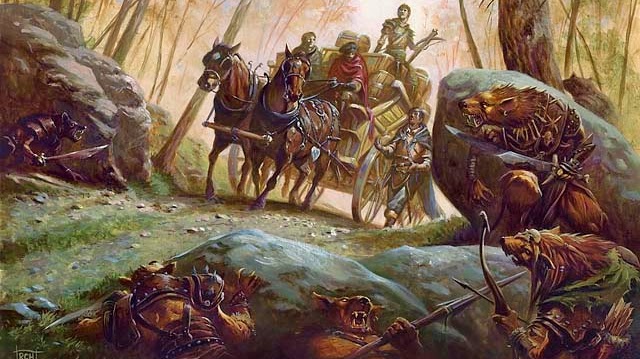
The good news is that you probably don’t need any special rules. Just create adventures where the treasure is a payment for getting a shipment of spices, silks, arms, wine, a noble’s bride, or whatever over a mountain pass, around a treacherous cape, or thru a murky forest. The dangers are wandering monsters, bandits or pirates, unscrupulous merchants, sea monsters, and weather. Use a robust weather system.
You’ll probably want to create one or two specific encounters that could sidetrack the heroes, like part of the shipment being carried off by monsters, the bride getting kidnapped (or running away with a lover), a weird island they need to land their ship at, or strange goings on in a ruins just off the road. They should often have a schedule to keep, perhaps seeing their profits diminish if they are especially late (due to market shift, spoilage, etc.).
To get them started, instead of the usual rumors about treasures in dungeons, you can give them rumors like…
- “Tamor is paying double for furs this autumn.”
- “The load of spices that went missing in Spiderwood Forest is probably just sitting there for the taking. The unlucky trader is surely dead.”
- “The craftsmen of this city are starved for copper. If someone were to cross the Winedark Sea for a shipment, despite the winter storms, it would profit them well.”
- “The Marsk Festival will be extra well attended this year, since it was canceled last year for the baron’s funeral. I hear the brewers are paying double for hops, and the vendors are offering double for a supply of beer. Imagine taking a shipload both ways!”
- “The bloody sea monsters are at it again in the Failors Straits. The people of Thum are hard up for grain. The local lord has promised a bounty on grain shipments and sea monster heads.”
- “Gontir merchants are up to their necks in beets this season, but the beet crop in Murthershire failed. And the Murther Pass is just about to close for winter.”
- “My wagonload was seized on the Kingstoll Road! The tolls are worse than the orcs, I tell you! If I could smuggle a load of sugar loaves thru to Boldsboro….”
Home Base
You might make the heroes’ home base a large port where goods come from all over the realm, and the heroes find distant cities where certain goods sell well. Or you could make their home base a more remote city, where merchants tell them what they need, and the heroes go to distant locales to bring it back. Securing the goods is easier in the former. Making deals is easier in the latter. And of course any city is likely to have both import and export, so the heroes might carry wool out and bring grain back.
You can make the route obvious or let them choose: overland thru the Yeti Pass or around the Ragged Rocks, where giant octopuses lurk. These are effectively two different adventures; you’ll prep the one they choose and save the other idea for a later shipment. After all, there aren’t that many trade routes across your realm.
Of course, there should be some tricky negotiations and strained encounters with other traders, guildmasters, nobles’ men-at-arms, toll bridge keepers, and royal officials. But the heroes don’t need to man a booth at the local market or bazaar at their destination. It’s in keeping with history that traders were required to sell their shipments (wholesale) to local merchants, who would then distribute them (retail).
I’ve written recently about how to conduct lively negotiations.
Specific Adventure & Complications
- A petty war has begun, and the heroes carry goods both armies would like to confiscate for minimal compensation.
- The specific goods the heroes are carrying are badly wanted by someone who doesn’t want to pay for them.
- The heroes are offered two different routes with two different kinds of perils they are likely to encounter.
- The heroes are offered a dangerous route with no tolls instead of an easy one with high tolls.
- A load of goods was lost or abandoned along the trade route by another trader and might be recovered.
- A ship with another load was wrecked on the rocks off a small island, its load probably intact. But something foul now inhabits the wreck.
- The goods the heroes are carrying are explosive, fragile, cursed, alive, or otherwise problematic.
- On arrival, there is some confusion or dispute over the nature of the goods or the price of them.
- The heroes are asked to do some spying while they are in the neighboring realm.
- Circumstances reveal that one of the items isn’t what it appears to be.
- A bottle falls and breaks, unleashing a djinni.
- A painting turns out to be animated and has opinions of the heroes.
- When the heroes weren’t looking, a mimic joined their wagon as an extra barrel.
- The heroes are asked to smuggle goods that are illegal (in their own realm or in the neighboring realm or both).
- The heroes are sold stolen goods, and the rightful owner wants them back. This is especially tricky if the heroes have developed a good relationship with the sheriff, but it’s the sheriff who comes after them.
- A stranger asks to join the company as a passenger.
- The stranger is cursed.
- The stranger is an outlaw luring them into an ambush.
- The stranger is an innocent being pursued by cult who needs his or her blood.
- The stranger is a helpful and knowledgeable guide.
 zarban.com