

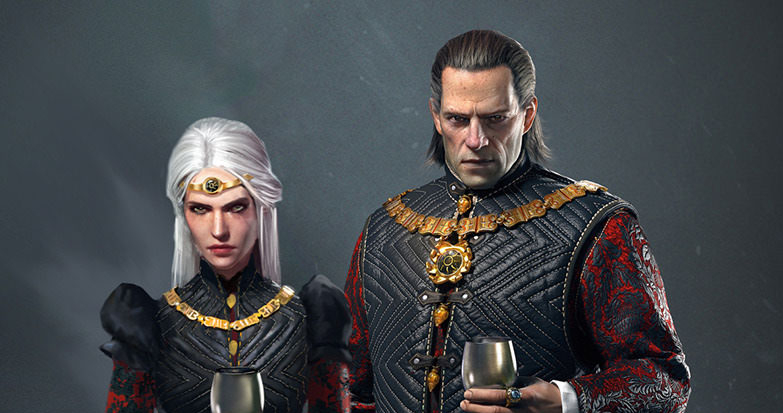
I wrote not long ago about how D&D and other fantasy RPG characters should mostly start as part of the gentry class. That will explain a lot about their ability to read and afford armor and weapons, not to mention their lack of obligations to herd sheep or craft lutes.
But if you don’t start as gentleman or gentlewoman, how do you get there? And if you do, how do you get higher?
Get a Coat of Arms
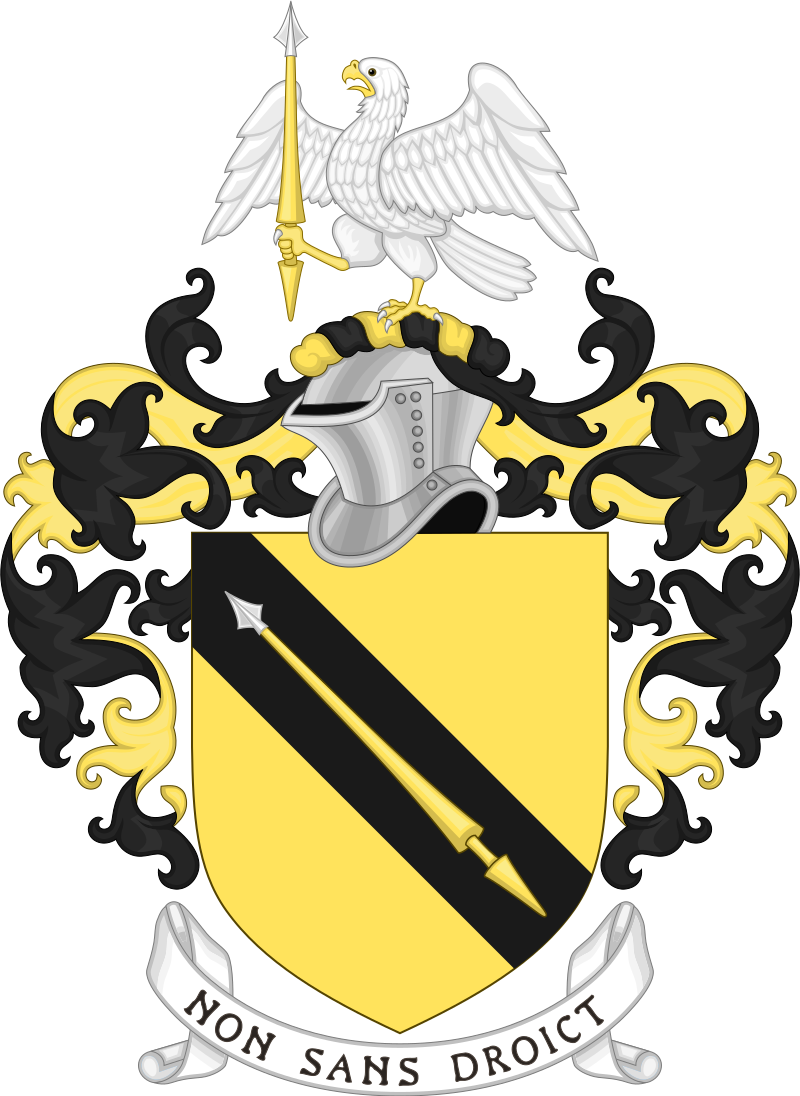
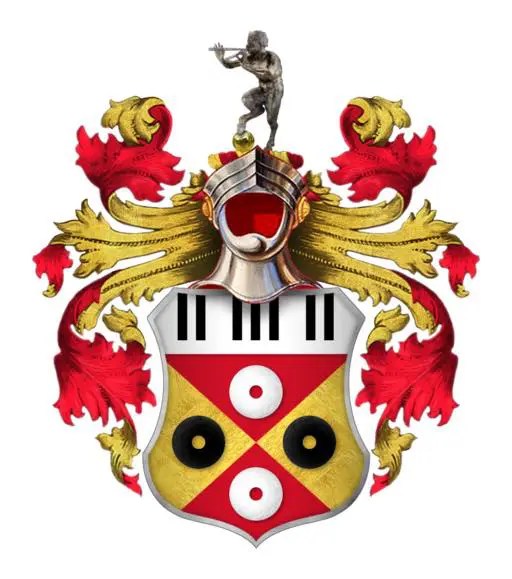
One of the main differences between the gentry and commoners is their right to bear arms (indeed, the gentry technically are commoners, because they don’t have a noble title like “baron”). This doesn’t mean weapons, surprisingly (practically every male trained for war and owned weapons and armor, if they could afford it), but rather a coat of arms. (Find a bunch of coats of arms here.) This marked your family as gentlemen and gentlewomen deserving of respect. Such people are typically addressed as “master” or “mistress”.
If you’re not a gentleman already, chances are you are a commoner of either a merchant family in a town or a yeoman family in the country. A merchant is a commoner who practices trade—meaning the buying and selling of goods—or other commerce, such as moneylending and shipping. A merchant has a good bit of work to do to convince people he or she should be considered a gentleman, but a fair amount of that work can be done with fine clothes and a fine house. It helps greatly to buy some land and become a husbandman (farmer) and/or herder (or, rather, rent to those willing to work the land). And it helps if you earn most of your income from rent or, at least, a profession, like judge, attorney, sage, printer, or playwright.
This is what William Shakespeare did. While his mother Mary was from a gentle family with its own coat of arms, his father John was the son of a husbandman and a glover by trade. He had to gain wealth and notoriety as a playwright and probably grease some palms to get his father a coat of arms. Now, John had become fairly well-to-do and held local office, including high-bailiff (the equivalent of mayor) of Stratford-upon-Avon, but he had been rejected for a coat of arms previously.
A yeoman is a commoner who possesses land directly from the king in greater quantity than a husbandman (enough to live off of). A yeoman already has the land–or connections to it by the family–that puts him or her a cut above the rest of the peasants. So what remains is to start living and looking the part of a country gentleman and applying for a coat of arms. And that requires money, so keep adventuring.
Get Knighted
At 5th or 6th level, martial types may be knighted. This is typically done as a reward for some particular service or in promise of it. It could be done by a sovereign or high noble, but depending on the campaign setting (or historical era) could be done by any noble or lord or even a bishop/high priest (especially appropriate for a paladin).
A typical knight is awarded land enough to support a household (called a fiefdom); this was typically about one manor. This comes with certain obligations, including 40 days of service to the nobleman who knighted him (in war or as part of a castle garrison, traveling bodyguard, advisor, etc.). Since knighthood is not inherited, a commoner knight’s heir will be a yeoman unless he earns knighthood himself; if the family is highly respected, the heir might be considered a gentleman–that is, a member of the gentry.
Alternatively, an adventurer might instead be made a knight-errant. A knight-errant is one who is knighted, given some gifts (arms, a horse, spurs, etc.) and sent on his or her way until it came time for the 40 days of service. This is pretty appropriate for most adventurers, but role-playing occasional service to a liege could also be fun.
A ranger or rogue might be given knighthood later–7th or 8th level, perhaps. In the meantime, a ranger might be made warden of a forest.
Any commoner who is knighted is automatically eligible for a coat of arms, so he or she effectively joins the gentry. A man named Dwyre Humblestart is dubbed “Sir Dwyre”; a woman named Hegatha Bottomup is dubbed “Dame Hegatha”.
Get Land
The next step up the ladder of medieval society is to acquire more land. This is typically granted as the hero does service to the king or high noble liege and traditionally happens in D&D at 9th level for fighters. For the sake of adventure, the players can be tasked with taking down a rebellious or corrupted lord, and then his or her lands can be gifted to the party’s fighter. Or they could seize land from a neighboring realm or an unclaimed wilderness.
When you own at least one full manor and are a member of the gentry, you are now considered a lord of the manor. Sir Dwyre becomes Dwyer, Lord of Shorbert Manor. Dame Hegatha becomes Hegatha, Lady of Goolsley Manor. As you add manors to your holdings, you may add them to your name, but you’re typically known by whichever manor you usually live on.
Your manor comes with a village (with a church) or hamlet (without one). That’s where your workers (50-150) live who work your fields and tend your livestock. And all they ask in return is a bit of the food for themselves, an annual bolt of cloth, and protection from raiders within the walls of your fortified manor house.
Some manors have towns on them, where there is a market; townsfolk pay rent to the lord of the manor. If necessary, you can levy your commoners to fight in a war. Yeomen are typically archers; peasants are typically light footmen. Townsfolk are typically heavy footmen, because they can afford better armor.
You’ll want some knights (your own or mercenary) and at least one wizard and cleric. The wizard can live in a tower nearby (or one attached to your manor house); the cleric can live next to the church in your village or at a nearby abbey.
A lord of the manor is generally expected to be both a landlord and a warlord, so keep adventuring.
Get a Title

Around level 12, it may be right for a fighter to be further elevated to the peerage by being awarded a noble title, usually “baron”. A step up, perhaps coming around level 15, is “earl”. In historical England, French titles like count and duke got mixed in. The German equivalents were vizegraf and graf. Nobles (nearly always) hold their titles directly from the sovereign, which means being ennobled directly by the king or queen and gifted several more manors. A baron’s lands will be scattered around, but typically an earl holds an entire shire or county (shire being the Saxon term and county the Norman term).
Historically Leicestershire had 91 manors. Cornwall had just 17. From time to time, the king absorbed lands and titles (by inheriting them or executing a disloyal noble, for example) and so could create new titles and gift lands with them.
A fighter might get created a baron for destroying a powerful dragon, helping in a successful war, seizing another baron’s lands at the request of the sovereign, or adding new land to the realm from a border wilderness, foreign realm, or newly discovered island. And it always helps to grease the king’s palm with gold tributes. (It will, in fact, be required.)
Likewise, getting elevated further to earl (or count or duke or whatever), would be for taking care of the frost giant threat, putting down an uprising in the highlands, or re-securing the king’s foreign holdings from seizure (as a vassal of a foreign king–a constant problem when nobles and royals intermarried across national borders).
Dwyer, Lord of Shorbert Manor, becomes Baron Pebrych of Pebrychshire. Hegatha, Lady of Goolsley Manor, might take over Foldingshire as the Earl of Folding. The king would call them “Pebrych” and “Folding”.
Go for the Crown

But why stop there, m’lord? The king is weak and sickly, unloved by the peasants and townsfolk alike. And his heir is a dissipated youth, besotted with wine, women, and song. Is it not their fault that bulettes roam the land unhindered? That barbarians threaten raids daily? That a vampire sat in the very seat you occupy now until you valiantly seized it from her?
Altho your father was but a gentleman, his grandmother was Lady Garl, the Baroness Tumb, sister to the king’s grand-uncle, the previous king but one, making her the king’s grand-aunt. Your claim is just as good as his. And–dare I say it?–were it not for the blessings of the previous sovereigns foolishly bestowed upon him, you–you, m’lord–would be king right now.
The people would support you (with a little persuasion); the archbishop would give you his blessing (with a little lubrication); the council of wizards would not oppose you (not enough of them, at least). Only the king’s champions would stand in your way… in addition to whatever meager army he could raise.
And, wait, what news is this? Trouble on the border? Giants? Dragons? Fiends from the darkest depths of the earth? Who will save the realm? Oh, who, m’lord? And what accolades will that savior deserve…?
 zarban.com