

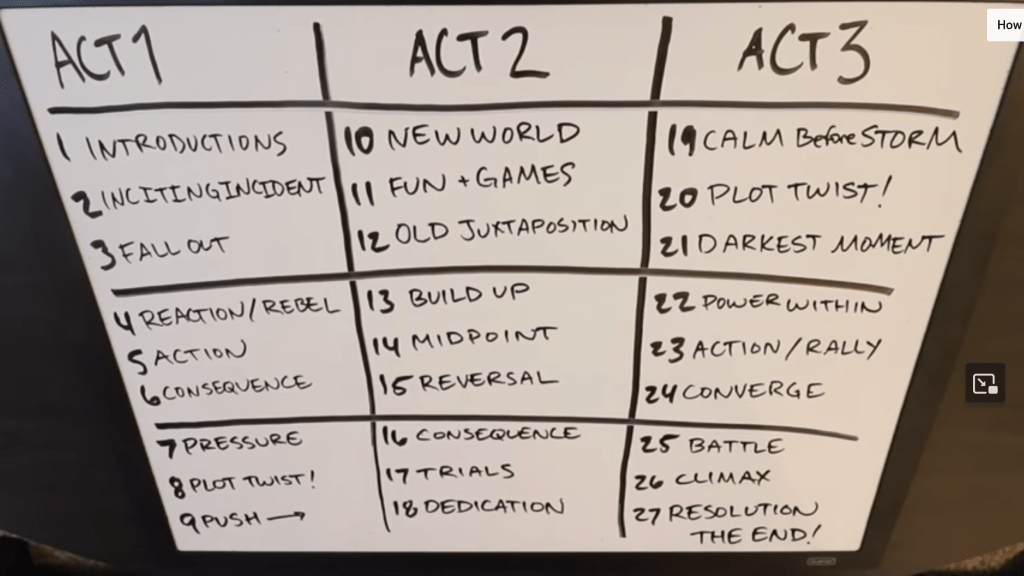
I just came across Kat O’Keefe’s 3-act, 9-block, 27-point structure. It’s a little wonky, because she actually puts parts of act 2 in acts 1 and 3. But since books and movies aren’t explicitly divided into acts, this doesn’t have much effect.
So consider this as a helpful way to think about story structure as well, because her individual points are quite good.
I compare it here to my 8-part story structure.

As you can see below, putting the act breaks where they belong reveals that act 2 is probably a little long, since it has 15 plot points instead of 12. However, as a writer, O’Keefe may keep these points a little shorter and punchier than the others to avoid a saggy middle.
However, take note that successful stories don’t follow any order of events this strictly. Some of these points can move around or be left out.
Act 1
- 1. Introductions
- 2. Inciting Incident
- 3. Fall Out from the Inciting Incident (what I call “call to adventure“)
- 4. Reaction/Rebellion (what I call “refusal of the call“)
- 5. Action Taken by the Hero
- 6. Consequences of the Hero’s Actions (what I call “motivation“)
Act 2
- 7. Pressure Is Applied to the Hero (this should be point 8)
- 8. Plot Twist! (this should be point 11)
- 9. Push into the New World (this should be point 7)
- 10. The Hero Ventures into the New World (what I call “into the wilderness“)
- 11. Fun & Games (this should be point 9)
- 12. The New Extraordinary World Is Juxtaposed with the Old Ordinary World
- 13. Build Up with Rising Action
- 14. Midpoint Crisis
Midpoint
- 15. Reversal of Fortune
- 16. Consequence of the Reversal
- 17. Trials
- 18. The Hero Dedicates Himself to the Conflict
- 19. Calm Before the Storm
- 20. Plot Twist!
- 21. The Hero’s Darkest Moment (what I call “failure”)
Act 3
- 22. The Hero Finds a Power Within (what I call “gaining the secret key”)
- 23. Action/The Hero Rallies
- 24. Plot Lines Converge
- 25. Battle
- 26. Climax
- 27. Resolution
 zarban.com