

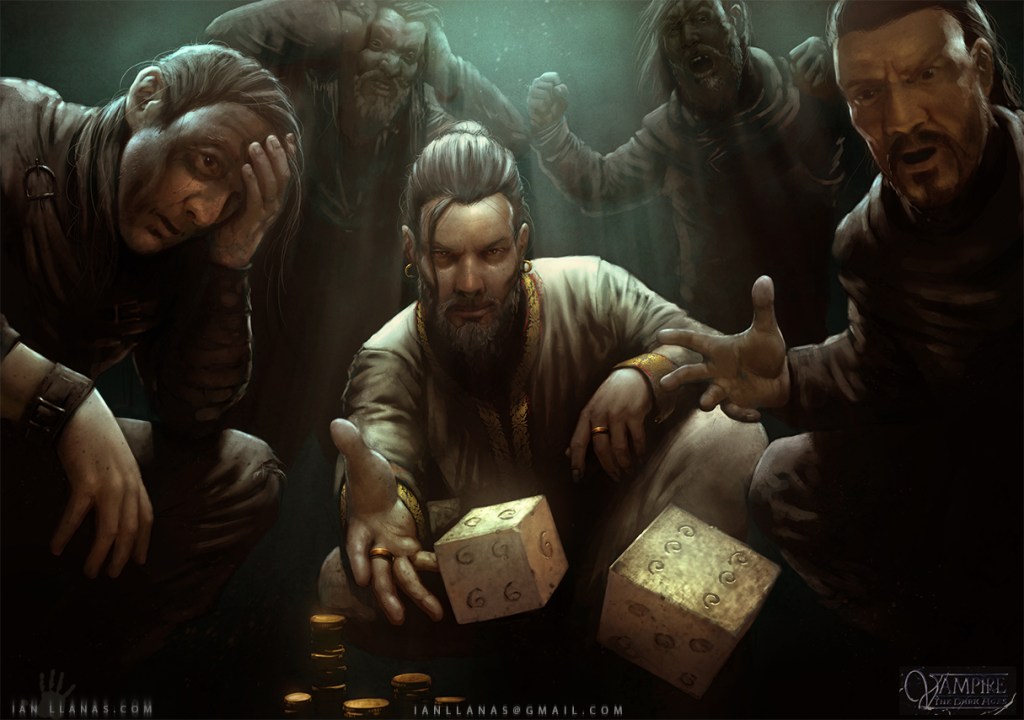
I came across this on Reddit, and found it to be a great mechanism, so I’m writing it up here to share it and to remind myself about it.
OffendedDefender’s thoughts
Whenever you don’t feel like making a minor decision, let fate decide! Roll a d6. High numbers are good results, low numbers are bad results. It’s mostly for inconsequential stuff, so not in place of encounter die or reactions rolls. Generally, stuff like “is there a pen and ink in the lord’s desk?”, “does the stable still have horses?”, or “does the tavern have rooms available for rent?”, so mostly questions involving a degree of luck. It’s a small way to lessen some of the mental burden and decision fatigue of GMing.
cp1r8’s thoughts
This is a favourite of mine that I use often: Whenever the players ask a question to which you (the ref) don’t know the answer—it isn’t obvious, isn’t in your prep, or you don’t have a strong idea of what it should be—rephrase it as a closed (yes or no) question and roll 1d6.
[If either yes or no seems more likely, roll 2d6 and take higher or lower roll.]
- No, and… [it’s worse than you feared.]
- No.
- No, but… [it’s not as bad as you feared.]
- Yes, but… [it’s not as good as you hoped.]
- Yes.
- Yes, and… [it’s as good as you hoped.]
Use this rigorously and exercise self discipline in abiding by the results.
My experience is this leads to much more interesting outcomes than arbitrarily deciding on the spot and lets you discover the world alongside your players. They also trust your “fiat” rulings more because it’s clear you’re willing to let the dice decide such details.
My Thoughts
This is a great idea and useful in many situations. Rolling a d6 with advantage or disadvantage will skew much higher or lower; there’s probably a better approach.
The idea of the varying answers is to give nuance to what would otherwise be a flat yes or no. However, Jason Alexander, in his fine book So You Want to Be a Game Master, points out that your instinct should be to default to “yes” for minor player requests. Yes changes the situation; yes pushes the narrative along; yes allows heroes to be effective. And after all, most player questions will start with the assumption that the question is reasonable. “Is there a well nearby? (because wells are pretty common around towns).” Now, using disadvantage when the expectation is “no” is more logical. “Is there a sage in this town, by chance? (because sages usually live in cities).”
So the thing to do is to treat “No, but…” as a type of qualified “yes”. There’s no sage, but there are a couple of bright young clerks who can look things up; their knowledge isn’t as deep or necessarily fully correct, but it may be enough. No, there’s no pen and ink here, but you remember seeing some elsewhere.
There’s another alternative you might use: Maybe. You might use it instead of a “yes, but”, so the results aren’t quite so slanted toward success. I would use something like this:
- No, and…
- No, as far as you can tell.
- Maybe: you can’t tell. Try again when something changes; maybe is now “sort of”.
(If you’re rolling just for yourself as GM, count this as “no”.) - Sort of: there’s something similar or there’s a cost in time, money, or risk.
- Yes, apparently.
- Yes, and… in a big way.
One place this is particularly useful is when a player is looking for an angle, an advantage, perhaps in the middle of combat, and asks if there is a table or something he or she can jump on to fight from the high ground or if the opponent is close enough to the edge of a precipice to push them in. You can let the dice decide (if you’d rather not follow “the rule of cool”).
Examples
Is there a well nearby?
- No, and there isn’t any river or other source of water that you can see.
- No. You’d have to ask around for one.
- Maybe. There’s one that looks to be in disrepair. We’ll roll again when you look it over.
- Sort of: there’s a river nearby where you could get dirty water; or…
Sort of: there’s a tavern a ways away where you could get ale or cider. - Yes. The bucket is ready to be dropped and hauled up.
- Yes, and the bucket is sitting full on the wall of the well; or…
Yes, and there’s a tavern right nearby also, if you’d rather have ale or cider.
Is this guy armed?
- No, and there’s nothing around he could use to defend himself.
- No, not as far as you can tell.
- Maybe. It’s not obvious, but there’s only one way to find out.
- Sort of: there’s a chair and some ceramic pots he could use.
- Yes, it’s pretty obvious.
- Yes, and… so are his friends.
Is there something I can use to swing across the gap?
- No, there’s nothing but a few rocks and nothing for a rope or chain to attach to above.
- No, there’s nothing but rocks.
- Maybe. That pile of debris has all kinds of stuff; you’d have to check it.
- Sort of: if you have your own rope, you might be able to attach it to a ring on the ceiling.
- Yes, a chain hangs from the ceiling.
- Yes, there’s a chain connected to the ceiling and attached to the wall right next to you.
Caveats
There are a couple of things to watch out for, tho. Notice how the answer sometimes depends on what the character is really after (water to put out a fire or water to drink).
Also, players will sometimes get an idea in their head about doing something and ask a bunch of questions about what craftsmen are in this town, and you’ll have no idea what they are looking for or why, because they sort of want their clever idea to be a surprise. Or they have an idea that a certain statue is trapped and ask all kinds of questions about it that you haven’t thought about because: it isn’t trapped.
In these sorts of cases, rolling a die to get the answer might not help. If you don’t mention a shoemaker among the craftsmen, it may ruin a player’s fun little plan to get fancy troll-hide boots made out of the dead troll. And in the second case, rolling dice may seem suspicious to the player and result in additional wasted time.
The other thing to worry about is that the player may have a fairly radical idea or ulterior motive, and allowing the dice to decide the answer may result in that player going thru with some outlandish, half-baked idea that they’ll be frustrated to learn won’t ultimately work. “Okay, so, since there are horses here, I get a bunch of fresh horse manure together in a cart–“
So just try to find out what the players’ questions are getting at before you roll for a random answer, and you may find you don’t need a random answer after all. Fortunately, the nature of a randomized yes-or-no answer encourages the player to be more up-front and straightforward.
 zarban.com