

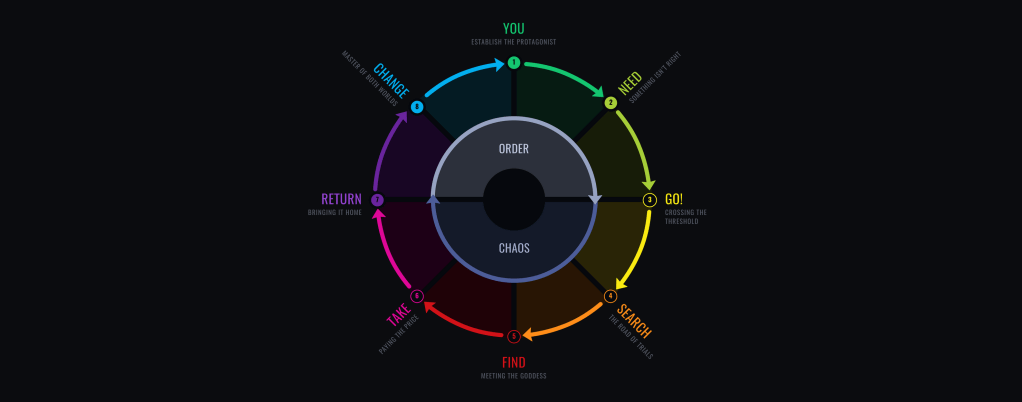
In this video on StudioBinder‘s YouTube channel, he explains writer/producer Dan Harmon’s method for building a compelling story. Dan Harmon is famous for creating the TV shows Community and Rick and Morty, both of which are known for their clever plotting as well as their off-beat humor.
This method is clearly based on Joseph Campbell’s Hero’s Journey work, cut way down, and with more general language. Campbell analyzed myth and folklore, but his work has been influential across later storytelling. His work was interpreted for screenwriters by Christopher Vogler, so that may be the direct source.
However, the way the video creator sees things in his example story, The Dark Knight, does not line up with the way Campbell laid out the story structure. I’m not sure if the disconnect is between him and Harmon or between Harmon and Vogler or between Vogler and Campbell. I think it’s a little of everything.
“The Road of Trials” and “Meeting the Goddess” are parts of Campbell’s model. But Harmon skips “the Ordeal”, which is the hero’s darkest hour and what I call defeat. And “The Return” is Campbell’s section three, which all happens after the hero defeats the villain and wins a prize in “The Transformation” or “The Ultimate Boon” and doesn’t exist in most modern stories. (You’ll find briefly in The Matrix, because it’s literally a savior story, but it’s not even in Star Wars, which is the quintessential Hero’s Journey story.)
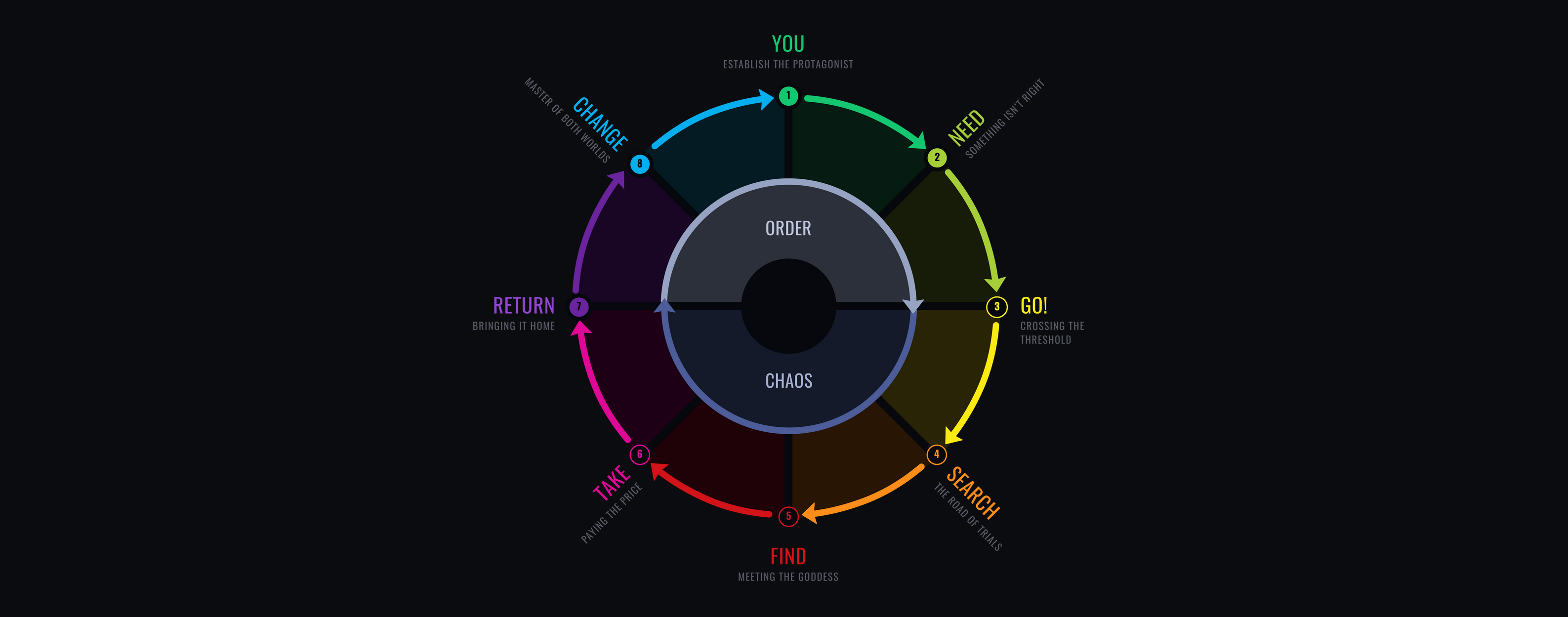
Below, I compare it to my 8-part story structure.
You

Create heroes the audience can identify with and invest in. This is part 1.
Need
Establish an active drive for the heroes. They need something. This is part 2.
Go!
The heroes start their journey to get what they need. This is part 3.
Search
The heroes face challenges in a search for the thing they need. This is part 4.
Find
The heroes find what they have been searching for only to find that it is false, disappointing, or the wrong thing. This is the midpoint crisis and part 5.
Take
The heroes must decide to continue and may need to sacrifice to succeed. This is part 6.
The creator of the video is not applying this the way Campbell does. In that model, this is where the showdown with the villain occurs, and the hero wins the “boon” or prize sought. In the video creator’s estimation, this is only the end of act 2, which is the “all is lost” moment.
Return
The heroes return home with a new capability to defeat the villain. This is part 7.
In Campbell’s analysis, this is a real return to the normal world with doubts that the prize won will be accepted or can be understood. Stories today almost never do this–Campbell specifically notes it. But the way Harmon and the video creator see it, this corresponds to my part 7.
Change
The heroes demonstrate that they are changed. This is part 8.
In the video creator’s estimation, this is the final showdown with the villain, where the hero is tested and found to have changed and can therefore succeed. But in Campbell’s version, this is where the hero, back in the ordinary or surface world, demonstrates that he is the master of both worlds–the ordinary and the extraordinary. Most modern stories demonstrate a change in the hero, but not that radical.
 zarban.com