

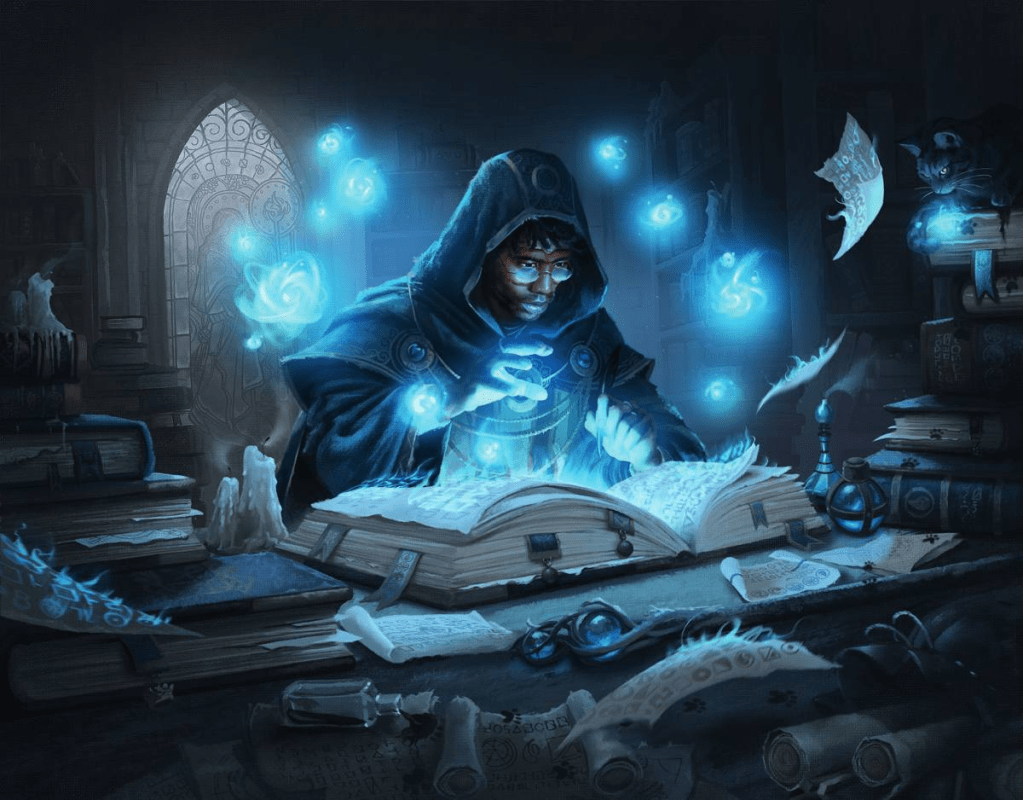
Most old-school D&D retroclones and similar RPG systems don’t have a crafting system, but players often love such things. Here’s a simple way to add one to your game. The mechanism is based on the classic code-breaking game Mastermind. The popular Wordle is the same game but with words.
Why
Players love crafting systems. They’ll look for ways to game them and optimize them until you’re sick of it. So be careful. Players don’t want to craft things for story reasons.
That said, it can actually be great story to allow heroes to craft items. They need to:
- Seek lore to learn what magic items are possible. (Hint: Not everything in the book, and some things that aren’t in the book.)
- Discover secrets to learn what components are needed and the method of assembling them. (However, anyone who has watched a little Tasting History knows how vague old recipes were, so good luck with your experiments.)
- Pursue social encounters to find an NPC who knows where the component might be found.
- Go on the adventure to find the component or two to be used.
- Spend money to do the crafting.
- Make a check to succeed at crafting the item, risking failure and possible disaster.
It’s critical that the crafting method can’t be easier than adventuring to find the items randomly.
First Things First
A wizard or artificer wants to create a spell or item that the GM approves as level-appropriate. As a general rule, the character should be at least three levels higher than the spell or character meant to use the item. That is, a 9th-level wizard could create a 6th-level spell or an item appropriate for a 6th-level character.
The character must have the necessary skill, materials, and location (workshop or laboratory). As GM, you may decide what components are necessary for a potion, for example. The Heroes of Adventure Monster Compendium is a great resource for harvesting monster parts for crafting or sale.
The rarer the magic item, the rarer the component needs to be. If the item has something to do with planar travel, guess what: the heroes are going to have travel to another plane to get the component they need. The nice thing about this is that they now have the knowledge to choose an adventure hook that will lead to planar travel and to know what component they need to collect to get the exact thing they want. It’s an even better, more player-driven method of getting magic items than donations for divine visions.
The Crafting Test
At 5th level, with a special (very fresh) component found by adventure or sidequest, a wizard or cleric can spend one week and 100 gp (plus the cost of the base fine-quality item) to try to craft a common magic item appropriate for their class. The component, sidequest, and item are determined by the GM. A wizard can’t create an amulet of the devout; items that cast wizard spells can’t be created by clerics; etc.
You must make a successful arcana check.
- On a success,
- On a recovery, something goes wrong and it will take a couple of weeks and/or another side quest and/or those involved suffer a minor wild magic effect.
- On a failure, all the effort, money, and components (except maybe the base item) are wasted.
- On a natural 1, the item is instead cursed.
Rarer Items
If you’re willing to allow it, the heroes can craft rarer items.
- At 9th, with 2 components, 500 gp, and one month, you can create an uncommon magic item.
- At 13th level, with 3 components, 5000 gp, and three months, you can create a rare magic item.
- At 17th level, with 4 components, 50000 gp, and one year, you can create a very rare magic item.

Components
For a spell, the components might be something like powdered bone of a magical creature, the blossom of a rare plant, a toadstool from a fairy ring, etc. but also verbal incantations and somatic gestures (the exact nature of which, like the material components, is immaterial✽). Some material components can be bought, but one or two should be side quests.
✽The hand-waving can be hand-waved. 😉
For an item, the components should all be materials and require an adventure or couple of side quests.

Example
Jesper wants to create a pair of magic arrows he calls +1 arrows of entanglement. On a hit, a two-legged target of small or man-size or less must check dexterity or be entangled and fall down, requiring 1 round to regain its feet. The GM agrees that a pair of such arrows is reasonable and that they can be shot at different opponents.
The GM decides the components should be:
- A small amount of refined mythril for the heads
- Three shafts crafted of livewood
- Feathers of a falcon
- A small amount of giant spider silk
- A bluebird’s tongue
- Nobrin moss
- Fulgar root
- Incorian leaf
- Lobis tree sap
- A few quillon berries
- A few pine nuts
As mentioned before, the exact nature of these is immaterial; this list is only for flavor, except that the livewood, spider silk, and lobis tree sap will have to be found by the character; the others can be purchased. Gathering these, the character has the arrow made by a master fletcher and then spends some time working on the enchantment.
 zarban.com