

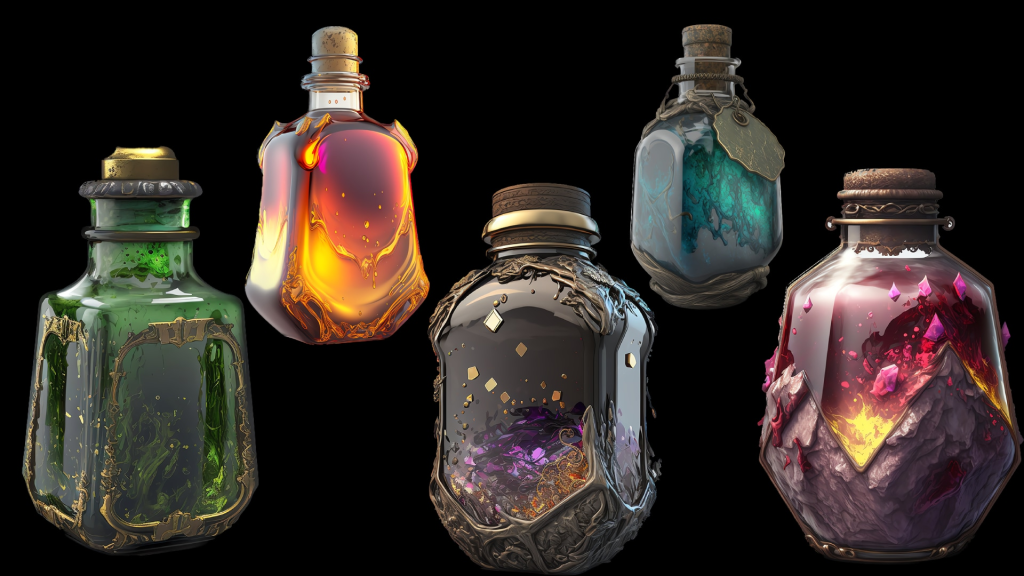
An interesting way of rewarding player characters came to mind recently. I found it in a description of Marvel’s Midnight Suns video game (which I don’t play, so I don’t know exactly how theirs works). Instead of finding a fully brewed potion, you can let the heroes find ingredients that go into them.
I like to say that potions are the only magic item the heroes can buy, but they don’t last long. So they have to be used in the adventure they are brewed for, or they spoil. That way, players can’t hoard them. This makes finding potions quite rare (but an NPC might still have a fresh potion on his or her person).
A simple way to do this would be to merely say “You find the eyes of a couatl in a flask. With that, you can have a potion of invisibility brewed overnight for just 10 gp, instead of having to wait a week and pay 160 gp.” Or perhaps with this system, you can’t even buy potions; you can only have them brewed from the ingredients you bring to the alchemist.
That’s fine, but a more interesting system would require the heroes to collect multiple ingredients to be brewed together. And ingredients, some more common than others, could be used in different potions….
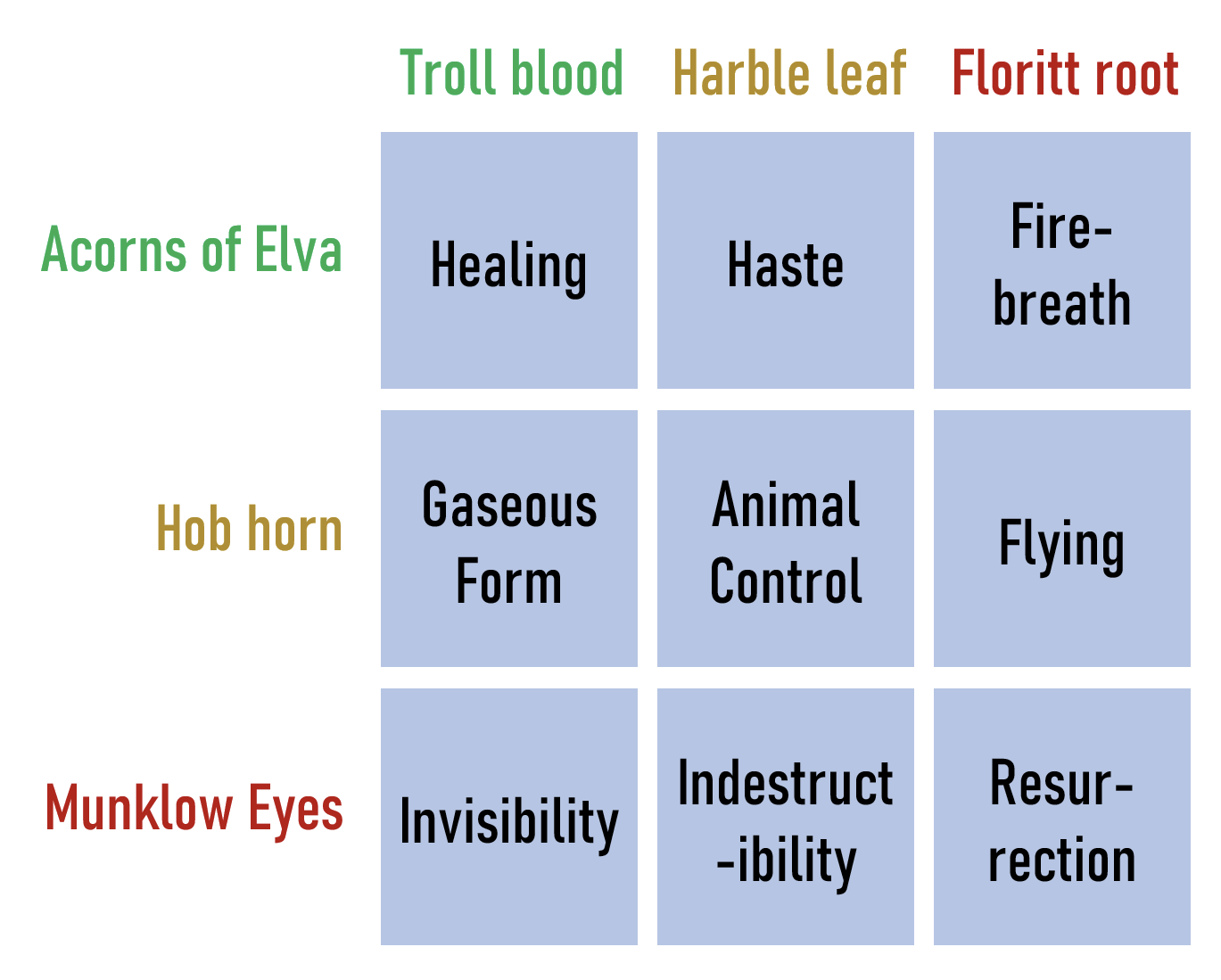
Now the players have to decide what potion they want to brew, based on which ingredients they’ve found. Have harble leaf? Get the eyes of a couatl, and you can make a potion of indestructibility. But get acorns of Elva, and you can make a potion of haste, and the acorns are easier to find. But if you get the couatl eyes, you could search for floritt root and make a potion of resurrection. Oh, the choices!

Getting these items can be side quests, or they can just be found among the possessions of other adventurers or as part of the bodies of monsters killed. Obviously, a good way to get troll blood is to kill a troll. But what is a hob? Just a harmless desert reptile that happens to be kind of rare? Or a monster that must be slain?
And how much troll blood are we talking about, anyway? Maybe it has to be boiled down, so a given troll body may only yield 2d3 doses of reduced troll blood. And the more limited items, like eyes, ears, and gall bladder are always good choices, since they naturally limit the heroes to one or two potions per find. Harble should grow in solitary stalks with only a few leaves each season. And powdered gems of a certain value likewise naturally limit the uses.
Matching Ingredient to Effect
You would probably also want the ingredients to match the potion. Trolls famously regenerate quickly but are susceptible to fire. So troll blood makes sense as an ingredient in a potion of healing. Couatls have truesight, so they would be good for a potion of invisibility.
The more powerful potions should require rarer ingredients, of course, so you’d need to be careful how you make your list. You don’t want the heroes brewing up draft after draft of potion of resurrection.
Of course, if the rare couatl eyes can be made into several things, the players may become paralyzed into searching for floritt root to make a potion of resurrection and never use couatl eyes (no matter how many couatl they find) to make a potion of invisibility. But, personally, I like this dilemma. It both gives the players a choice they didn’t have before and requires them to make a choice.
These are things you need to decide for yourself. And your recipes don’t need to be in a matrix as above. They would be more practical in table or list. Here’s a list based on D&D 2e.

Shelf Life of Ingredients
Now, this all could, of course, create a different problem the spoiling-potions idea was meant to avoid: hoarding potion ingredients. So… make at least the very rare ingredients spoil too, after two adventures. After all, body parts and vegetable matter shouldn’t retain their potency forever.
But not everything has to have a short shelf life. A powdered ruby worth 100 gp is a nice bit of treasure and also useful in certain potions at any time, as long as the other ingredient spoils easily.
Effects
If you sniff a potion, you can tell if it’s spoiled. If unspoiled, it gives you an idea of the effects it will have (altho this will be false if it’s a cursed potion). If it’s on the verge of spoiling, it won’t stink yet; you get the full effects but suffer a minor wild magic effect.
You also get a minor wild magic effect if you drink two potions together or drink one while still under the effects of another. If you drink a spoiled potion that stinks, it doesn’t work, and you suffer a minor wild magic effect. After several months, a potion will lose all its magic, have a neutral organic smell, and no effects.
Learning the Recipes
Another aspect to consider is how the heroes learn what potions could be made from what ingredients. Just letting them pore over the recipe list isn’t very realistic. They shouldn’t really even know what potions are available, let alone exactly how to make them.
Instead, this is a chance to let the wizard show off some arcane knowledge. Do an intelligence check for each potion that uses the given ingredient. So the character might know that pigwort can be used to make a potion of water breathing but not know it can make a potion of fire breath.
Of course, you can role-play an alchemist who asks for certain ingredients to be brought back, if they can find them. This could be part of the adventure’s treasure. And you can let the heroes find a sage who can tell them about two or three potions and their ingredients. And certain common potions–like a potion of healing–could be well-known.
The heroes might eventually even stumble upon a real gold mine: a book listing numerous potions and their ingredients–a very valuable bit of treasure!
Simplifying Things
You could simplify it to just one ingredient for each potion. Then, as soon as the heroes get it back to town, they learn it can be brewed (with varying common ingredients) into one of three potions–for different prices. Now, you’ve given them basically the same kind of choice and decision to make without the hassle of hustling after another hard-to-find ingredient.
In such a case, I would suggest making uncommon ingredients be brewable into perhaps three ordinary potions, rare ingredients into three mid-level potions, and very rare ingredients into three high-level potions. At the very least, a high-level potion like restoration should cost more to brew than a mid-level potion that uses the same ingredient.
It all depends on your table. Maybe your players are keen on fetch quests and will eagerly hunt down rumors about cackleberries and dire goose liver. Or maybe your players would just be bored with such things but still enjoy the option of choosing a potion instead of being handed it.
Exotic Ingredients
Heroes of Adventure has a great component grid you might be interested in for crafting inspiration….

 zarban.com