


Do you struggle populating your fantasy world with towns and cities that feel distinct and interesting? Try some of these.
But keep in mind that what makes a location interesting to the players is what happens to the heroes there. By having sources of rumor, news, and intrigue scattered around your city, you make it seem alive and exciting. If you bunch them up in one tavern, the rest of the city will be a blank slate.
Note that inhabited cities and castles are labeled directly on your map; any settled hex without a city or castle is assumed to have 1d6+10 manors and one town or coaching inn.
Categories
Some of the things you may want to consider siting:
- Hubs of trade of various sorts
- Seats of power (temporal, divine, and arcane)
- Colleges and libraries
- Trade ports and shipyards
- Royal mints
- Mining centers
- Centers of the arts
- Strategic fortresses
- Historical and religious sites
- Bases of factions

Manors & Villages
Villages exist to support the manor where they are situated and so are basically just hovels and houses for the workers on a big farm. They normally have a blacksmith and alehouse (literally a house where an alewife brews ale) and not much else that adventurers would want. Map them only on 1-mile hex maps, and don’t even mention them during travel except to say, “You pass thru various villages along this road.”
- Millbridge, a village with a fine stone bridge attached to its flour mill.
- Tunnyford, which sits by a shallow ford of the Luwan River.
- Ruddylane, where the mud is red.
- Tem, where even the humblest houses all have red tile roofs, owing the lord being particularly friendly with a tile merchant.
- Brewsterly, which has a fine malting barn and brewery to supply the cities not far down the road in either direction.
- Galliwile, where every year giant frogs return for mating season in the small lake.
- Hastcorn, where grain is stored for neighboring villages and many cats are employed to keep down the rodents.
- Lonnidal, where a force of 20 men held off 200 in the Little War of the Brothers at the manor house.
- Stonewalk, which is situated on a stretch of old imperial paved road.
- Ipplegar, which features a church with a very tall, narrow steeple.
- Lanliou, which is the source of much of the lanliou sprigs that are key to potion-making.
- Villa-by-the-Wold, a former villa from imperial times near a bare, hilly upland.
- Sheepfold, a waystop for shepherds bringing sheep to market, with several large, stonewalled pens.
- Harfare, which sits on the thoroughfare leading to Harcester city.
- Hillbonnet, which sits on top of a hill like a hat.
- Faebrook, rumored to have a faery ring in a thicket by the brook.
- Oak Hollow, which sits in a hollow surrounded by oak trees.
- Saint Previn’s Rest, where good Saint Previn rested a night on his journey to Carborough to be appointed archbishop.
- Dragonsfoot, which is the last village on the road that leads up the mountain, where a dragon dwells.
- Pogrun, on the Pog millstream.

Market Towns
Walled towns stand between cities, often at crossroads, and serve villages in the area as a place for buying and selling at the market in the town square or churchyard each week. Each one should have a particular resource, such as a mine or craft industry. Map them only on 3-mile hex (or smaller) maps.
- Fort-on-Bracken, a former hill fortress on the Bracken River.
- Inkleton, a bordertown with a defensive ditch outside the wall.
- Hammersly, a town known for its armorers.
- Swordale, a town known for its weaponsmiths.
- Braine/Brenny, a town where two ethnicities have different names for the town.
- Colberwail, a town on a pass thru hills where tin is mined.
- Moster-on-Lake, a town on a fine lake.
- Little Warring/Great Warring, two towns near a famous battlefield.
- Kepton, a town known for its bows and archery.
- Arkjavik in the frozen north, where dwarves carve a living out of deep gem mines. (Explore the annual Ice Palace! Pet a fur serpent!)
- Lenk, a town known for its musical instruments; base of secret bard faction.
- Twobridge, a town with two fine bridges over different rivers.
- Deneth-on-the-Bog, a town near a bog where peat is cut.
- Caber Knock, which was, at one time, known for its fine, straight trees that were sawn into long beams for house and castle roofs. But the forest was assarted (clear-cut and converted to fields) by a dissolute lord more than a generation ago.
- Squareston, a town with a large, paved town square, known for its furniture.
- Browl, a town known for its beer; base of a smuggling ring.
- Slome, a town known for its rugs and tapestries; base of a death cult.
- Mudleg Ford, a town built by a muddy ford but now having a fine bridge.
- Charmy Hill, a town with a signal tower that overlooks dangerous territory.
- Afton, a town known for its very fine church/temple, but also the location of a secret nature spirit shrine.

Cities
Cities stand at strategic locations, almost always on a waterway, and feature a major marketplace. They are typically home to the castle of a minor noble. Each one should have a particular craft or two that it is known for. Map ordinary cities only on 6-mile hex (or smaller) maps.
- Nuncester, a fortified abbey, around which a city grew.
- Castle-on-the-Lake, a small castle on a small lake and a pilgrimage site, as it was the final redoubt of Estor, Paladin of Hamn, in her defense against the fire demons.
- Eagle’s Rest, a city on a mountain and home to a royal mint.
- Walcaster, a castle city built as part of a border defense.
- Woolbury, a center of the wool trade and meeting place of the council of wizards.
- Highbridge, a city with a particularly tall bridge for ships to pass under.
- Kingsheart, a city built up from a town where a foreign king was executed.
- Spardon, a city known for its shipyard and hallowed home of Patriarch Ingor, patron of sailors.
- Feber, a city important in the grain trade but which is run by a thieves’ guild.
- Slike, a mining city in tin-rich mountains.
- Nox, a mining city in iron-rich hills; base of a faction seeking to kill the king.
- Cattelston, a city important to the cattle trade.
- Wuxtede, a domestic trade city that grew up around an ancient farmstead.
- Wainbry, a city known for its wagon-makers and home to a college of divinity.
- Amierre, minor trade city near the border and home to a modest library.
- Far Ride, a border city quite a distance from the nearest city.
- Monkshabit, a city with a large abbey and which is run by the monks.
- Vistamonte, famed for its dwarven armorers.
- Bonehall, a city with some buildings that incorporate the bones of giants (due to scarcity of wood) and home to a royal mint.
- Bridlewick, a city known for its horse and leather trade and home to an academy of chivalry.

Second Cities
These are major cities second only to the capital of the realm and typically are home to the castle of a major noble. They often have particularly fine architecture and arts as well as crafts, as they tend to have a rivalry with the capital. They often feature colleges. Map them on all maps.
- Fallenkirk, a city built around a cathedral ruined in a war. Home of a huge lion statue carved from a natural rock outcropping.
- Yorvik, the old capital, filled with fine buildings, all a bit decrepit.
- Harbry, a city known for its shipyards and home of the king’s fleet.
- Golt, a border city that acts as a gateway for foreign travelers, famous for its buildings preserved from the Old Empire.
- Paguer, a low-lying city prone to flooding but full of fine buildings and famous for its music.
- Dwye, a coastal haven for merchants at the heart of the realm and home to a royal mint–and a cabal of priests who seek to overthrow the temple leadership.
- Scorrant, an important deep water river port with the realm’s naval academy.
- Meckelsly, a city known for its zoo and museum of mounted monsters.
- Sorliwick, independent-minded city known as the “traitor city”, which once switched sides in a war. Home of a shipyard and an academy of chivalry; has a guildhall with a spire that acts as a lighthouse.
- Cabelbory, a city known for its public baths and fountains and a shrine to the martyred High Priestess Vinesta.
- Gattagar, a city with a famous fountain, known for its great many parrots and college of divinity.
- Donuit, a city known for its fine food and college of magic and famous for its giant statue of a warrior wielding a spear and shield.
- Tarmolica, a border city known for its large foreign population; also the entry to a vast system of caverns called the Tarmolican Deep.
- Hippopolis, ancient city of grand ruins partially rebuilt from an earthquake long ago and famed for its horse trade and races.
- Siparre, city of magical lights and sages; home of a college of magic.
- Milara, the crossroads of the realm and therefore an important fortress.
- Tuscara, fabled for its arts and public works and home to a royal mint.
- Pontavilla, famed for its bridges and home of an academy of chivalry known for parades over the bridges.
- Borjou, home of the finest palace outside the capital city and a port with a tall lighthouse tower.
- Hunderly, a county court city that sets precedent for the realm’s courts.

Capital Cities
Capital cities are almost always the largest in the realm, as they are home to the ruler and principal court. They naturally attract most of the finest craftsmen and artists. Map them prominently on all maps.
- Portovinia, grand port city with canals and glorious fountains and statues.
- Coronia, ancient seat of power on a hill overlooking the workaday port of Alaria.
- Filence, storied city of art and finance at the heart of the realm.
- Port Crown, bustling port and home of the Corkinghall Palace.
- Hastenbory, a city known for its sculptures and theater.
- Corneus, grand seat of temporal and religious power.
- Dreicerno, serious and rather gray; the fortress of the realm.
- Coldon, broad, rambling, and filled with tiny lanes with fanciful shops.
- Targeron, seat of administrative power, but apart from the country palaces.
- High Helm, grand castle standing at the gate of the realm.
- Forrenia, the twin city of the rich and the struggling masses.
- New Walbin, the fine new capital since the fall of Old Walbin.
- Corsindal, filled with bazaars and markets filled with foreign and domestic goods.
- Tinkatu, small city in the mountains with many steps up and down.
- Tenderwich, famed for its magical features.
- Thovial, a city of education, with college of sorcery, college of divinity, and academy of chivalry.
- Castle Hangol, an ancient castle city known for tyranny and treachery.
- Brightsdonbur, a bustling city of merchants famed for its library.
- Staneboro, the only fully paved city and the only with with public parks.
- Glattonhigh, mountain city so secure, the king’s palace features large stained-glass windows and broad courtyards.
Populating Your City
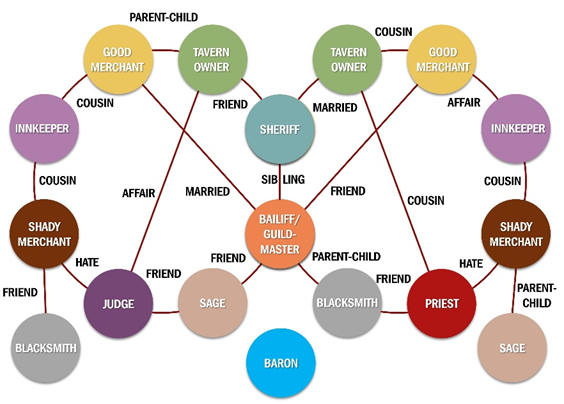
I written about how to populate your city. And don’t forget to add relationships between the various characters. You can find more detail in my post on adding politics to D&D.
 zarban.com