

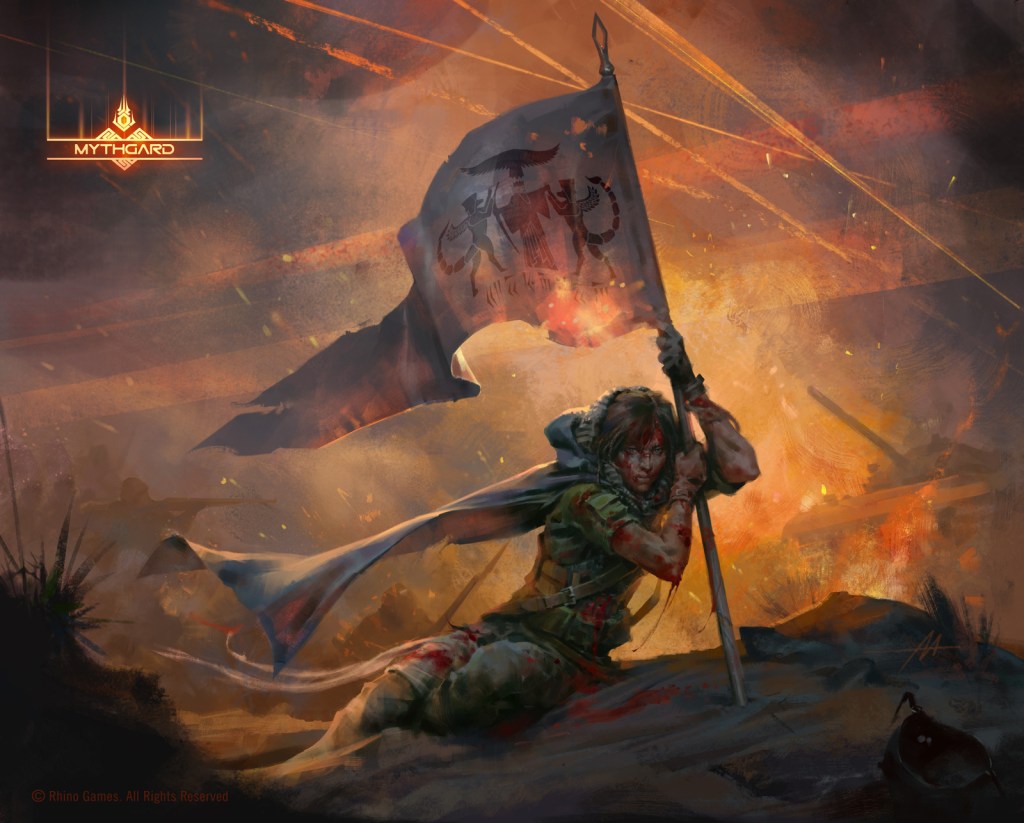
Give your heroes something to be heroic about. A heroic duty is a brief statement of the character’s personal goal, aim, or obligation in life. It should be quite personal. It should take the form of a desire to correct some problem or make up for some past failing. And fulfilling the duty could involve fighting or serving someone, reclaiming or restoring lands, or buying or building something at substantial cost.
This will help them help you to create a bigger world and deeper commitment to it. Not every player character needs a heroic duty, but some players will relish it.
If every character has a heroic duty, you may need to have them cross and/or combine (perhaps two of the heroes are siblings, for example, or one hero wronged another and is making amends). Otherwise, you’ll find the heroes swinging from one to the next with every adventure and never merely pursuing adventure for adventure’s sake.
Pursuing a Duty
When a hero meaningfully pursues this duty, the GM should award a some small token, such as inspiration or luck or a small XP bonus. This includes things like seeking out information, following up on leads, visiting NPCs, and making attempts to fulfill the duty (but not just asking a random NPC if he or she knows anything).
The character should get a clue now and then that advances this subplot–sometimes as a side quest for more detail, woven into a regular adventure. This is not a single adventure but is the character’s personal story or overall arc and might last several adventures before culminating in a revelation or other resolution.
Fulfilling the Duty
Successfully fulfilling the duty should typically win a boon of some sort, such as a level boost or a powerful magic item, depending on how difficult and how much sacrifice is required (in addition to the rewards for the adventure in which you did it).
Fulfilling a duty should never directly benefit the hero (“claim the Mace of Power for myself”, “get revenge on Count Huhl for the wrong he did me”). The heroes are usually clutching at glory for themselves; the heroic duty is a duty to others.
Fulfilling a heroic duty should involve sacrifice and the possibility of disappointment and even failure (which still counts as fulfillment). Perhaps success requires sacrifice: a powerful magic item, large sum of money, or family heirloom.
Even so, it may be that the ancestor’s name can’t be cleared because he was guilty of the offense he was executed for, or a lost artifact can’t be reclaimed because it was destroyed. But maybe solace can be found in rescuing someone else from the fate the loved one suffered. If you want this to be a possibility, decide on a roll for it when fulfillment is near—the GM should not arbitrarily decide the cause is hopeless from the start.
Create heroic duties with requirements, clues, and meaningful outcomes. Some duties, such as debts and enemies, might be fairly straightforward with only one or two steps. Others may require a full investigation, such as…
- The hero must first find out the details of what happened in the past and so must talk to the people who were involved to understand it better.
- That should lead to people who know more about what then happened in the situation or to the victim, culprit, place, or item, some of whom might be culpable in some way and may be reluctant to talk.
- That should then lead to hard evidence—eyewitnesses, letters, court records, ship’s logs, contracts, official reports, etc.—that makes the circumstances clear and provides an idea as to what happened and why.
- Then that should lead to vital information about the whereabouts or final circumstances of the person or item or how the problem of a person or place can be reversed (or that it is a futile endeavor). This is where the player might be asked to roll 1d20 vs difficulty 8 to determine if the long-sought-after answer is sweet, bitter, or (recovery) bittersweet. A bitter outcome may not be the end: revenge may be in order.
Typical Heroic Duties
1. Free a loved one from bondage or an unjust duty
Your loved one was kidnapped, captured in battle, imprisoned, tricked into serving on a ship or in an army, or something similar. It would take determination to track the person down and power, influence, and gold to win their freedom—resources you don’t yet have.
- Perhaps the person was given over to an evil cult and sacrificed or joined and is now a ranking member.
- Perhaps the person was imprisoned and died of a disease or was eventually freed, only to become an outlaw.
- Perhaps the person was too young to remember their old life and is reluctant to leave.
2. Avenge the wrongful death of a loved one or hero
Someone you loved or admired was murdered or wrongfully executed but you don’t know why. Finding and following the clues to their end would be difficult and likely to pit you against powerful forces who think nothing of doing away with troublesome interlopers.
- Perhaps the person was the victim of a political conspiracy due to secret bloodline or inheritance.
- Perhaps the villain continues to engage in similar behavior.
- Perhaps it was all a mistake or a crime of passion, and the villain is racked with guilt.
3. Determine the fate of an ancestor or lost loved one
Your loved one was lost on a journey or adventure or an orphan sent away to live with another family. It would be a long and arduous task to find them, and you would face many dangers along the way, perhaps even uncovering the dark reasons behind it.
- Perhaps the person died on the journey in a way that others needed to cover up, or the person was abandoned or betrayed by companions.
- Perhaps the person died heroically and was buried with honors, finally putting the question to rest.
- Perhaps the orphan was taken in by good people or bad and lived a difficult or comfortable life; and either way the reunion is a happy one.
4. Clear the name of a disgraced ancestor or loved one
Your ancestor or loved one was falsely accused of crimes or ruined by rumors of scandal or betrayal. Proving your own worth would go a long way to shining up the family name, but it would take grit and daring you have not yet earned to pursue the matter to its perilous conclusion.
- Perhaps the accuser stood to profit in some way.
- Perhaps the accusations were wild and unwarranted, and the people involved live with the guilt.
- Perhaps the disgraced was earned, but there were mitigating circumstances.
- Perhaps the rumors were true, and the person was a true scoundrel.
5. Struggle with a determined rival or family enemy
You or your people have a rival or enemy who opposes and hinders you, seemingly at every turn. When you have some hope, they crush it; when you strive for some goal, they oppose it; when you establish some success, they try to tear it down or establish their own.
- Perhaps you developed a rival during your training who matches your successes, sometimes beating you to treasure, and may one day join an enemy organization or villain and come after you directly.
- Perhaps your family has a long feud with another whose scions are a constant thorn in your side.
- Perhaps your organization has developed bad blood with another faction, whose members are forever showing up at inopportune moments and creating complications.
- Perhaps your family has become the enemy of a powerful official or a noble who stands in the way of your rising to influence and power.
6. Repay a great debt or fulfill a heavy obligation
You or your people owes a great debt of some kind, be it money or honor. You must perform tasks or recover treasures to pay it off.
- Perhaps your education and training were funded by a benefactor who now is in dire need of help.
- Perhaps your family has fallen into debt with merchants or a noble, and you must work to capture treasures to pay it back.
- Perhaps your town failed to provide footmen to protect itself from raiders and had to be rescued by the local noble; and now someone must pledge their service to the noble to restore the town’s honor.
- Perhaps your organization failed to stop the great villain from acquiring power, and now its members—including you—feel an obligation to undermine and topple the great villain.
7. Find and reclaim a lost heirloom, artifact, or relic
You have long heard rumors of a lost family treasure or heirloom, or some artifact or relic known to be in someone else’s possession rightfully belongs with your family, town or organization. If it has magical power that you could wield, finding and reclaiming it would take great skill, determination, and heroism that you do not yet have.
- Perhaps it was lost by a family member on a failed journey or adventure and lies where it fell or was carried off by foes.
- Perhaps it was seized by raiders or claimed by a noble.
- Perhaps you find by scrying or divination that it lies at the bottom of the sea or some other difficult place.
- Perhaps it lies in some noble or bishop’s treasury or is carried regularly by them.
- Perhaps you need to collect the broken pieces of an item or scattered items in a set.
8. Reclaim a corrupted wilderness
Some land—such as an overgrown forest, small river valley, or mountain meadow—with importance to your people is overrun with evil people or creatures but could be reclaimed or restored to its natural state. You have a duty or deep desire to do so, but it would take time and determination.
- Perhaps an evil cult took up residence and has ruined it by building fortifications or a temple. They’re too powerful to take on right away, but you look for ways to undermine them and, perhaps one day, defeat them.
- Perhaps some strange monster has made a lair there and is a blight on the land—a dragon, werebeasts, basilisk, undead, etc.
- Perhaps some mage has built a tower there and blighted it, making it more habitable for monstrosities than normal beasts, perhaps even cultivating toxic or meat-eating plants and other dangers.
- Perhaps it is a formerly settled land overrun with monsters and bandits since a plague caused it to collapse. Its towns, abbeys, and castles were slowly abandoned and fell into ruin. But a dedicated effort to clear it could reclaim it for peaceful people.
- Perhaps it is a rocky or mountainous highland where giants or trolls have long reigned. But if it were tamed, it would allow trade with neighboring peoples and stop incursions by the hungry creatures.
9. Restore an abandoned ruin
Some particular location or structure with some importance to you or your people was once a useful and thriving place but fell into disuse for some reason. Restoring it would bring back prosperous days to your people and/or glory to your religion. But it is far too dangerous for a few inexperienced fellows; it would take a hearty company of veterans.
- Perhaps it an ancient palace that was destroyed when the last of the Old Empire pulled out or collapsed. Restored, it would make a beautiful town or a grand castle. But it would need to be rebuilt after being cleared of dangerous beasts.
- Perhaps it is an old abbey or cathedral, destroyed by raiders or by a rival religion, and reviving it would bring renewed faith among your people in the true way. But infernal creatures have taken residence…
- Perhaps it is a ruined villa of the Old Empire, a great library, or mountain fortress that saw fire or other disaster. Parts could be contain treasures lost or abandoned in the disaster, things that would renew this shire and return it to prominence. But an evil lurks within and may even spring from a portal to a dark underworld.
Specific Examples
A Sister’s Fate
- Growing up, you knew you lost an older sister in a raid on the town, but your family was always tight-lipped about what exactly happened. Fresh from your initial successes at adventuring, you ask about this hole in your life. Your parents say that they were away in a neighboring town that day, but your uncle, who lives in another town, is sure to know more, for he was there.
- Your ailing uncle is reluctant, but he tells you of the day the Coastal Raiders attacked and captured the town by stealth before the gates could be shut. They were led by a beast of a man named Harkuk the Brazen, who wielded a cutlass that could set fires. He demanded valuables and prisoners and took your sister along with several others. So your sister wasn’t killed but rather kidnapped. The sheriff was alerted to the raid, but nothing came of her investigation; however, she may know more.
- The sheriff remembers it well. Harkuk was a known brigand and pirate, and his ship, the Dancing Bones, still stalks the coast, altho the coastal raids are rare now that the raiders have had close calls with a force determined to stop them. And Harkuk himself is dead: killed with his own flaming cutlass by a woman of his crew. The new captain is Rasheel Corness—a terror of a woman—and the Dancing Bones is rumored to lie in port at Cavot Rock for repairs.
- In Cavot Rock, you find a man who knows the Dancing Bones, old Garzon. According to him, your sister is now among the crew of the Dancing Bones: half-captive, half-pirate, and right now ashore at one of Cavot Rock’s notorious inns. She can be rescued with effort, if assured her family will accept her back. But to be sure, Rasheel Corness and her fiery sword will stand in the way. And the man who will put her onto your plan is old Garzon, AKA Harkuk the Brazen, AKA Harkuk Corness—past his prime and nursing a bad leg from the injury his own daughter Rasheel once gave him.
The Blood Debt
- In your youth, you knew your father, uncle, and their cousin to be a mighty hunters in the great wilderness not so far away. But more than pelts, they brought back the corpses of werewolves, something your family has done since the infamous Gray Beast rampaged across the county as payment for some debt. They never shared the details, because they had hoped to finish without involving you, but now that the “dire cough” has taken them, it’s left to you to slay four werewolves. When you’ve killed your first, your mother sends you to the patriarch in the city.
- Patriarch Lindus tests and registers the corpse and has it taken away to be buried at a crossroads. Then you learn from him that the infamous Gray Beast of Dugborn was your own great-grandfather, Golblac of Dugby, who took 19 innocent lives. The folk of your family brought in 15—and now 16 werewolves; it’s your blood debt to find, slay, and bring to the patriarch the remaining 3. The steady installments staved off a curse that hangs over your family line, placed by the Manbeast Pursuivant, the church’s officer tasked with destroying lycanthropes. When you bring in your second werewolf, the patriarch will send you to the current Manbeast Pursuivant, Matriarch Eldima for a reward.
- Matriarch Eldima congratulates you on your courage and shows you the documents of the trial of your great-grandfather and some of the details of his victims and how he lied, hid, murdered, and ultimately cowered before the pursuivant’s champions. They show how your grandfather protested the curse that the pursuivant of the time put on the family line, and how the pursuivant relented, belaying the curse if the debt of 19 innocents were repaid with 19 werewolves. If you default, all the surviving members of your family will suffer the curse and die of the righteous fire from within. For the courage you have shown, she offers you a token enchanted item to help you on your quest.
- When you bring in the fourth and final werewolf, Matriarch Eldima represents you before the Grand Council of Nine, of which she is one. This council declares the debt repaid and that, if you go on a pilgrimage to the Fountain of Perfection, your family’s bloodline will be washed clean, the curse lifted, and a great boon delivered: a wondrous magic item offered to you in a vision. She asks if you might be willing to continue on as her new champion, fighting beastfolk across the realm (eventually earning lands and titles).
Birthright of the Sabertooth Clan
- In your youth, you recall the old shaman using the ancient sabertooth that was the totem of your wildkin clan in ceremonies and once even calling upon it in battle with raiders from a rival clan. But a sneak-thief stole it away one night; and, ever since, your clan has suffered. When you speak to the young shaman, he assures you the totem is out there, and so you came into the warm lowlands in search of it–and of fortune and glory. Your only clue: a wildkin hero of the boar clan is said to wear it.
- Everywhere you travel, you ask about a beardless, golden-haired barbarian with sabertooth around his neck. Usually, you learn nothing; but sometimes, you learn of some deed–or misdeed–of the reckless warrior… and his sneak-thief companion.
- One day, you hear a troubadour sing a song about the golden-haired wildkin and his raven-haired woman, who ride astride a great saber-toothed panther and a great boar and who slew a sorceress, a firedrake, and a death knight… and who set up in a wooden hill fort on the edge of the ancient Blacktimber Forest with the blessing of the queen. Their names: Hargeld the Golden and Idrisora Blackcat.
- Admirers and peasants who work their land can tell more–as can the couple themselves, if care is taken in the introduction. She, it’s said, was caught stealing by him while still a girl and tamed from her wild ways of thievery and witchcraft. And together they amassed fortune and glory… and a raven-haired boy-child. If you confront them, they may react badly, as Hargeld knows nothing of the origin of the sabertooth, but he will not want to relinquish it, since its magic is helpful and gained him his great cat companion. Idrisora (a rogue who dabbles in magic) is unapologetic, as her hard-scrabble life required her to steal to survive, but she would prefer for Hargeld not know the valued totem remains sacred to another clan of wildkin. One or both may offer gold or other treasure to replace it but would be hard-pressed to relinquish it.
 zarban.com
Leave a comment