

Awhile back, I wrote about what jobs were done by various people who lived in towns. In it, I mentioned that many townsfolk would actually have been peasants who tended fields around the town. After all, why build extra villages for them to live in when the town is right there, with its nice, safe walls?
As I’ve mentioned before, villages existed to support manors and their fields (and their lords). And, being without walls, villages relied on the fortified manor house to protect them if invaders (or neighbors) attacked–or, in a fantasy setting, monsters.
The Background
Various scholars tell us that 90% of people in the Middle Ages were agricultural workers (or, at least, lived in an agricultural worker’s household). So it took nine peasants to support each burgher, clergyman, and noble. Burghers included tradesmen, craftsmen, and merchants (all of whom were in the merchant guild).
We also know that a manor was anywhere from 900 to 2000 acres, depending on the quality of the land. There are almost 20,000 acres in a 6-mile hex, so an average of 1325 acres per manor gives us an average of 15 manors per hex. Happily, that’s a number that’s confirmed by counting manors in old maps.
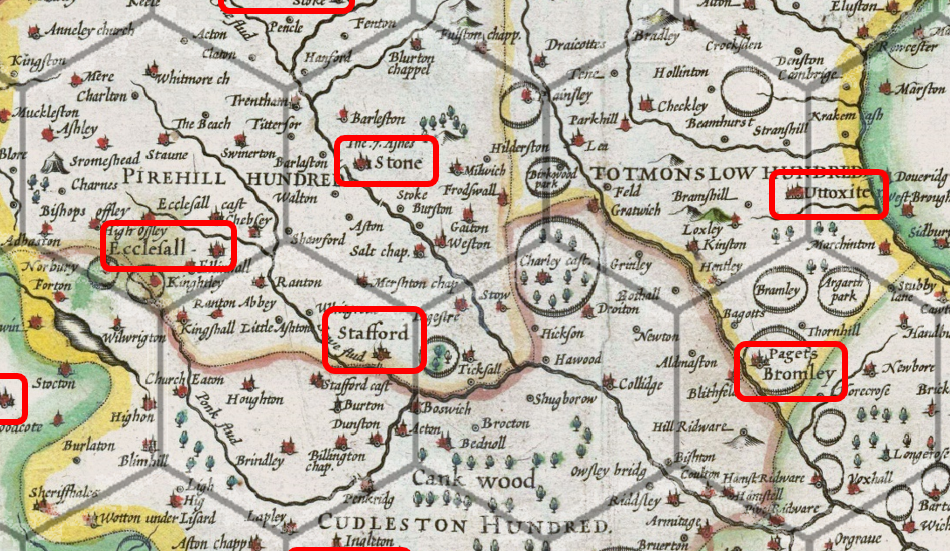
Now, we’re also told by scholars (and confirmed in other ways✴) that a manor’s village would be anywhere from 50 to 150 souls, so we’ll use 100 as an average. Now we know that each hex of manors contains about 1500 peasants (15 manors of 100 peasants) tending fields and livestock to feed the realm. Each would also be home to the household in the manor house, which might (if the lord lived on that manor and not at some other) include the lord’s family, his bailiff, several servants, and a handful of rotating men-at-arms serving a brief period each year from the lord’s lands.
✴A modern family farm in the 1800s was commonly 140 acres, and families would often be 10 people; Amish families, which don’t use tractors or combines, are still that big. So it’s no surprise that a medieval manor of 1400 acres would need 100 people to work it.
Since it took 9 peasants to support 1 guildsman, a town of 300 might 2700 peasants to support it. But surely some of the townsfolk would work the fields and tend livestock around the town in place of villagers. So we can estimate that it would take 20 manors to support such a town, or 1.3 hexes of manors.
This all matches the old maps that show a town in about 75% of 6-mile hexes (which is to say, I adjusted the ratio of peasants-to-guildsmen to make it square with the maps). The other 25% are hexes without towns, and they’re needed to support the cities, which ranged from 2000 to 10,000 people, except for London, which was 30-50,000. (However, some of that 25% was also things like a royal forest, such as Sherwood Forest or, on the map above, Cank Wood, today Cannock Chase nature preserve.)
Demographics
This allows us to think about the demographics of a medieval town. In this scenario, a town has just 300 people. Many of them (75?) are free peasant laborers who do part-time work at a trade, such as thatching, plastering, and painting. But at certain times of the year they go into the country as plowmen, sheep-shearers, ditchers, or just extra harvest labor.
The remaining 225 or so are guildsmen who provide all the specialized labor and products of a pre-modern society–the shoes, the cloth, the furniture, and such. Now, those numbers includes the whole household, so it’s probably more like 45 households of a father, mother, and three children, apprentices, and/or servants. Obviously, not every town could have even one of every type of craft worker. For more selection and finer crafts, the heroes will have to go to a city.
A city probably had a higher percentage of guildsmen. A lot of fine craftswork–your glaziers, your luthiers, your carriage-makers–would be limited to cities, and they often had several guildsmen of a given craft in the same street. So bards will have little luck buying their lutes and violins in a town of 300. In fact, there might only be several luthiers in the region–and all in a couple of towns.

 zarban.com
Leave a comment