


I wrote previously about many types of puzzles, but I didn’t cover logic puzzles. These are tricky to implement in an RPG, because they are–or at least seem–very open ended.
And keep in mind that puzzles of all kinds are easier and more fun when you’re in the mood and choose to work on them than when they are thrust upon you as an obstacle to your real goal, so keep them simple.
Logic Puzzles are normally presented on paper as stories with a pat collection of clues. In video games & RPGs, they usually take the form of mysteries, where clues are gathered to find the solution.
They are rather rare in video games & RPGs, because the players typically don’t think to write down the clues in a way (such as a grid) that makes it easy to see their relationships.
You can find logic puzzles at Puzzle Baron and at Aha! Puzzles.

Since it’s not obvious when they have enough clues to reason out the answer, the players will likely just keep trying to gather clues until the solution becomes obvious.
You can avoid this by having an NPC give the clues to the heroes, saying they’ve been told by divine authority that the clues they’ve gathered are all that’s needed to find the solution. Or an NPC can say that this information was enough for someone else to get the right answer. But if you don’t also give them a grid (by divine vision), they’ll likely struggle more than you want, unless the puzzle is especially easy.
Example: The Bell of Godurr
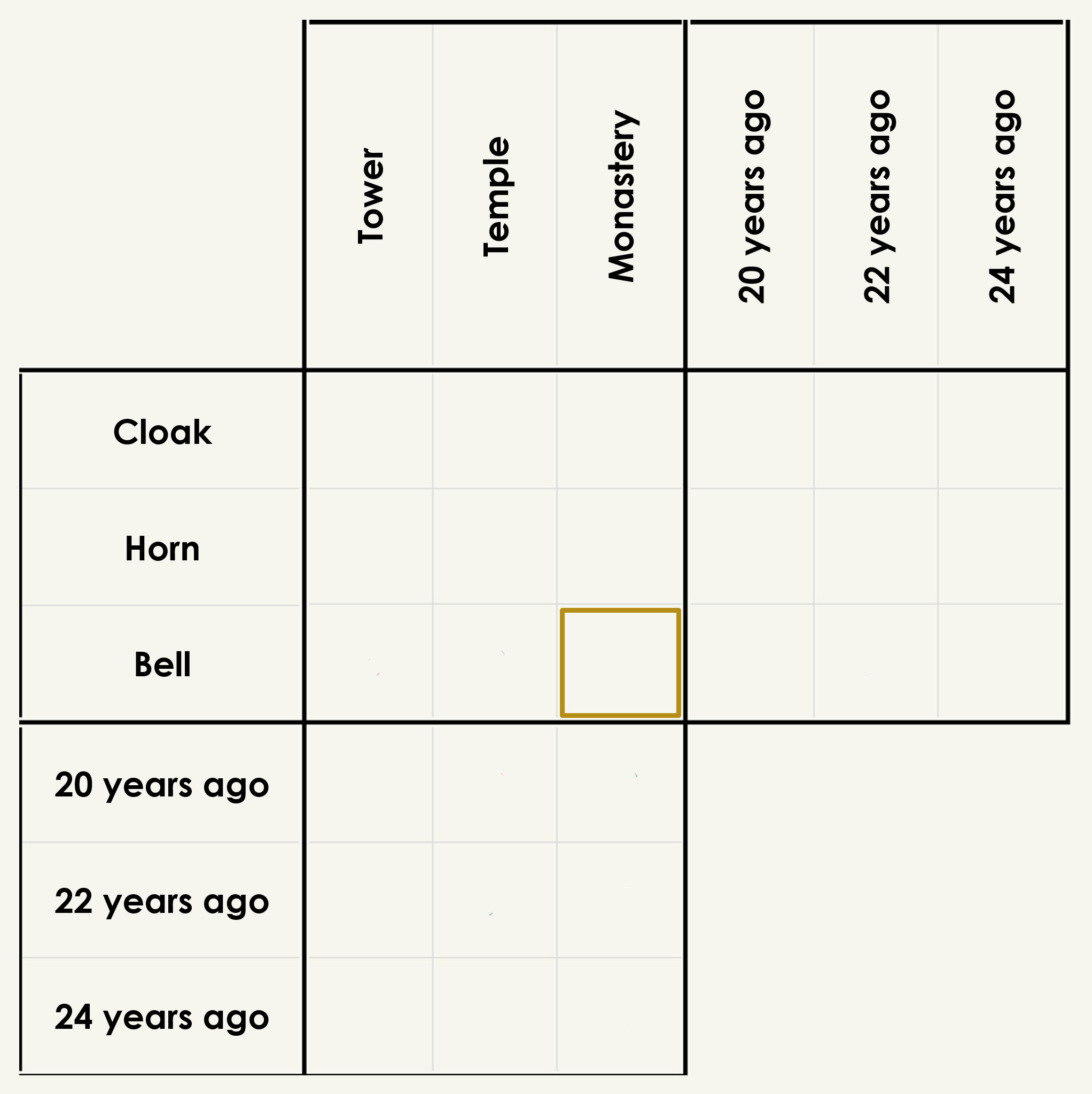
The sages have scoured the archives for references to three artifacts lost during the Time of Troubles a generation ago. The priests are most interested in locating the Bell of Godurr, which the Oracle on High has said can be located using these clues:
- The three lost artifacts are the Bell of Godurr, the Cloak of Hamsel, and the Horn of Nyal, which were all lost a little over 20 years ago.
- The three artifacts are known to have been lost in the Temple of Boughor, the Monastery of Chrum, and the Tower of Dinar.
- The Horn was not left in the Monastery.
- The first of the artifacts to be lost was left in the Tower.
- The Bell was not lost first.
- The Horn was lost second of the three.

If they struggle, offer the cleric a divine vision of a spider spinning a web that happens to look like this grid but blank.
Zebra Puzzles
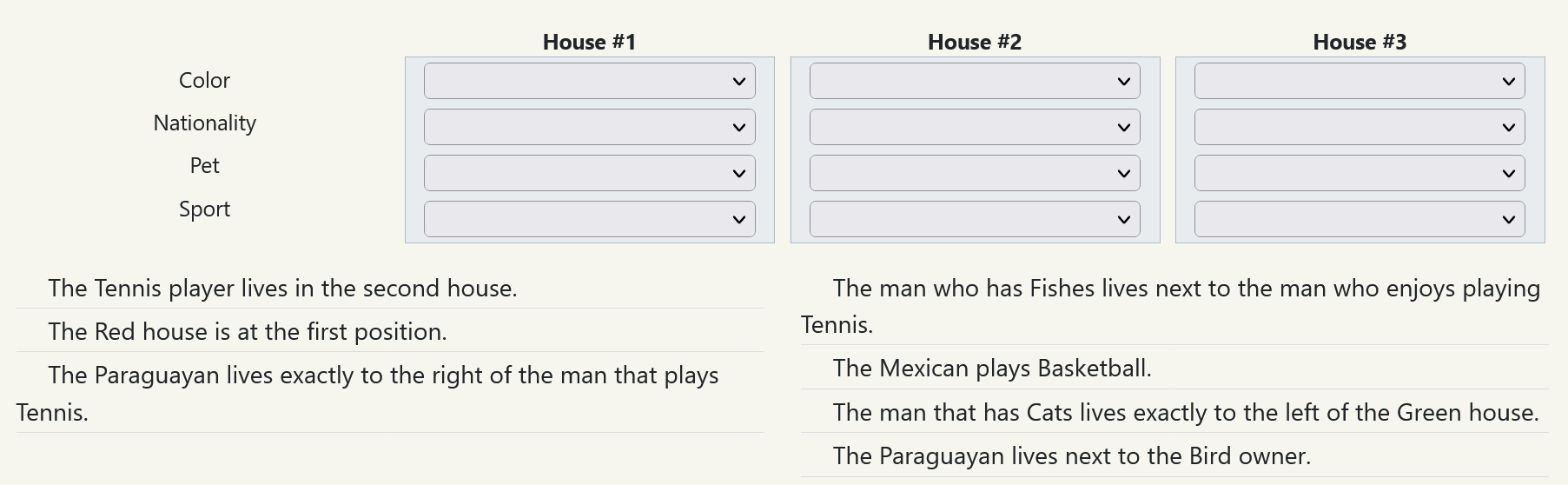
Another type of logic puzzle is called a “zebra puzzle” because its first version asked “Who owns the zebra?” This type is easier to work without a grid being given to you, because players will naturally create columns for clues about each house in order.
Logic Equations
Altho sounding difficult, these can be quite basic. A number of things must be ranked, and a few equations tell us what ranking each one must have.
Example: The Rank of Abbots
In this example from Aha! Puzzles again, we see the solution. We start by seeing that B+C must be greater than 6. The only way that can be is if one is 3 and the other 4. Then we see that C must be greater than D+2. If D is even just 1, then D+2 is 3, so C can only be 4 to be greater than that. Now we know that C is 4, D is 1, so B (which we established can only be 3 or 4) must be 3, and–by process of elimination, A must be 2.

In an adventure, change A, B, C, and D to something relevant, like the names of former high priests of the temple (Avold, Barcon, Corvin, and Deganis), so the task requires the players to identify their length of service in alphabetical order, using the little equations as clues. The clues can be found somewhere else, and the fact that the clues mention the same names as in the puzzle will prompt the players into realizing their importance. Another clue is the grid with holes for inserting your fingers to indicate the answers.
- The high priests’ lengths of service were all between 1 and 4, and none were the same.
- Barcon and Corvin combined served more than six years.
- Corvin served more than two years longer than Deganis.
Puzzling this out gives us Avold as 2, Barcon as 3, Corvin as 4, and Deganis as 1. Therefore, the passcode for a secret door or vault is “2-3-4-1” or “Deganis, Arvold, Barcon, Corvin”, depending on the nature of the code entry device.
Process of Elimination
The heart of logic puzzles is a process of elimination: which thing is matched to which other thing and which is excluded from that thing? You can just make a very basic logic puzzle out of this. One clue rules out suspect A; another clue rules out suspect B; therefore, the perpetrator must be suspect C.
In practice, you need to provide two or even three clues that rule out A and another two or three that rule out B, because the heroes won’t think to search all the places you thought were obvious and therefore won’t find all the clues.
This very basic sort of logic puzzle is nonetheless very satisfying for players to discover and solve on their own with all the noise inherent in an adventure.
 zarban.com
Leave a comment