


The heroes must explore a ruined castle to find a lost treasure. This adventure is for a mid-level company of adventurers. Note that only ten or so out of 22 rooms have monsters, clues, or other items of interest. This is meant to create a feeling of ruin and spooky emptiness.
The Lost Barony of Iber
There are rumors that a treasure remains hidden in the ruins of Castle Cuar [KWAHR], a fortified manor house that was once home to the Baron Iber [EYE-ber]. Fourteen years ago, the baron lost a dispute with another nobleman, and the entire family died in the siege. Castle Cuar was destroyed, and—lacking an heir—the land was escheated back to the king, who keeps the revenue from the fields but did not rebuild the castle or create a new Baron Iber.
It’s a small castle that began as a manorial hall that was added onto. There were windows in many rooms, but they were mostly bricked up (leaving space for defenders to shoot bows) when the occupants prepared for war. Nevertheless, the castle fell by fire.
You can make the ruins more gruesome, if it fits your style, by including blood stains and more skeletons among the roof rubble. Otherwise, the villagers buried the bodies, but they didn’t dare break into the chapel.
The Village
The village of Cuar is a community of 78 people, including a blacksmith and a baker. Shepherds bring their sheep to graze the area around the castle, including the bailey within the curtain wall, but do not go to the house for fear of monsters. They say lights sometimes shine in there at night.
An older villager can relate a little about the attacks that finally destroyed the castle. Lord Iber and another baron, Lord Hensey, had a dispute over an orchard on their adjoining manors, and Lord Hensey gathered knights and men-at-arms to lay siege to Castle Cuar to force Iber to capitulate, but Iber held out until the castle was set ablaze, and the whole household perished. The only survivor was a small boy servant (see The Fate of Master Raner below), carried off to Hensey Manor. Hensey’s thugs were callous but not daring enough to break into the chapel for fear of being cursed.
The king rebuked Hensey, who paid a royal fine that included the orchard.
The Castle Ruins
The low curtain wall (7 feet high on the outside, 4 feet on the inside) stands about 60 feet away from the front of the castle and quite close at the back, right up to the garden. It has no towers, and the front and back gates were torn down in the battle.
The roofs of the castle are collapsed but were partially cleared away by the besiegers searching for valuables; this leaves the floors partly covered in burnt debris and roof tiles, except on the east side, as noted in the rooms. Some gargoyles remain at the top of some walls; some are fallen and overgrown. If any hero flies or climbs on to the top of the ruined walls, a guardian gargoyle will confront them.
- The guardian gargoyle is neutrally aligned and takes up residence at a ruin as its domain. It’s intelligent enough to know the hero is not competition for food, so it may be persuaded to let them pass. It wants to eat the umber hulk under the castle of the main hall (3) but hasn’t caught it out in the open yet.
The doors are broken and/or burnt, except where noted. Some rooms have fireplaces and leaded-glass windows that are not shown; the windows are largely bricked up, but, looking out toward the garden (20), the heroes might catch fleeting glimpses of a large, pale figure among the overgrown hedges.
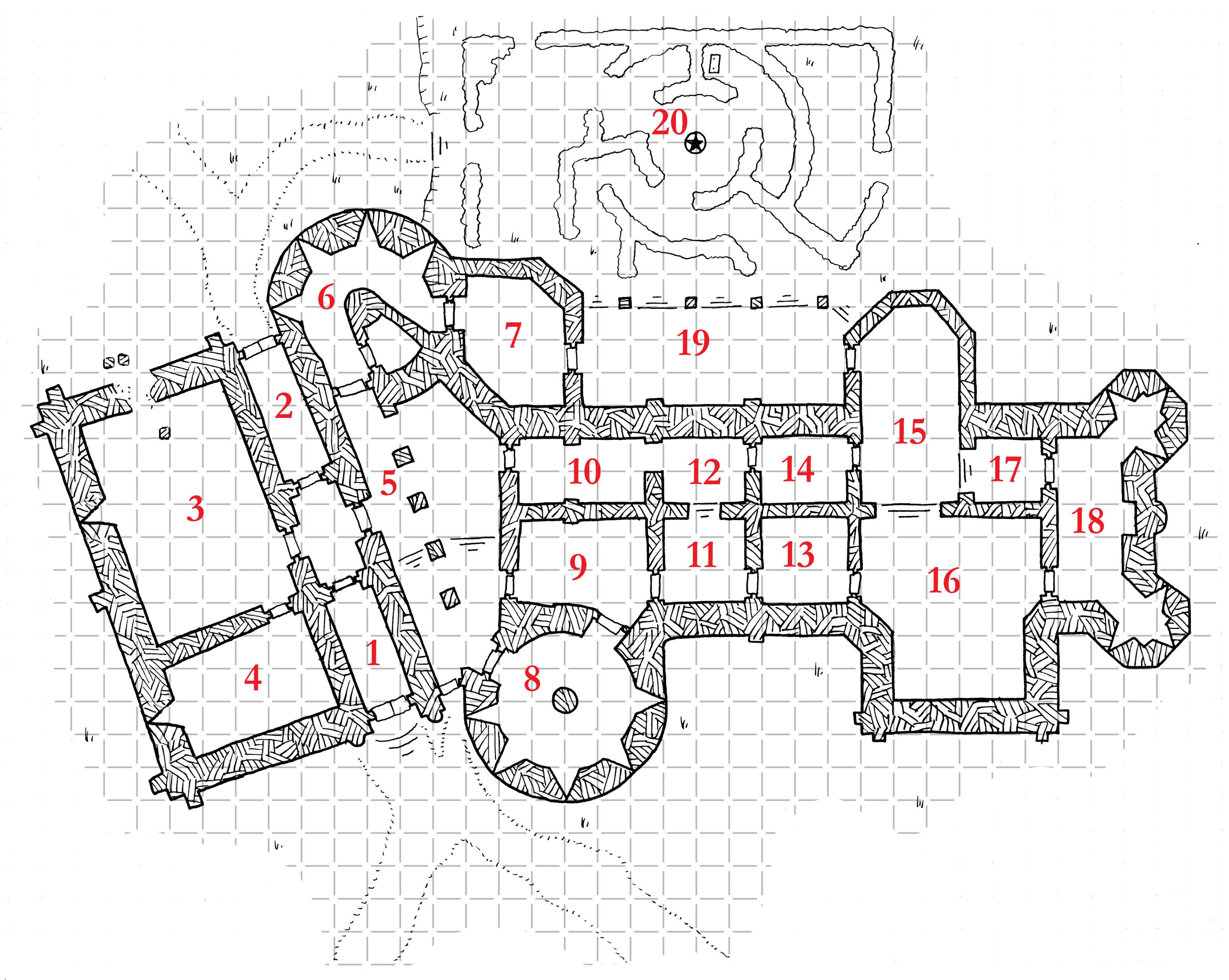
- Entrance Hall: Empty and open. Leaves litter the floor.
- Rear Hall: The doors are intact but open.
- Main Hall: Tattered tapestries with hunting and garden scenes hang here. Fireplace. The north wall has tumbled down due to undermining in the siege. Sizeable hole.
- An umber hulk lives in the tunnel below. If the heroes descend, it will move into a niche where it’s hard to spot (difficulty 18) then spring on prey.
- Otherwise, when the party makes substantial noise, it will climb out and move to ambush unarmored heroes. The guardian gargoyle that lives on the roof might swoop in to attack it.
- Drawing Room: Empty and bare but for roof debris. Fireplace. Protected by the roof debris is a fine cloak, altho a bit dirty; probably the baron’s.
- Under the cloak, dirty but not damaged, is a large, fine oval mirror; this is a portal mirror. An inscription says “Speak my name and pass”.
- If the command word “Clanham” is spoken, you can push your hand or other item thru the glass; it emerges wet, as the other end is a small pond in the woods not far away. The command word is in a document in the counting room (13) and also will become visible if Detect Magic is cast on the mirror.
- A search of the pond will reveal a locked coffer containing the Iber family jewelry, worth 3000 gp.
- Entrance Hall: Empty but for the debris of wrecked furnishings.
- The simple fireplace suggests this was originally the kitchens and that everything east was added onto the original structure (1-5).
- Rear Tower: The floors above have fallen in. The door to a little storeroom is blocked by debris. It contains many arrows, but only a dozen are usable.
- Kitchen: Fireplace. Window. Various kitchen utensils are among the debris.
- Front Tower: Empty. The floors above have fallen in.
- Armory: The roof is largely intact here, altho there is a hole. A few weapons and armor lie scattered among the debris, all badly rusted.
- Pantry: Shelves contain various dining service items (cup and plate, utensils). The remains of food containers are scattered on the floor along with debris, but the roof is largely intact here, so debris only barely conceals a trap door.
- Larder: A trap door with a ladder-stair leads down to the 10×10-foot cellar. There appears to be a pile of refuse and possibly human remains, but it is actually a gibbering mouther that has been surviving on moldy food and vermin and is hungry for a new meal. If the heroes make enough noise, it will have already turned the dirt floor to quicksand everywhere except immediately around the ladder.
- There are empty barrels and shelves, except for one smallish barrel (about 13 gallons) with a leather-sealed lid: a cask of keeping, containing bread and fruit in perfect condition. It keeps items as fresh for decades. A piece of roast beef is wrapped in parchment that says: “Gomas, fill the cask of keeping with foodstuffs in case our enemies return. It will keep in there for as long as necessary.”
- Day Chamber: Window. Fireplace. Comfortable furniture in ruins. In a broken cabinet is a hooded lantern. It’s a lantern of endless light, which sheds light in a 30-foot cone.
- Antechamber: Window. Empty. Evidence that paintings once hung on the walls.
- Counting Room: Window. Fireplace; a false stone conceals the signet ring of the baron and blue sealing wax. Burned furniture and ruined documents.
- Some seem to be letters and notes about the siege, noting “Seven dead. How much longer…” and similar dire details (answering any questions about how the castle was destroyed that the players may have).
- There is a map of the castle that includes the crypt but doesn’t indicate how to get to it.
- One mentions the use of the portal mirror “Clanham” to send a messenger for aid, but he was captured “exiting the pond” and killed in view of the castle. They decided not to try to use the mirror to try to escape.
- Bedchamber: Window. Fireplace. Empty but for remnants of two children’s beds. Under the bed there is a brainteaser puzzle, but it isn’t magical, and solving it reveals nothing; it’s a child’s toy. (However, see The Fate of Master Raner, below.) A wardrobe hides the old, disused door (locked) to 15.
- Master Bedchamber: Window. Fireplace. Partial roof. Remnants of a fine four-poster bed and empty clothes chests. A comfortable chair, a close stool, and even the lady’s embroidery remain.
- Some small objects of value remain hidden under the floorboards (200 gp), along with some letters to Lady Iber. The content of the letters is trivial but includes mention of her children, Diobe [dye-OH-bee] and Raner [RAIN-er], including hope of finding magic “to repair little Raner’s malformed ear”.
- Concealed in the close stool, in place of the usual bucket, is a burlap sack containing the baron’s jewelry box, decorated with hunting scenes, empty but worth 50 gp.
- Private Hall: Window. Fireplace. Partial roof. A large, ornate table is covered in debris and char. The door to 18 is locked and covered in webs (see 17). The doors at the steps to 15 were battered and torn off their hinges and lie here.
- Among the debris is a skull, but it’s not from the siege. It is labeled “Thorbur, defeated at the Battle of Dol River”.
- There is also a charcoal portrait of little Master Raner, the baron’s son, who has a malformed ear. A note attached says “Master Artist, please do another that hides the poor lad’s bad ear.” (Good evidence for later; see The Fate of Master Raner, below.)
- Antechamber: Window. The roof here is intact. The fine rug is moldy and darkly stained. The door to 18 is locked.
- There are two phase spiders hiding among the rafters, ready for prey. They will web the doorway to divide the party and attack from behind, preferring unarmored characters.
- Chapel: Stained-glass windows. Fireplace. The roof here is intact, so the room is not accessible but thru the doors, leaving the room musty but weirdly almost untouched by time. An altar remains, along with tarnished silver religious ornaments (25 gp) atop a cabinet.
- The ghost of the chaplain is here; it tends to look out the loopholes, where the chaplain was killed by a lucky arrow in the battle—his skeleton remains, with an arrow in the eye socket. It will jealously guard the cabinet, which is locked; but it can be distracted by messing with the skeleton or a chest of the chaplain’s belongings at the south end of the room (he slept in the chapel). Its spirit anchor is a silver locket (5 gp) in the chaplain’s chest.
- The cabinet is empty, except for a single page of moldy parchment that says “My Lord & Lady Iber— If I should die here, know this: I have used divine favor to help little Master Raner escape outside, disguised as a servant boy. May the gods protect him.” See The Fate of Master Raner, below, for how to console the ghost.
- Concealed under the cabinet is a trap door and staircase down to the crypt (see The Iber Crypt, below).
- Portico: The roof is largely intact here. It didn’t catch fire.
- Garden: A fountain still bubbles in the center, fed by a clean spring. A majestic but skittish unicorn buck grazes. If not approached carefully, he will defend his little domain. If treated well, he will escort the heroes to the chapel window and indicate it as the location of the treasure, altho he is unable to speak to explain.
- If the unicorn is run off or killed, creeping vines will attack from all around; they were previously cowed by the presence of the unicorn. Among the other plants here is a fire-rose bush; if one of its beautiful red-and-orange blossoms is plucked, one round later, it explodes for 1d4 hp fire damage.
- Also, there is a rotting wooden marker here on the mass grave where the Iber household was buried.
The Iber Crypt
The crypt is two rooms separated by a door. In the first, four chests sit along the wall, all locked. Each contains a mix of human bones. This is the ossuary, where the remains of various family members are interred after they are removed from the coffins when the flesh has decayed. However, one chest includes remains that appear more hastily added (to make room for Diobe’s corpse in a sarcophagus). The door to the second room is locked. Attempting to open the door triggers a glyph of warding that creates 4 spirit guardians to guard the doorway. They will let good-aligned creatures pass, if approached peacefully; attack neutral ones if they attempt to pass; and immediately attack evil ones (2d6 hp damage or save for half).
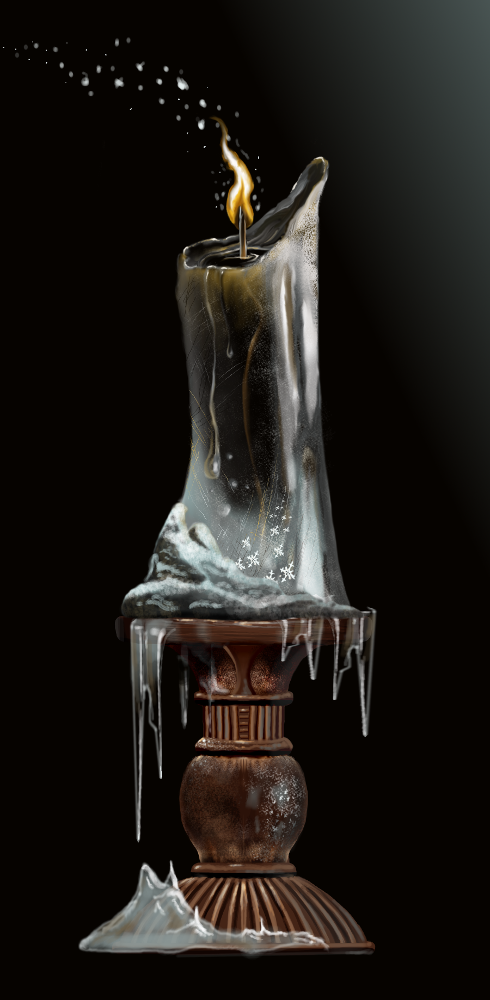
In the second room, six stone sarcophaguses sit on stone pedestals; the smell of death is noticeable. All are sealed with lead except one. In that coffin is 4000 gp in gold and silver ornaments and coins and a candle of discovery (see below). The sealed coffins contain the remains of older Iber family not yet removed to the ossuary (including young Diobe, who died before the siege and is a gruesome mass of stinking, putrid remains). The baron and baroness and members of the household are not here; they were buried in the garden in a mass grave. They have modest jewelry, but looting graves of good people is an evil act.
If the adventure has been a bit light on trouble, one of the dead might be a wight, its coffin marked with a reminder (but not an explicit warning).
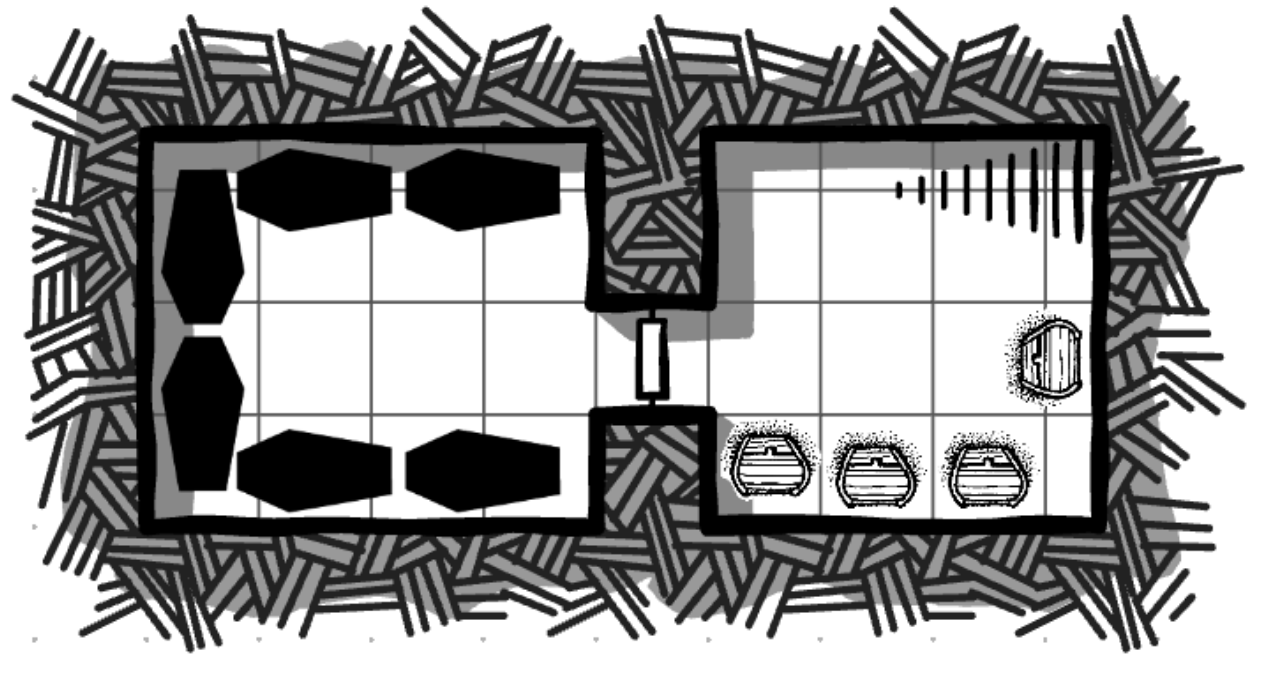
Candle of Discovery: When lit in darkness, one of these candles will illuminate a 10-foot diameter area and reveal anything deliberately hidden, including secret doors and traps as well as invisible creatures and such. Each candle lasts one hour but may be extinguished at anytime to save its use. They blow out as any normal candle.
The Fate of Master Raner
If the players gather the clues, they may realize that little Raner, the baron’s son, escaped in disguise and was captured by Lord Hensey as the only survivor, thought to be a servant. Fourteen years later, he is an 18-year-old garrison sergeant (4th lvl fighter) in the Hensey household who is known as Redrick, and has only dim memories of his real identity. He may be identified by his malformed ear (mentioned in Lady Iber’s letter) and confirmed by some old residents of the village or his ability to solve the brainteaser puzzle in 14 or—best of all—the charcoal portrait in 16.
In theory, the heroes could help Raner regain the barony as a later adventure (taking his plight to the king). But just figuring out that Raner might still be alive is enough to give solace to the ghost of the chaplain and cause it to pass on. In the meantime, Redrick/Raner might join the adventurers with the heroic duty of one day regaining his birthright.
Adding Elements
Additional elements could include:
- A giant snake in the overgrown bailey inside the curtain wall.
- A pixie in the garden (20), who will explain a little about the unicorn, albeit in condescending tones. If a hero ends up at the pond at night, a pixie will be there, contemplating how to get the box out of the pond without getting, claiming ownership, threatening the hero, offering a “fairy kiss” that “grants your fondest desire”, etc.—all nonsense.
- A roper disguised as the top of a broken column in the kitchen (5).
- An abandoned stable, dog kennel, and/or dove cote inside the curtain wall, which might contain a random monster, such as some rust monsters or at least harmless bats.
- A druid who lives nearby, warning the heroes not to proceed and possibly attacking if they become hostile. This should allow for the possibility of the heroes talking the druid into letting them explore with respect rather than loot the place.
If this adventure is used to give one of the heroes a magic weapon (because the character heard rumors about it being lost here, had a religious vision after a substantial donation to their faith, etc.), it can be hidden in the counting room (13) or chapel (18).
For a higher-level party, you might add monsters and expand the crypt to raise the difficulty of the adventure. Then the king might offer to gift Castle Cuar to the heroes as their reward while Raner (if he’s identified) takes over the Hensey land as both Baron Iber and Baron Hensey. One of the heroes would then become the lord of Cuar Manor.
If the heroes discover the pond in the woods via the portal mirror, you might add something there, such as a tomb or shrine or druid’s cottage.

 zarban.com
Leave a comment