

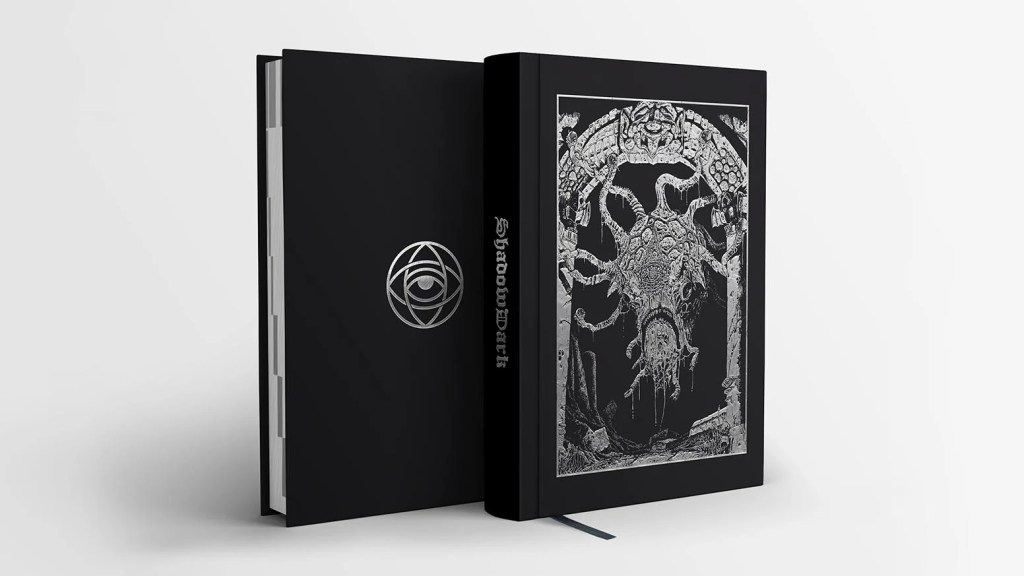
I’m reviewing various fantasy RPG systems for what I like and don’t like. I haven’t played most of them, so I’m mainly reviewing the ideas so I can remind myself later which games had which features. I’m starting here in part because Shadowdark just won four gold Ennies, including Product of the Year at GenCon 2024.
Shadowdark is a traditional, old-school RPG with simplified modern mechanics by Kelsey Dionne. It’s well written and exceptionally well laid out. Those who have played it report that it’s fast and rather brutal, but many miss some of the robustness of modern D&D. Find the quick-start PDF here.
My opinion of this and other fantasy RPGs is colored by my experiences with B, X, 1e, and especially 2e in the 1980s and ’90s, when I played extensively, and somewhat by my more modest experience with 5e.
Basics
You can get advantage and disadvantage, as in modern D&D.
You can get a “luck token” as a reward from the GM and use it to reroll a die roll. Only one token at any time, like heroic inspiration in modern D&D.
Alignment is just chaotic, lawful, and neutral, like B/X D&D, which I always thought was an odd choice over good and evil.
There are no rules for retainers, which bothers some people, but not me. I can negotiate pay for retainers easily enough.
Classes
Fighter, Priest, Thief, Wizard. Certainly simple, but not much variety. Spellcasters get new spells as they advance. Spells go to 5 “tiers”, like spell levels in D&D. Wizards and clerics don’t have spell slots; they have to make spell checks, which can limit them and cause them problems.

Levels top out at 10. Leveling up is the same for all, by experience points; linear progression to 100 XP to get to 10th level. Leveling up gets you hit points (kept low, like BX D&D) and a talent (class feature) every odd level.
There are additional classes available in a series of supplements called Curse Scrolls. These are rather brilliant combinations of additional classes, spells, monsters, and adventures specific to a new setting.
Ancestries
Dwarf, Elf, Goblin, Halfling, Half-orc, and Human. Personally, I’ve never understood the idea behind playing a monster (goblin, half-orc) but not being a monster (a creature that eats people). But of all the monster types, half-orc and goblin are probably the most popular.
Your ancestry gives you one trait. For example, dwarves get +2 hp and roll hp gains with advantage. Humans get one additional talent roll (class feature) at the start. No ancestry gets anything similar to darkvision.
Abilities
Strength, Dexterity, Constitution, Intelligence, Wisdom, and Charisma. Indexed from 3 to 18 for humans, rolled 3d6 in order and giving modifiers of -4 to +4 for ability checks.
Your constitution bonus only gives you more hit points at first level. Even more oddly, your strength bonus does not apply to damage. The idea here is clearly to compress hit points and damage to keep play at similar level for longer. Unfortunately, I think that means low-level play rather than mid-level play most gamers consider the sweet spot.
Skills
There’s no skill system, per se, but thieves, for example get “tasks” they’re good at (the usual thief skills).
You make a d20, roll-high, check against a GM-set “difficulty class” using the modifier from your various ability scores for things like bending prison bars, scaling a wall, holding your breath, or spotting a hidden enemy. I don’t know who in the world ever used the bend bars/lift gates rolls in an old D&D game, so it’s wacky to see it here in a game that otherwise strips out the nonsense.
Combat
Heroes and GM (highest-dexterity monster) make a dexterity check for initiative; highest goes first, then it’s clockwise (presumably with the GM alternating between the heroes).
Roll 1d20 and add modifiers for attack against the opponent’s (ascending) armor class, as in modern D&D. A natural 20 is a critical hit; for weapons, this is double the damage dice.
Damage & Healing
If reduced to zero hp, you fall unconscious and die after a few rounds unless stabilized by an ally (intelligence check). Each round, you get a death save, but only a natural 20 allows you to survive.
With a good night’s rest, you regain all lost hit points and daily abilities, such as spells. Interrupted rest requires a check.
Magic
You don’t have to memorize spells as in D&D. To cast a spell you know, you must make a d20 spell check against 10 plus the spell’s tier. This makes spellcasting pretty chaotic, because you’ll fail about half the time.
You can get a critical success (double effect) or critical failure (mishap or deity displeasure) on a spell check. A natural 1 means a wizard has a mishap (roll on a table) or a priest has displeased their deity (sacrifice gold as penance). In either case, you also can’t cast that spell again until you rest. The wizard mishaps are grounded and not gonzo.
Weirdness
Like Dungeon Crawl Classics (and just as pointless), the system gives you a title based on your class level and alignment, so a lawful fighter of 7th level is a “thane” while a chaotic one is a “reaver”.
Game time is real time. A torch lasts for 1 hour, so set a timer.
The lack of darkvision/infravision/night vision for heroes is a big deal if you come from modern D&D, where nearly every species gets it. Personally, I would be very tempted to give it just to halflings, which would make them excellent thieves, but it would seem cheap to say that monsters with darkvision get a penalty in sunlight but halflings don’t, so it would have to be an inferior form (30 ft instead of 60 ft maybe).
Conclusion
If I were to play Shadowdark, I would want to flesh out the classes a bit. As in old-school D&D, only spellcasters get options as they level up, and the random advancement features are boring bonuses. The combat system also doesn’t feature any maneuvers like shoving or protecting an ally.
I would want to implement some kind of minimalist feats system or mighty deeds of arms from Dungeon Crawl Classics to avoid the age-old problem of martial types having little to do in combat but swing a weapon. And spells seem just as powerful, if not more so, than those of old D&D, so the martial-caster divide isn’t mitigated.
It would also be cool if each of the non-caster classes had some sub-class choice that gave you a couple of features. Like, ranger would be a subclass of fighter and give you tracking ability and nature lore. That would reduce the sameness of playing each class. Casters get that kind of variety already by spell choice. (Heroes of Adventure does just this very efficiently. Your barbarian can be a beast master, berserker, outrider [horseman], or primal warrior [shaman], each of which is just one short paragraph of skills, abilities, and starting materials.)
I’d want to give all heroes an extra 6 hp–so they have a little staying power–and implement my own ideas for injury and dying. I’m not a fan of the 5e-style long rests, which return all your hit points. Just 2 per level would be generous enough.
Spell checks that fail about half the time don’t seem fun, so I might say that on a “failure”, your spell works but you get a minor wild magic effect and are unable to cast that spell again until you rest overnight. That makes spellcasting more interesting without being fully gonzo. I would also create more ways for priests to atone, such as defiling a rival temple, killing a rival priest/shaman, etc.
And I can’t see myself using real-time for game-time. A melee shouldn’t last 20 or 30 minutes in real life; and searching a room can just be a single die roll, so that errs the other way. Now, I can see how spending five hours playing the game might equate to five hours in the dungeon. There are a lot of things that are glossed over in play, after all–eating, fixing armor, binding wounds. But that’s not really helpful in the middle of the game.
 zarban.com
Leave a comment