


If you are creating a story or building a world for your RPG campaign, you can easily create a web of intrigue around your characters with this method, which I described a year ago in a post about adding politics to D&D.
Create a circle of blank characters–they don’t even need names yet–and create more-or-less random connections between them. Then decide what kind of connections those should be.
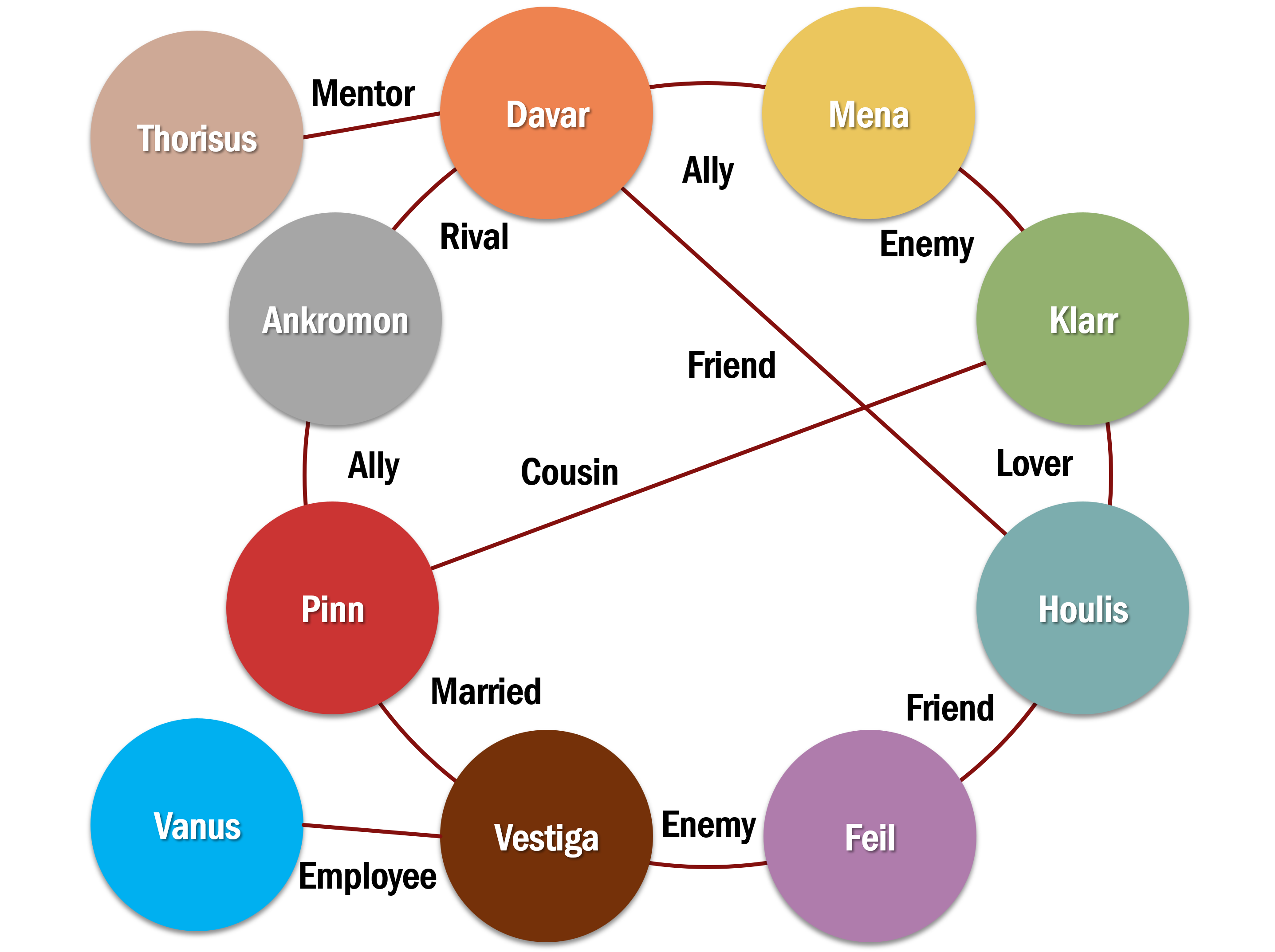
The character with the most connections (Davar, in this case) will essentially be at the center of the web of intrigue. That character will likely be your hero or villain but could also be a pivotal supporting character, such as a crafty power-broker or resourceful advisor.
You can select these connections for specific effects or randomize them by rolling dice. Prefer them to be political? Give more weight to allies and enemies by rolling 2d6 instead of 1d12. Prefer them to be more romantic? Roll d12 with advantage to give more weight to lovers and spouses.
- Parent
- Employee
- Ally
- Enemy
- Mentor/Advisor
- Friend
- Cousin (or aunt/uncle)
- Sibling
- Rival
- Suitor
- Lover
- Married
For relationships that aren’t reciprocal–like mentor, parent, and employee–you’ll need to decide which is which. Relationships tend to carry over, so Vestiga, who is married to Pinn, is probably quite friendly with Pinn’s ally Ankromon. Likewise, Pinn is probably quite frosty to his wife’s enemy, Feil.

Putting It into Practice
You can use these relationships to decide how characters will react to various events and what events they will instigate themselves. Allies will collaborate, enemies will scheme against each other. Siblings and certain allies may act like rivals until an outside force or character threatens, causing them to close ranks.
Use the relationships to create points of friction between NPCs. That way, one can ask the heroes for help against their enemies. If there isn’t a clear good or evil side, the players can decide for themselves whom they want to help, if anyone.
Getting the heroes involved in a web of intrigue can get them to side with a cause. And furthering that cause becomes its own reward. Then you’re not constantly worried about how to get them to go on an adventure. Instead, you can make the adventure about achieving something that…
- Furthers the cause of the heroes’ faction
- Convinces another faction to ally with the heroes’ faction
- Hurts an enemy faction

 zarban.com
Leave a comment