

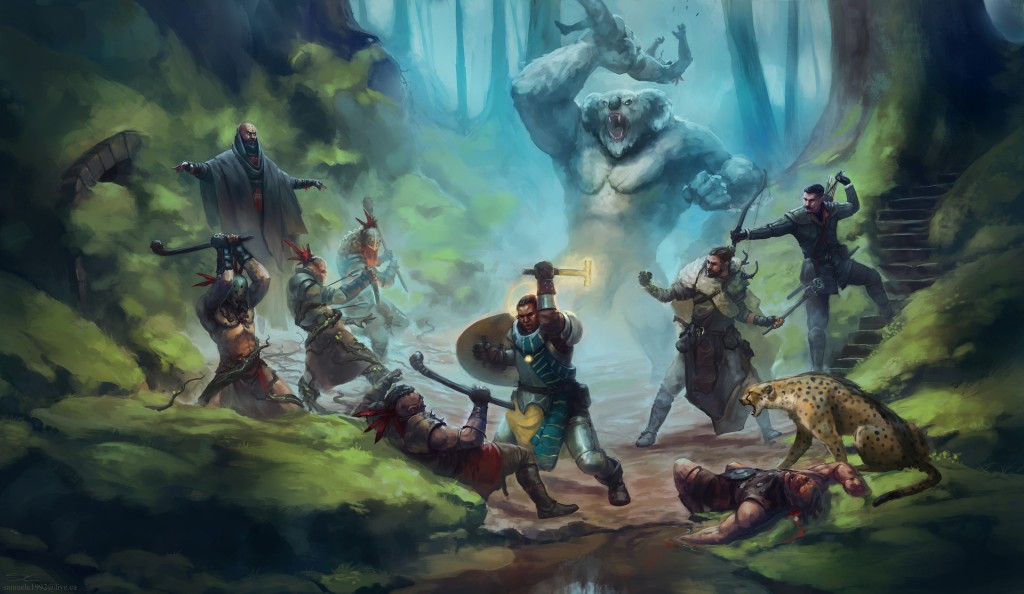
A lot of OSR systems, even the better ones, like Shadowdark, still fail to give martial characters much to do in combat beyond swinging a sword. Here’s an easy fix that doesn’t mean creating a whole system of 5e-style feats.
Opportunities Arise
For martial types, whenever you roll a natural 1 or 20 (in addition to the usual effect, like mishaps and critical hits), roll on the Heroic Exploits table: 1d6 plus the result of your hero die. (If you fumbled, you’ll try harder next time; if you critted, you’re cooking.)
You can perform that exploit immediately or later; they reset at the end of the encounter, so use them or lose them. The exploits are like 4e exploits or one-time 5e feats: cool, heroic things you can do in the moment. Since they’re opportunities, they don’t cost you an action.
Divine characters (clerics of various types) and adroit characters (rogues of various types) also get these, but only on a natural 20, and not on a natural 1.
Hero Die
Characters get a different hero die depending on their class type and level. Aside from using it help determine your exploit opportunities, once per round you can add your hero die to your damage roll.
| Level | Martial | Adroit & Divine |
|---|---|---|
| 1 | +1 | — |
| 2 | +1 | — |
| 3 | +1 | — |
| 4 | +1, 1 free exploit | — |
| 5 | +1d3, 1 free exploit | +1 |
| 6 | +1d3, 1 free exploit | +1 |
| 7 | +1d4, 1 free exploit | +1 |
| 8 | +1d4, 2 free exploits | +1d3 |
| 9 | +1d4, 2 free exploits | +1d3, 1 free exploit |
| 10 | +1d4, 2 free exploits | +1d4, 1 free exploit |
| 11 | +1d6, 2 free exploits | +1d4, 2 free exploits |
| 12 | +1d6, 3 free exploits | +1d4, 2 free exploits |
| 13 | +1d6, 3 free exploits | +1d6, 2 free exploits |
| 14 | +1d6, 3 free exploits | +1d6, 2 free exploits |
| 15 | +1d8, 3 free exploits | +1d6, 3 free exploits |
You Can Make Your Own Opportunities
At higher levels, characters start every combat encounter with one or more heroic exploits. Roll for them as combat begins. These also reset at the end of the encounter.
Heroic Exploits
| 1d6+hero | Exploit | Description |
|---|---|---|
| 1 | Dodge | You can avoid an opponent’s melee attack (before damage is determined) but end up in a random spot around the opponent. |
| 2 | Spoil | You spoil an opponent’s next attack or attempt to chase you by throwing sand or dirt, knocking over barrels, toppling a brazier, etc. |
| 3 | Precision | Your well-aimed attack gains 1d3+1 damage. |
| 4 | Shove | You kick or shove a similar-sized opponent back or throw them to one side a distance equal to your height. This does 1d4+1 hp damage; if there’s a wall there, 2d4+2. |
| 5 | Swap | You swap places with an opponent you’re fighting, putting yourself between them and what they’re attacking or protecting. |
| 6 | Evade | You manage to disengage from an opponent while still getting an attack, robbing the opponent of an attack. |
| 7 | Target | You target a specific body part or item with your ranged or melee attack, such as cutting a strap or disarming. This attack does half damage. |
| 8 | Block | You intervene to save an ally 5 feet away from taking damage from an opponent’s attack (before damage is determined) on the opponent’s turn. |
| 9 | Pounce | You leap or swing (on a chandelier/chain/branch) to land on an opponent up to 1 size larger, doing 1d6+2 damage. On 6+, you bring the opponent down. |
| 10 | Intimidate | You display such skill at arms (or vicious mockery, if they can understand you) that it causes similar or smaller opponents to make a morale check. Even if they succeed, their next attack is at disadvantage. |
| 11 | Reflex | You get an extra action for this round as if it was prepared, regardless of initiative (in addition to your usual attacks). |
| 12 | Topple | You topple a similar-sized opponent by tripping, kicking, or pushing. Or you get hold of a smaller opponent by the throat. |
| 13 | Sense Unseen | For the duration of combat, you detect creatures within 20 feet that are invisible or otherwise hidden and fight them as if they were visible but at -1 to hit. |
| 13 | Defiant Spirit | You draw on your personal spirit to fight back against magic to cut the duration or damage of one such effect (on you personally) in half. |
| 14 | Any | Choose any exploit on the list. |

Addition: Cleave
In addition to exploits, martial characters should always be able to sweep thru a room and take out enemies in a way that’s superior to others can do. Ideally, this would be coupled with a reduction of the ability of spellcasters to neutralize enemies. Combat should be the place where martial types rule, while spellcasters should more often use magic to solve problems: detecting things, altering things, teleportation, invisibility, etc.
A simple rule could be that if a martial character slays an opponent and can engage another opponent by moving five feet, then the character gets a free attack at disadvantage on that opponent. If that attack succeeds and also slays the opponent, the character can continue. They can do this (theoretically) a total number of times equal to their level. So a 1st-level fighter can only attack and slay one orc, but an 8th-level fighter could cut down one orc, move five feet and attack a second orc at disadvantage and perhaps cut it down as well, and then move on to another… as many as eight times in total.
Variations
If your system features both brawling warriors and swashbuckling swordsmen, you might create two separate tables. The first would feature more grappling, punching, and tossing maneuvers, and the second would feature more disarming, intimidating mockery, and chandelier-swinging.
You might prefer to say that you gain an exploit if you roll a natural 20 or if your opponent rolls a natural 1. If you like the idea of making these more like 5e feats, you can allow a character to “collect” them. Starting at 3rd level and every third level thereafter (3, 6, 9, 12, and 15), roll on the table twice; you can select one of those exploits to “specialize” in. You start each day (or even each encounter) with one use of that exploit.
 zarban.com
Leave a comment