


I’m reviewing various fantasy RPG systems for what I like and don’t like. I haven’t played most of them, so I’m mainly reviewing the ideas so I can remind myself later which games had which features.
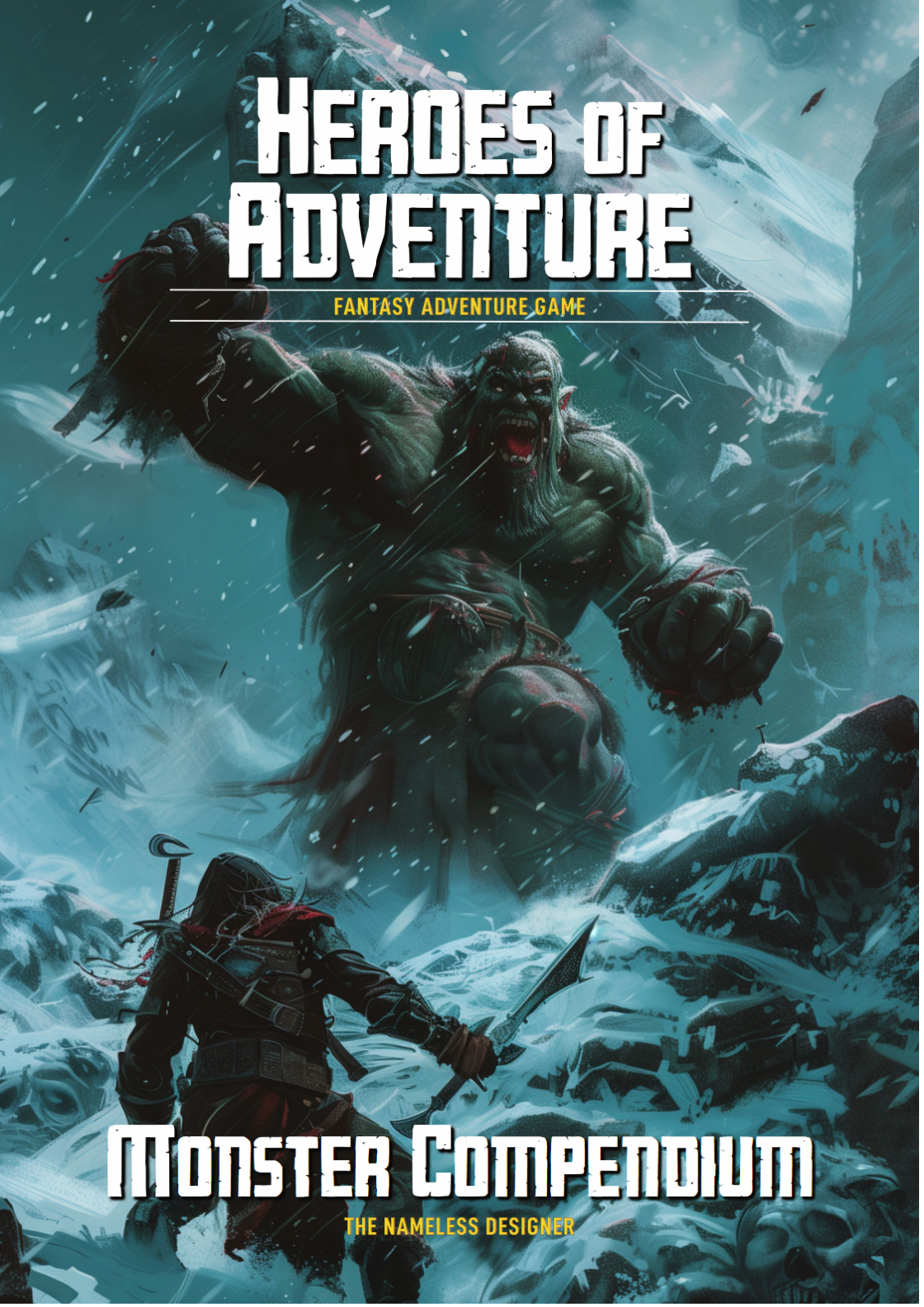
Heroes of Adventure is a modern fantasy RPG–toned down and with a lot of old-school sensibilities–by The Nameless Designer. It’s well written (in UK English, with a few apostrophe errors) and quite well laid out, and a new version of the PHB and Monster Compendium are just out. It doesn’t get a lot of attention, so it’s hard to know how it would play at the table. Note that I’ve only read over the material. Find it here.
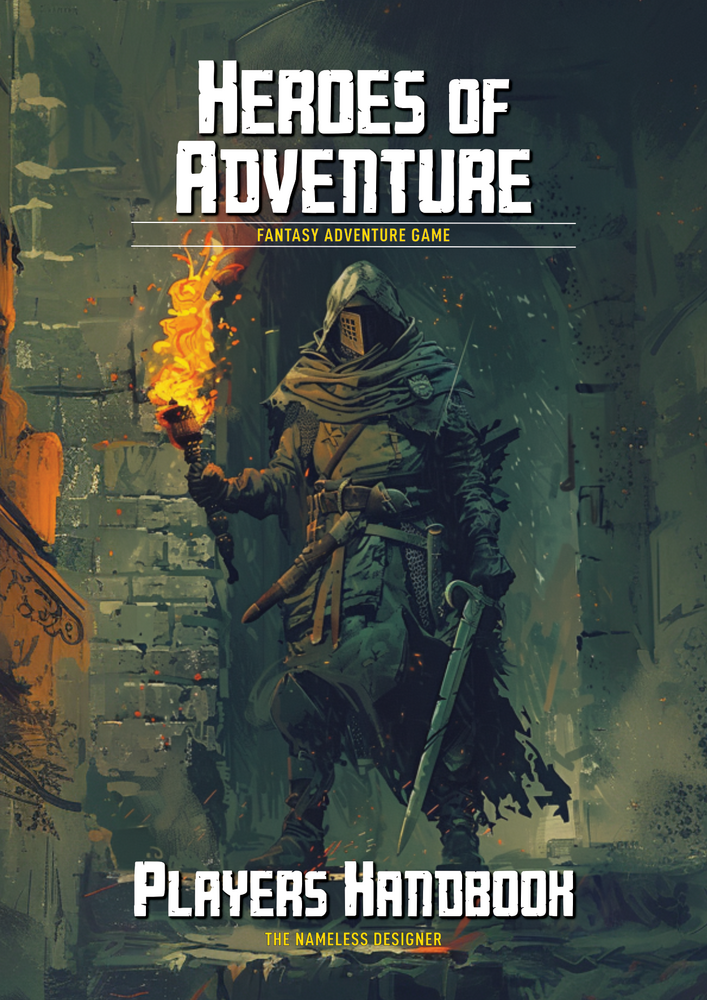
My opinion of this and other fantasy RPGs is colored by my experiences with B, X, 1e, and especially 2e in the 1980s and ’90s, when I played extensively, and somewhat by my more modest experience with 5e.
Basics
You can get advantage and disadvantage, as in modern D&D.
Nothing like alignment exists. It sort of feels as if at one time there was, since there are dark, light, and shadow magic, as well as shadow creatures. But no explanation of these remains. This means there’s no way to detect or protect from evil/good or hold paladins to a code of behavior.
There are no rules for retainers, but I can negotiate pay for retainers easily enough.
The game has a built-in campaign world that I think really helps add flavor. Characters can be from specific nations. Ancestries have history (and beef) with other ancestries.
It uses a zone system in place of concrete distances.
The great majority of the artwork in the Player’s Handbook, Game Master’s Guide, and Monster Compendium is AI art, but the great majority of that is very good. No matter how good it is, tho, it’s hard not to look for mistakes, which is off-putting.
Classes
Barbarian, bard, cleric, druid, fighter, knight, mage, monk, ranger, and thief. Not only is this a full list, but each class offers four sub-classes to choose from called “packages”. Each package has certain skills and class features (called “abilities), as well as default equipment and starting money.
These are remarkably concise in their presentation and should provide for plenty of flavor to differentiate characters of the same class. Your barbarian can be a beast master, berserker, outrider [horseman], or primal warrior [shaman], each of which is just one short paragraph of skills, abilities, and starting materials. However, there’s little that’s shared between packages of the same class; and since all classes level up the same, the enchanter bard is much more similar to the wizard mage than it is to other bards.
Spellcasters don’t have spell slots; but they have to make spell checks, which can limit them and cause them problems.
Advancement
Experience points are awarded for milestone-type events. You need 8 XP per level to advance to the next level. This is demonstrated with “progress clocks” that have 8 slices. It seems like higher levels would become a tedious grind of collecting a point for each session, adventure, major villain, dungeon, magic item, etc. Sixty-four of these to get from 8th to 9th level seems like too many. This is essentially diegetic advancement, altho it’s not called that in the rules.
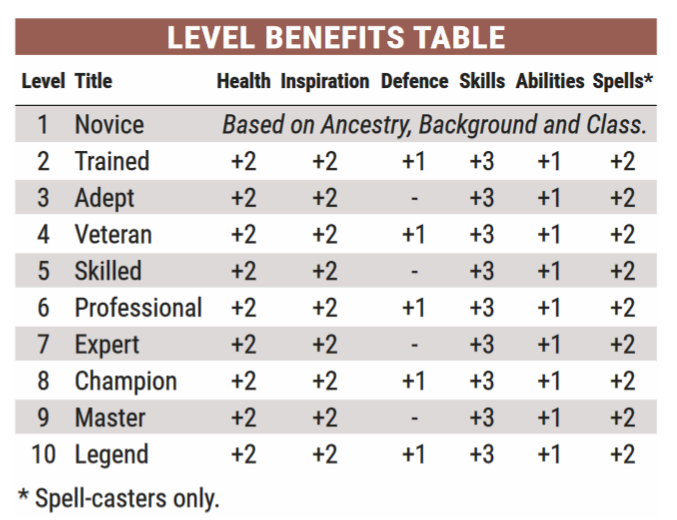
What you get out of advancement is more health, inspiration, defense, skills, abilities, and–for casters–spells. These are the same across classes, for some reason, so higher-level wizards won’t be outpaced by warriors. It’s not clear to me how a barbarian, for example, gets to be “tougher” than a wizard if they’re getting health at the same rate.
Ancestries
Dwarf, Elf, Goblin, Half Elf, Halfling, Human, and Beastman (goblin, orc, or giant variety). I don’t care for players playing monsters, but this is an interesting way to do it. Your ancestry gives you a choice of nationality (for humans) or bloodline. These give you certain skills and abilities, which can include “dark vision”.
There’s a good bit of flavor about each ancestry, but the name generators are not useful. No one is going to play “Pupin” or “Twikle”. They could have just been lists of common names.
There are 100 backgrounds, each of which is a bit of flavor and a skill and perhaps some starting equipment. However, a lot of them don’t make sense with many of the ancestries and classes. They probably should have been categorized.
Abilities
There no scores for traditional abilities like strength, dexterity, and intelligence. Instead, characters have health (hit points), inspiration (meta currency to power abilities), defense (armor class), and damage resistance, all of which are influenced by their ancestry, level, and class features called “abilities”. But these include things like great strength and agility, as well as traditional thief skills and even turn undead.
Health is kept low, but weapons still do standard D&D damage, albeit with fewer bonuses.
Skills
There’s a skill system that is limited to 21 skills. If you have a skill, you get a bonus die to add to the check roll; this is improved as characters level up, from d4 to d6, d8, d10, to d12. Wearing heavy armor gives disadvantage to agility, athletics, and magic checks.
You make a d20, roll-high, check against a GM-set “target value” and add your skill die. The fact that traditional ability scores are instead part of the skill system means having a high strength, for example, is perhaps less important than having a high, for example, athletics skill and melee combat skill.
Combat
Each character involved rolls 1d20 plus agility die, if any. Play proceeds from highest to lowest. GM may group opponents.
To attack, roll 1d20 plus melee or ranged combat die, if any, against the opponent’s defense. A natural 20 is a critical hit; for weapons, this is double damage. There are a few different types of attacks and combat maneuvers, such as pressing (gives you advantage but also your opponent against you) and push (push an opponent anywhere in the current zone).
For push and similar maneuvers, the opponent can accept the result or elect to take damage; this doesn’t seem like it would be very effective. I’m not sure why anyone would accept being disarmed rather than taking damage unless they were nearly dead.
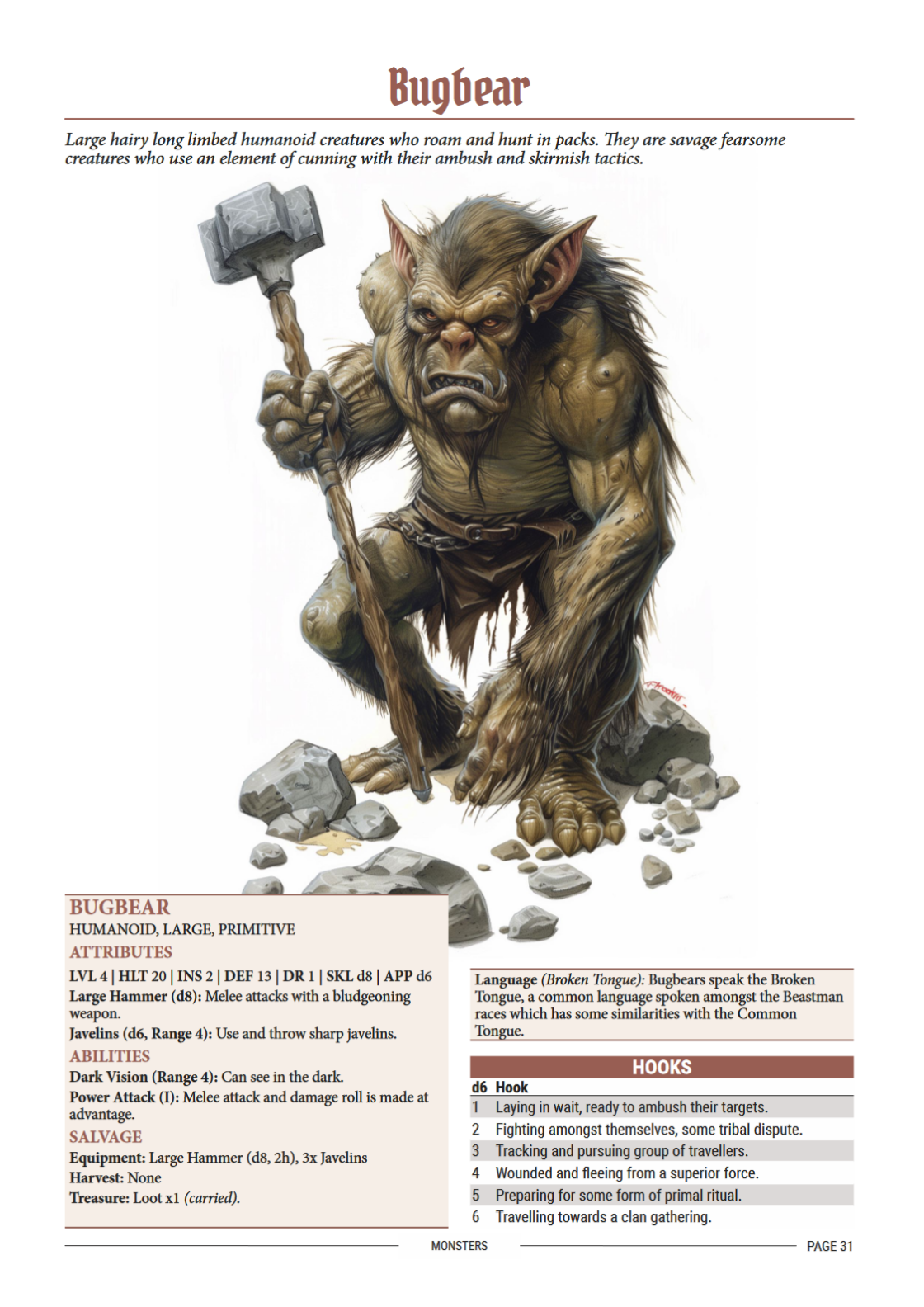
The Monster Compendium is really good. Every monster entry includes a d6 table for what the monster was doing when you encountered it. That’s so good that I’ve stolen it. It also includes treasure and salvage possibilities (that is, the value of the monster’s weapons, hide, horns, etc.)
Damage & Healing
If you are reduced to one third of your health, you are impaired and get disadvantage on checks.
If reduced to zero hp, you die or roll for a serious wound that gives you a negative effect, such as permanent loss of a health point or two or disadvantage on physical checks for the rest of the session.
With a good night’s rest, you roll to regain some health and inspiration. You can get advantage or disadvantage based on the quality of the rest (a comfy inn vs camping vs interrupted).
Magic
Characters with magic skill can cast spells in one of several domains. Rather than spell slots, you make a d20 check and spend inspiration points to determine the “level” at which you cast the spell. If you fail, you lose the inspiration points without the spell working. A natural 20 is a critical success (+1 level of power to the effect), while a natural 1 causes a wild magic effect. Spells are very succinct (just a couple of lines).
This system is a little fiddly; you have to look at what parameters are affected by the spell and consult a table for the quantity of the effect for the level you cast it at. Spending more can raise the area of effect, duration, range, etc., but this varies with each spell.
Weirdness
The term “target” means both the difficulty class for a magic skill check and the subject of the effects of the spell; that’s not ideal. And the term “level” is used here, as it has always been in D&D, to mean both class level and power level of the spell.
The system uses “exploding damage” for certain abilities and weapons. (If you roll the maximum, roll the damage again, even if it’s another maximum.) I’ve never felt it to be a very compelling mechanism, and in this case it kind of clashes with critical hits on natural 20.
The crafting and alchemy system amounts to little more than “check target 10, the GM will decide what a success means”. There’s a page of components, but no mechanics behind them. I actually took inspiration from it when I created my own system of alchemy. I also created a general crafting mini-game.

The lack of alignment creates some issues that could have been resolved some other way but which were not. There’s no explanation as to the difference between the dark knight package and the paladin package for the knight class, for example; it merely says “Write a sentence to describe your knights [sic] code of honour”. This could have been remedied by describing knightly orders in the Referee’s Guide. And it could have been broad enough to give clerics the same guidelines. (For example, say the Domercian Order “requires helping the innocent, acceptance of surrender, mercy for captives, and the blood sacrifice of an enemy or animal once per adventure”.)
Conclusion
All in all, Heroes of Adventure is an astonishing product, managing to fit a neat and trim modern system into just 64 pages of PHB–including a campaign setting section. But it’s robust enough to have a monster book with 200 creatures, each of which has a nice piece of color art (albeit AI-generated).
I feel like this system really straddles the divide between old-school gaming (and its focus on exploration) and modern gaming (and its obsession with player character options) and achieves the best of both worlds.
If I were to play Heroes of Adventure, I’d want to give something to all packages in a class, so that they hang together more closely and are better differentiated from other classes mechanically.
Similar to Shadowdark, spell checks that simply fail don’t seem fun, so I might say that on a “failure”, your spell works but you get a minor wild magic effect and are unable to cast that spell again until you rest overnight.
And I would prefer a more robust world. This one just has a few generically named territories; no points of interest or even cities. I’m not sure of the point of even including a campaign setting if it’s so scant that it doesn’t impact the character classes or other rules. And it’s huge–the size of central Europe. It would take you days to traverse one 48-mile hex, so your first few adventures would all take place in one hex. (You could just say they’re 18-mile hexes, which would still make it nearly the size of Britain, and you could use Perilous Shores to make 1-mile hex maps that flesh out one 18-mile hex each.) Also, some text in the PHB and MC mention the Shadowlands, but the Shadowlands are never explained anywhere.

 zarban.com
Leave a comment