


When Gygax and Arneson created Dungeons & Dragons, they settled on a magic system based on Jack Vance’s Dying Earth fantasy novels. But it has certain problems we might be able to fix without abandoning the tradition of Vancian magic entirely.
The Vancian system limits spellcasters to a few “spell slots” per day; they forget the spell once they’ve cast it and have to study it again to regain it. At low level, spell-casters were too limited. At 1st level, you get just one 1st-level spell. But at high level, spell-casters became much too powerful, able to cast reality-altering spells and inflicting army-crippling damage.
Martial-Caster Divide
But Gygax and Arneson didn’t see much of a problem with powerful spell-casters at high level. That’s because they expected fighters to also get superpowerful by switching to domain play. That is, a fighter would become a lord, build a castle, raise an army, and fight a wargame, because the creators and most of their players were wargamers first.
But that was never the case with most players who had no wargaming background. And they’ve suffered with “quadratic wizards and linear warriors” ever since.
But there’s another aspect to the issue: who says it’s a problem? I suspect Gygax would say it’s not, because D&D is a cooperative game; you’re all fighting monsters together. So what if wizards start weaker and end up much more powerful than fighters? Play whichever class you find compelling. And DMs need ultra-powerful spellcasters to fight PCs, because PCs are devious about hamstringing their enemies and taking them down quickly.
Still, players would prefer that there not be such a wide gap at high levels, and a major reason campaigns fizzle out at high level is that spellcasters get so powerful they can solve any problem.
Worthless Spells
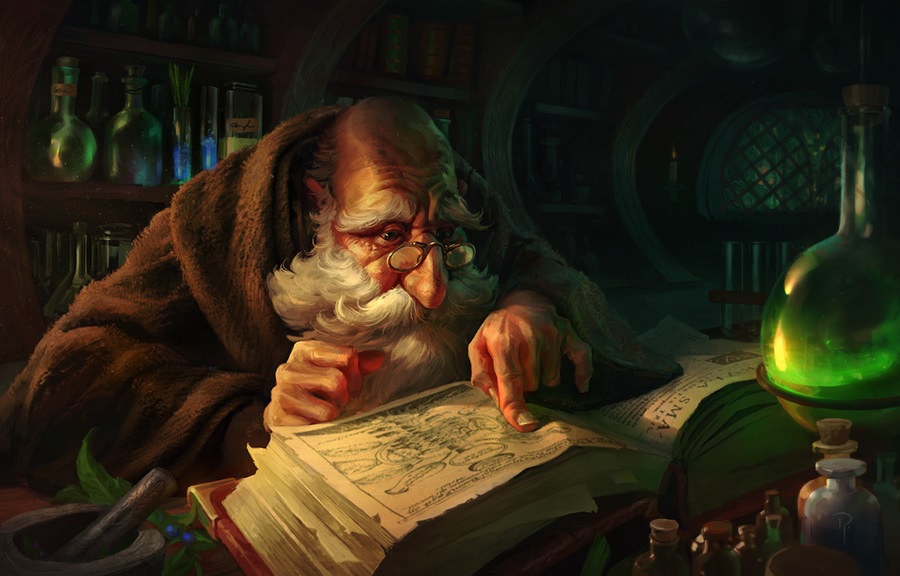
But there’s an additional effect that Vancian magic has: in all editions, spell-casters almost always memorize their most useful and impactful spells and almost never memorize their quirkier utility spells. This is partly because the rules said you could only cast a spell once when you memorized it, unless you spent additional slots memorizing it multiple times.
As a result, I don’t recall a single instance of a magic-user memorizing read magic or a cleric memorizing resist cold. We went for zap-for-damage spells and healing spells, because we knew those would be useful.
Fixing Vancian Quirks
To make utility spells like these more useful, and to fix the problem of spell-casters simply having too little magic at low level and too much at high level, I propose some modification to old-school D&D magic.
Sleep & Fireball
First, we deal with two problematic low-level spells. For sleep, simply say that those affected are not “comatose”, just sleeping. Doing anything that would normally wake a sleeping creature—including making noise or touching—causes all sleeping creatures to awaken. That way, a party can’t use a mere 2nd-level spell to put several monsters to sleep and then easily execute them all; they can only sneak away.
For fireball, just make it a 4th-level spell. Then, 5th-level wizards can cast lightning bolt but have to wait until 7th level to get fireball. If you’re committed to fireball as a 3rd-level spell, just make it less powerful: 1d4 damage per level of the caster and a fixed area of 20-foot radius, not 33 cubes of 10×10-feet. Lightning bolt can remain 1d6 per level because of its straight-line area of effect.
Spell Checks
A big part of the power of spellcasting is its reliability. Except where the target gets a saving throw, casters never miss. Require a spell check to make spellcasting less reliable and require it to hit AC 10, if aimed at an opponent. (That is, armor/hide doesn’t matter to magic spells.)
Whenever you cast a spell, roll 1d20 versus a difficulty equal to double the level of the spell.
- If the check succeeds, the spell succeeds.
- If the check fails, the spell works, but you suffer “spell burn”, which makes you unable to cast any spells the following round.
- If you roll a natural 1, the spell actually backfires, causing you a minor wild magic effect instead of coming off successfully, and you suffer spell burn. If the spell is an 8th- or 9th-level spell, you also lose 1 point of wisdom permanently.
Losing 1 point of wisdom from a backfired high-level spell makes their power extra dangerous and also explains the existence of funhouse dungeons: high-level wizards will tend to have a low wisdom—that is, be eccentric or even crazy—which explains funhouse dungeons.
Flexible Spell Slots
Make spell slots somewhat flexible.
You don’t have to memorize the same spell more than once to be able to cast it more than once in a day.
So a 5th-level wizard (with four 1st-level spell slots) could memorize four different 1st-level spells–say burning hands, sleep, jump, and shield—but cast burning hands twice and sleep twice, if necessary, or even burning hands four times. This encourages casters to memorize—and make use of—a wider variety of spells.
Rituals
Ritual magic is something introduced in modern editions of D&D to make it possible for spell-casters to make use their more esoteric spells. Modern D&D is far too generous to casters—giving them several spells at 1st-level and unlimited (and fairly powerful) cantrips all day. However, we can borrow ritual magic to reduce the problems that the old editions had.
Simply say that any spell they know that doesn’t affect an unwilling creature can be cast as a ritual, which takes 10 minutes. If you like gonzo gaming, you can give them the option of casting these spells at the cost of a minor wild magic effect instead of 10 minutes. You can even say they can cast any spell they know (regardless of spell slots) at the cost of a major wild magic effect.
If a spell is cast as a ritual by more than one caster (all of whom must be able to cast it individually), then the only way it fails is if all the casters fail or if the ritual is interrupted.

Cantrips
Modern D&D basically made the old 1st-level spells free by calling them “cantrips”. The old cantrip is now called prestidigitation and is itself a cantrip. I say the old-school game requires old-school cantrips, but they should be available at will to all spellcasters, not a 1st-level wizard spell, as in 2e D&D. Since cantrips are little utility spells, this makes spellcasters more interesting in non-combat situations.
A cantrip is any small magical effect like puffs of smoke, sparks, a candle flame, flavoring for food, and conjuring the illusion of an object you are familiar with. They can’t affect a creature or sovereign material. They can be made up on the fly, or you can use my specific cantrips.
However, read magic and detect magic count as cantrips, altho the cantrip form is only for the immediate area around items touched (so, perhaps a 2-foot circle section of wall, for example). This encourages greater use of such magic, including tempting casters to touch things that might be dangerous as well as magical.
 zarban.com
Leave a comment