

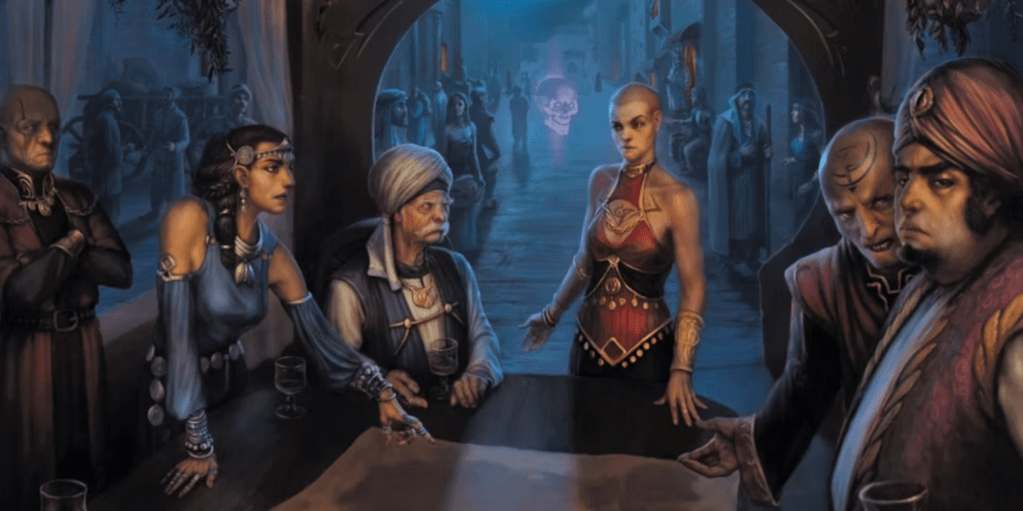
A lot of modern D&D and related games focus on social encounters that require persuasion or knowledge. Modern systems tend to have robust skill lists to support this, but they often go too far and become bloated. To accommodate more social interaction than is traditional in old-school gaming, you only need to borrow a couple of pieces of modern systems.
Persuasion & Intimidation
One mechanism you might borrow is “persuasion” and “intimidation” checks. That can be done with a charisma (or, for fighter-types) strength checks. If adventuring skill is relevant to the attempt, allow a bonus equal to the character’s class level or half the character’s class level (depending on how relevant).
Roll-Under
Roll-under mechanics are not quite as satisfying as roll-over mechanics, since the best roll is a 1, which is normally bad in the rest of the game. This is usually done as a roll-under check: Dalkar, a 4th-level fighter, successfully intimidates the guard if he rolls 1d20 and the result is lower than his strength plus 4, his class level. (That doesn’t mean the guard lets Dalkar pass; he’s a guard, so he’s more likely to raise the alarm.)
Of course, a thief might intimidate a merchant by implying he or she will do nasty things in the dark of night or might alert authorities to the merchant’s tax dodge. A cleric might use his or her religious authority. A wizard might threaten to turn an official into a newt. They roll 1d20 under their charisma plus their level.
You can switch to a roll-over system just by saying the target is always 21, and adding the ability score to the roll. A character with an 18 would on fail on 19 or 20 but now will fail on a 1 or 2.
Roll-high
If your system gives standard bonuses for ability scores, you can use those versus a target number you determine as the difficulty. In such a case, you might allow both the intelligence and charisma bonus (or, for fighters trying to intimidate) strength and charisma.
The math works, because systems with bonuses tend to increase the bonus by one for every two points, while a roll-under system essentially gives a +1 for every point.
So, a 4th-level wizard needs to beat a 13 with a 1d20 plus your level plus his or her charisma and intelligence bonuses. And a natural 20 is the best roll.
Note how the use of charisma and intelligence helps make them more important in the game than they usually were in old-school D&D.
Class Skills
Each class (or category of class) should also have certain extra skills or knowledge, but these should not be very extensive or very narrow.
- Thieves should be able to disguise themselves, impersonate officials, and forge documents, as well has appraise common valuables.
- Wizards should have knowledge of the arcane and history.
- Clerics should have tradition (foreign and domestic customs) and religion knowledge.
- Fighters should have monster lore and (magical) arms and armor lore.
For these checks, you can roll 1d20 against a GM-determined difficulty target, with level as a bonus as well as intelligence. So, a 3rd-level thief with a +1 intelligence would get +4.
As the GM, it’s your job to make these skills useful in your adventures.

 zarban.com
Leave a comment