

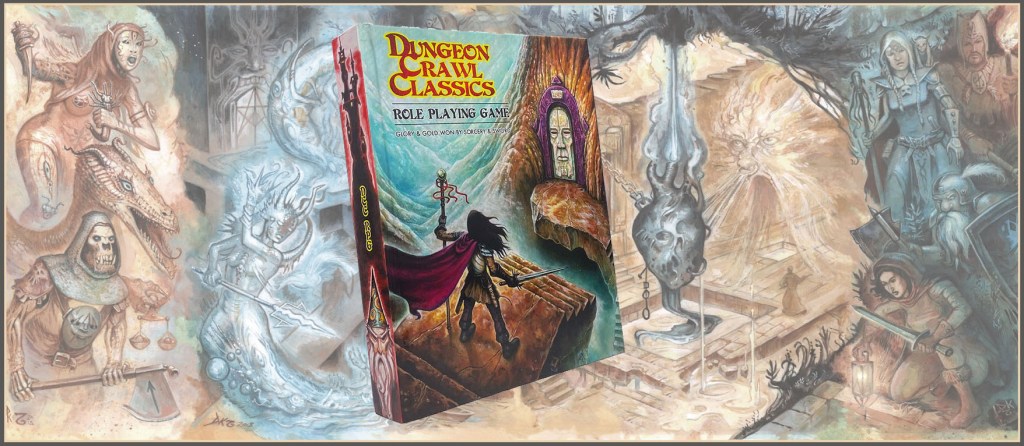
I’m reviewing various fantasy RPG systems for what I like and don’t like. I haven’t played most of them, so I’m mainly reviewing the ideas so I can remind myself later which games had which features.
Dungeon Crawl Classics is a fantasy RPG with more-or-less modern mechanics by Joseph Goodman of Goodman Games. It’s mostly well written and well laid out. I’ve played a little of D&D 5e, so my opinion is colored by my experiences with B, X, 1e, and especially 2e in the 1980s and ’90s. I don’t care for a lot of the art, but it’s very old-school–sometimes even being direct homages to old TSR art but with a gonzo twist. The game is very gonzo.
Basics
The system suggests using a character creation “funnel”, in which players create highly random 0-level characters and run them thru a deadly dungeon, a very silly system meant to ensure balance thru randomness and making players emotionally attached to the “survivors”.
There are no opportunities attacks. There are no feats, altho there is a system of “mighty deeds of arms”, which allow fighters to accomplish cool maneuvers.
The system uses an almost continuous “dice chain” of unusual dice d3 to d30. Certain rules instruct the player to “improve” the die, meaning moving up the chain or “reduced”, meaning moving down the chain.
Alignment is limited to lawful, chaotic, and neutral.
There’s no advantage or disadvantage.
Spells are cast with a spell check.
There are basic rules for retainers.
Ancestries
Human, Dwarf, Elf, and Halfling. The system uses race-as-class, like OD&D, so all elf characters are “elves”. But it uses ascending armor class and attack bonuses instead of old-school attack tables. However, there is a critical hit table, and higher-level characters get to use it more often.
Classes
Cleric, Thief, Warrior, Wizard, Dwarf, Elf, Halfling (race-as-class, very similar to OD&D). This means halflings can’t be thieves, so they’re just stealthy little fighters, weirdly.
Wizards and clerics don’t have spell slots; they have to make spell checks, which can limit them and cause them to misfire or lead to corruption.
Levels top out at 10. Leveling up is the same for all, by experience points; linear progression to 100 XP to get to 10th level. Leveling up gets you hit points (kept low, like BX D&D) and a talent (class feature) every odd level.
Abilities
Strength, Agility, Stamina, Personality, Intelligence, and Luck. Indexed from 3 to 18 for humans, rolled 3d6 in order and giving modifiers of -3 to +3 for ability checks. They mention overriding the roll method but figure you can make your own house rule for it, so why waste precious space describing alternate methods? After all, they only have *checks notes* 488 pages(!) to squeeze their game system into.
Agility is basically dexterity, of course; stamina is basically constitution; personality is basically charisma. Why change them? Luck is applied to only one type of roll, which you determine randomly on a table. Apparently you are only lucky at finding secret doors or making mounted attacks. And you never recover luck. So there’s a whole set of rules for something you might only use three times in the campaign.
Skills
Everybody gets a mundane occupation, randomly rolled. This comes with a weapon of some sort and one item, like a tarot deck or a pound of clay or a ukulele, because who could possibly know when the ukulele was invented? (1880s, a decade after the telephone.)
You make a d20 (if trained in the skill) check against a GM-set “difficulty class” using the modifier from your various ability scores for whatever you can convince the GM is related to your occupation.
Thieves get a variety of thief skills reminiscent of OD&D but expanded (forgery, disguise, handle poison, etc.). These are d20 checks that get bonuses by level.
Combat
The game recommends side initiative for early play, when each player has multiple characters, and individual initiative later, “when each player has no more than two characters.”
To attack, roll 1d20 and add your attack bonuses against the opponent’s (ascending) armor class, as in modern D&D. A natural 1 is a fumble, and a natural 20 is a critical hit; there are several tables to determine the gonzo effects.
A big part of combat is mighty deeds of arms, which are available only to warriors. When you attack, you also roll your hero die to try to achieve something, like blinding, disarming, pushing, tripping, defense, or any crazy idea that you can think of.
Damage & Healing
If reduced to zero hp, you die unless you’re at least 1st level and are healed within a number a rounds equal to your level. But even then, you might turn out to be alive if you make a luck check.
With a good night’s rest, you regain 1 hit point, as in OD&D, and 1 lost ability score point, if relevant.
Magic
You don’t have to memorize spells as in D&D. To cast a spell you know, you must make a d20 spell check (d20+level+ability modifier). Compare your modified roll to a chart for each spell for the exact results or gonzo misfire effects. This makes each spell take up an entire page, much of which is corruption and misfire results, which only happen 5% of the time (altho it grows for clerics).
Wizards can burn ability score points to recast a spell he or she has lost thru spell failure. This generates some gonzo results, like the wizard having to tattoo a mystical symbol on his face.
Weirdness
Oh my, is there weirdness. Aside from the art, there are the fumble and critical hit tables; these aren’t especially gonzo but they are extensive. The spell results tables are gonzo and, as a reminder, extensive for each and every spell.
There are rules for spell duels and, of course, tables for what gonzo things happen when a duel goes wrong. There’s even a “mercurial magic” table for wizards to roll for every spell they learn for the weird thing that happens every time they cast that particular spell.
Mighty deeds of arms is a great idea and is given a lot of space. Despite being ostensibly a free-form, do-what-you-imagine mechanism, there are numerous examples of both what a player could do and what the results of the attempt are, based on the roll.
The system gives you a title based on your class level and alignment, so a lawful fighter of 5th level is a “paladin” while a chaotic one is a “reaver”. Pointless.
The monsters at the back of the book are the traditional folklore with a bit of weirdness, like androids. The art in this section is very good.
Conclusion
I can’t see myself playing Dungeon Crawl Classics. I don’t like race-as-class rules, and the endless results tables–punishing for failures and unpredictable for successes–are annoying and, I have to imagine, crippling over time.
However mighty deeds of arms is a mechanism that, cleaned up a bit, would be a great addition to any OSR-type game.
 zarban.com
Leave a comment