


Victorian mansions are very evocative of creepy adventure. They may be home to ghosts, vampires, creepy aristocrats, and such. But they don’t belong in the Middle Ages. Assuming that you don’t want to just ignore the anachronism, how would you justify the occasional Victorian-style mansion in a medieval setting?
If monsters are common, and nobles attack each other frequently, you would think the land would be covered with stone castles and walled cities (which was historically the case, due to warfare and foreign raiders). A largely-wood mansion with large windows would be easily destroyed by marauders.
It’s helpful to remember that Victorian architecture drew heavily on Gothic architecture of the past, which was often executed in stone for cathedrals and castles, so the two are more compatible than one might think at first.
And a mansion might have a first floor built of stone to provide some defense and upper stories built of wood, rather than being entirely timber. It could even have a moat with a drawbridge.
1. Remains of the Old Empire
The Old Empire was relatively stable, so castles weren’t needed in the interior–altho Gothic-style castles did exist in the borderlands as outposts of the imperial army. Over time, ancient Roman-style villas gave way to fine Gothic-style mansions with towers and spires mimicking the imperial castles.
When the Old Empire collapsed, monsters and raiders invaded, so nobles had to build castles quickly (often replacing a gothic mansion). These castles were built in a simpler (medieval) style and are now the current style, while the gothic castles and remaining mansions are old and haunted or else occupied by an eccentric noble family without the money to renovate them.
2. Newer Style in a Stable Realm
Dramatic mansions are the newer style (altho still a century or more old), with a wall around them to protect from the occasional raid. Old (medieval-style) castles are still used on the borderlands but many in the interior are ruined relics of the barbaric past.
However, a recent plague left some manors abandoned, so their manor houses remain creepy dens of undead and other monsters. So some Gothic mansions are in full glory, while others are decrepit and haunted.

3. Neighboring Styles
Neighboring realms are in two different eras of stability and so have different styles.
The heroes may have been raised in the unstable one, where castles defend against monster raids, and they sometimes travel to the neighboring realm, where a period of stability (thanks to a wall of border castles) has led nobles to build lightly fortified mansions. Or they may have been raised in the more peaceful land and chosen to mostly venture into the dangerous neighboring realm, where only moats and stone walls stand between them and fierce beasts.
Either way, the stable land nevertheless has its share of skulking monsters and eerie spirits inhabiting the remains of ruined mansions, perhaps partially destroyed by fire, by a cross-border monster raid, or abandoned due to a plague or political intrigue.
4. They’re the Same
Victorian style being largely an emulation of gothic architecture, the mansions are actually gothic manor houses, and the castles are stone versions of the same style. Both are a bit older than the current style, which is half-timber.
The castle windows, poor for defense, can be shrunk to arrow loops with shutters carved from stone slabs and blocks kept at the ready as window benches.
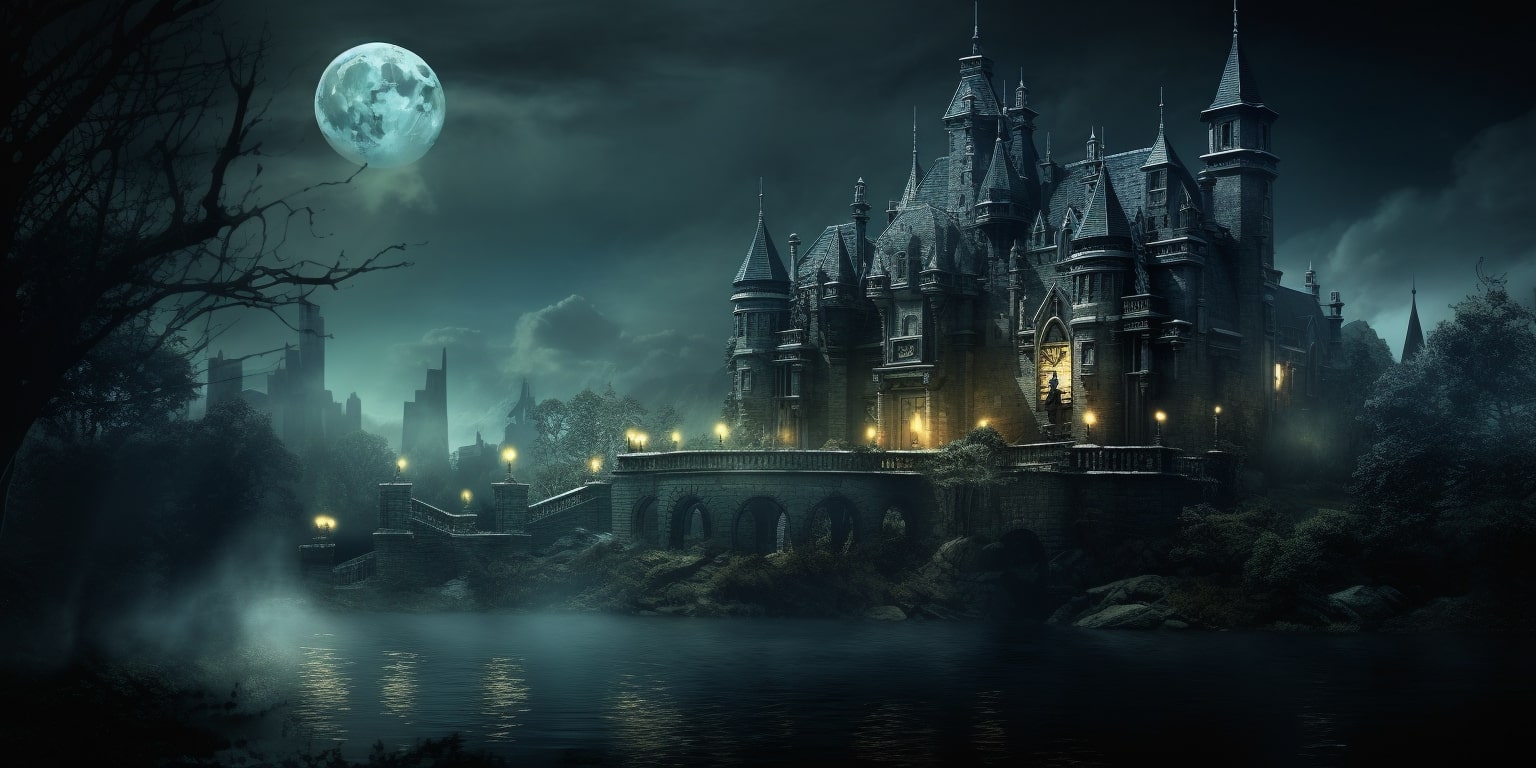
But merchants and gentry build fine mansions in the country with the same gothic look as these dark stone bastions but made of wood and lacking fortifications. They do so because they are in an area where raids are rare and a proper castle or walled city is close enough to flee to–and because they don’t have the money or the king’s leave to build a proper stronghold.
 zarban.com
Leave a comment