


I’ve previously written about starting a D&D campaign in a borderland, so the heroes have the choice of going into the wilderness or into the heart of the realm. A border with a wild land–not a foreign country–is kind of a fantasy concept, but we can conjecture based on what we know about the Middle Ages.
The Context
Medieval Europe used the manorial system. Each manor was around 1500 acres–about 10 times the size of a family farm today. Villages were only about 100 peasants and existed as homes for the workers who tended the manor’s fields and livestock. They were built on both sides of the nearest road and, because manors sat side-by-side, were about 2 miles apart. Therefore, if you walked at a sustainable 2 miles an hour, you would expect to pass thru a village every hour.
Some manors owned by the same lord were served by a larger village, so there was more space between them. And some manors were separated by large forests kept by nobles for hunting. (Sherwood Forest was one of these.) Others were separated by badlands, such as bogs and rocky wastes (where monsters might gain a hold). And every manor had woodland for growing poles (coppicing) and fruit and nut trees and often some scrubland considered “waste”.
Towns were 6 to 12 miles apart and were 500 to 1500 people. Cities were about 18 miles apart and were as small as 2000 people unless it was the capital city of the realm. This meant that the great majority of manors were no more than 6 miles away from a market town, which could be walked in the morning and, when business was done, walked back again in the evening.
In some places, there might be ruins of some kind in settled lands, the remains of the homes, temples, and/or tombs of a previous society, now used as a source of cut stone or abandoned to superstition or monsters. But this might instead be the “waste” on a manor.
The Border
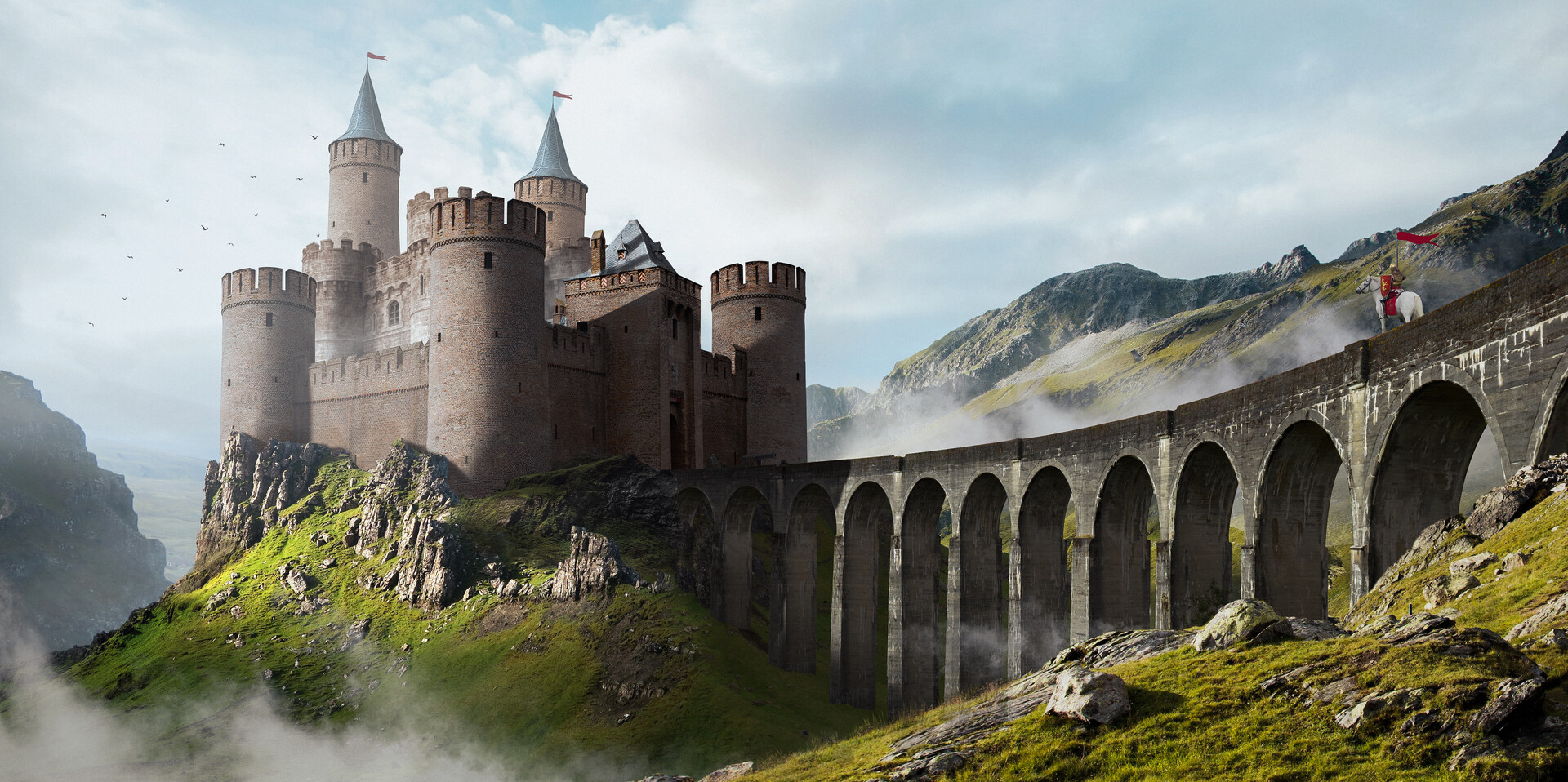
On the border (marches) with Wales, the English built castles for the “marcher lords”. (In Germany, these were the “marks” of the “markgrafs/margraves”.) The borders were fairly broad areas of no-man’s-land so that any incursion could be seen. At the edge, trees were harvested to keep the land clear, and ditches were dug to slow invasion. In a few cases, a wall might be built, as Hadrian’s Wall in Scotland was built by the Romans to stave off raids by the Scots. But more often, just a couple of miles of clear land separated kingdoms.
Often, borders are formed by a river, ravine, bog (or marsh, swamp, etc.), rocky wasteland, or mountain ridge. These tend to be hard to cross and therefore easy to defend.
Beyond the clear-cut edge, the land was wilderness, since no one was allowed to venture there, let alone develop it into farmland. In most of the Middle Ages, large swaths of Wales and Scotland were still forest. (Today’s barren landscapes are due to clear-cutting; and any saplings that get a start are grazed by deer and sheep.)
Border Castles
The marcher lord castles were small but provided security for the lord’s household as well as many villagers who worked the land and tended livestock–and kept watch–along the border. These had a garrison of perhaps 30 men at most. Most small castles and fortified manor houses had only the lord and a couple of brothers or sons, with servants and peasants armed when necessary. (As with towns and cities, all men were trained as footmen or archers.)
The Wilderness
The wilderness would presumably be the untamed wild lands where monsters roam freely. Their incursions into human lands would be detected whenever possible and resisted by armed peasants and townsfolk vigorously.
Anyone brave enough might venture over the ditch, beyond the shrubland, and into the wilderness, but they would find no other humans there but, perhaps, druids and outlaws. The king owns this land, and from time to time some would be gifted to someone who did did service to the king; that person would build a fortress and clear the land for farming, becoming a marcher lord.
There might also be substantial wilderness between two kingdoms, especially if they were unfriendly and spoke different languages. In that case, there should be trails thru it that lead to towns on the other side. And some merchants would brave the wilderness to make a profit on goods that are scarce on the other side; these would naturally require armed escorts (a good pre-adventure occupation for fighters).
Perhaps there was once a civilized society that occupied the wilderness, and the remains of their homes, fortresses, temples, and tombs may still be found there.

 zarban.com
Leave a comment