

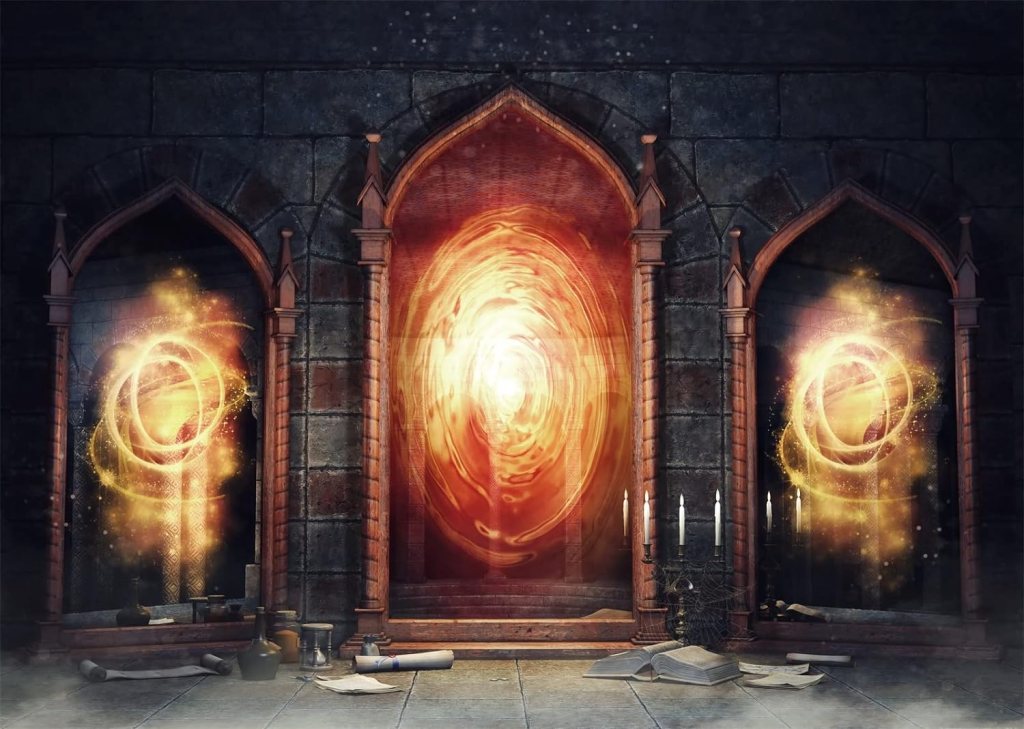
A mirror can be a great tool for puzzles due to the way it skews one’s point of view.
1. Acting thru a Mirror
When you look in the mirror, you see the thing you’re looking for (a sword, a treasure chest, a magic tome, etc.). But it’s not there in real life, and you can’t reach thru the mirror. Instead, you can only touch the item if you look in the mirror while moving backwards and watching yourself grasp it in the mirror.
You can have a player act this out with a real mirror and stand-in object. For an extra challenge, the mirror may also show the object surrounded by thorny vines (or poison ivy) that are not there in real life but which will harm the character if he or she is looking in the mirror while trying to grasp the treasure. You might simulate this with plastic cups surrounding the item that, if touched by the player, cause the character damage.
Once the character grasps the object, he or she can turn around and see it (but not the traps).
2. Mirror Code
The heroes are given a riddle to which the answer is the name “TOHITO”, but the real passcode is “OTIHOT”. There are various letters in a box that can be set on a rail across from a mirror, and there is a hint that “the mirror will tell”.
The mirror shows the name backwards, but the real passcode is backwards from the apparent answer, so that it reads forwards in the mirror.
So the heroes have to solve the riddle, spell out “TOHITO”, then notice it is “OTIHOT” in the mirror, and rearrange the letters to get the real, backwards, passcode (displayed as “TOHITO” in the mirror, of course).
3. Mirror Duplicate
The mirror produces an exact duplicate of the first character to approach it, which leaps out and tackles the character, mixing them up. There is no way for the player of the cloned character to prove he or she is the real one, because he or she flip-flops between playing one or the other randomly, and the DM plays the other.
This will become apparent to the players when the DM says the player’s action is done by the left character when the player’s previous action was done by the right character. (This avoids the players metagaming and saying they simply “don’t believe” the character played by DM.)
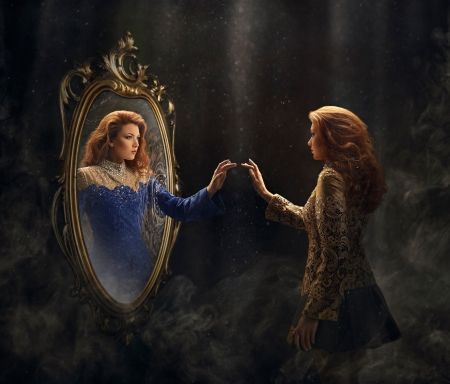
Any damage done to one of the characters is done randomly at first (then everyone can differentiate between the injured and uninjured one), but the player still alternates between playing each–make it as confusing as possible. The other characters might eventually notice that one of the duplicates is right-handed, while the other is left-handed… but that only gets them so far. Do they even know which hand their friend used most?
If the player tries to make peace and simply have a twin, say they just can’t stand each other and must fight. You can have one be definitely the real one or you can even say that whichever survives is the real one… or at least might as well be. (The body and possessions of the other disappear.)
4. Mirror Portal
In one chamber, you find a large mirror. In another, you find a reflecting pool that, when examined while it is still, seems to reflect an image of another chamber (the one where the mirror is). An object poked into the pool will smoothly pass further than the pool is deep. If you enter the pool, you pass thru a portal and come out thru the mirror.
This could be used to gain access to a treasure vault: there is no door, only a large slot. You can get the mirror, slide it thru the slot, go into the pool, and emerge (wet) in the treasure room, then pass back thru it.
 zarban.com
Leave a comment