

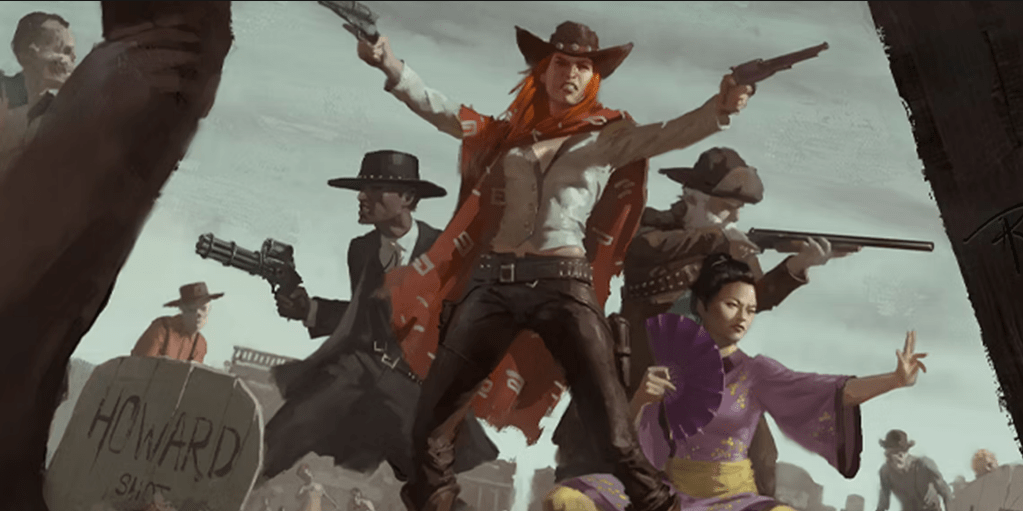
I’m not a fan of firearms in Dungeons & Dragons, but I was thinking about mechanics, and I wanted to write down a way to handle such a thing, if it came up. Perhaps this could be applied to other games that use firearms, but they have their own methods already, which I’m not familiar with.
Firearms don’t fit well into older versions of D&D, with their 1-minute combat rounds. But in my version of D&D 2e, combat rounds are 15 seconds instead of 1 minute. And these rules could easily apply to modern D&D, with its 6-second rounds.
I have a problem with 6-second rounds for other reasons (it pretends people think faster than they do and results in “epic battles” that are not even 30 seconds long), but that doesn’t matter here.
Note that these don’t actually have to be firearms. They could instead be magic items, like a wand of spikes or a crossbow of striking.
Shot Choice
The idea is this: you can choose to fire 1 shot or multiple shots. If you have a slow, pump-, lever-, or bolt-action firearm, it’s different, but a revolver or semi-auto rifle is the default.
If you fire 1 shot, you roll 1d20 to hit and add your attack bonus, assuming you’re proficient with the weapon.
If you fire multiple shots, you roll 2d3 to determine how many shots you take. That’s right: you’re not consciously in control of how many rounds you fire in the moment, which is something that happens to be true in real life. However, you get a bonus to the attack roll equal to the greater of the two dice rolled.
So, if you roll a 1 and a 3, you fire 4 rounds and get +3. If you don’t have 4 rounds left in your magazine, you subtract the missing rounds from the larger die. So, if you have 3 rounds in the above example, the 3 die becomes a 2, and you get +2 to your shot. On the other hand, if you rolled 2 and 3, when you only have 3 rounds left, the 3 is reduced to zero, but you still get a +2, because now the 2 die is the larger of the two dice.
Slow Firearms

If you are using a slow firearm (as defined above), you roll 1d4 to determine the maximum number of rounds you have an opportunity to fire (because maybe the target ducks, you’re distracted for a moment, a shell isn’t ejected cleanly, etc.). You can choose to fire up to that many rounds, each shot giving a +1 to hit. But you only roll 1d20 for one “attack”.
Shotguns shooting buckshot, as opposed to slugs, get advantage on the attack roll but do less damage.
Automatic Firearms
When firing an automatic firearm in full auto mode, roll 3d6 for the number of rounds fired in the burst. The largest die represents the bonus to hit.
Damage
If you roll a natural 20 for your attack, you roll damage twice, for 2 shots hitting or 1 shot hitting especially precisely.
Firearms don’t work so well for D&D, because of the way hit points are meant to allow heroes to get whittled down. But getting shot doesn’t whittle down your will to fight; it makes you crumple to the ground dead or seriously wounded. So instead, you might say a single hit does 1d3 hit dice 0f damage, and a critical hit does 2d3 hit dice. Obviously, this is very lethal indeed, but it ensures that higher level characters are more likely to survive being shot (perhaps taking a thru-and-thru flesh wound), as are big monsters, which can take a lot of physical damage.
So, if you are 5th level, and you get shot and take 2 hd damage, you now have 3 hd left. When reduced to zero hit dice, you’re seriously injured.
Shotguns firing buckshot do reduced damage as the range increases: -1 for long range (60 ft); -2 for very long range (120 ft). If a hit does zero hd damage, it does 1d8 hp damage instead; if it does -1 hd damage, it does 1d4 hp damage instead.
 zarban.com
Leave a comment