

This a fetch quest adventure in which the heroes must delve into the tomb of a nobleman to retrieve a goblet. It’s an adventure for about 3rd-level characters, or it could be a substantial campaign lasting several adventures.
Dinner with the Sage
The heroes are invited to dine with the sage they commonly consult. The sage reveals that evidence in old tomes suggests a lost goblet was buried with Giothrey, Lord Helvit, a hero of by-gone days. That goblet could be the key to a solving a mystery that could help all good folk against the a villain in the realm.
It’s up to you as the GM to decide what the mystery is and, indeed, who the villain is. Presumably, it is this villain that the heroes would one day themselves fight and defeat to save the realm.
The family is interested in helping, but Curvas, the current Lord Helvit, is away on campaign with the king and so cannot do it himself. His bailiff will be helpful but not eager to allow the heroes to open the tomb. But the sage will give the heroes a letter from his lordship authorizing it. The family has said that they believe an enchanted ring of some value is also buried with Giothrey, and the heroes may keep it as their reward for helping the good folk of the realm.
Tomb of Giothrey, Lord Helvit
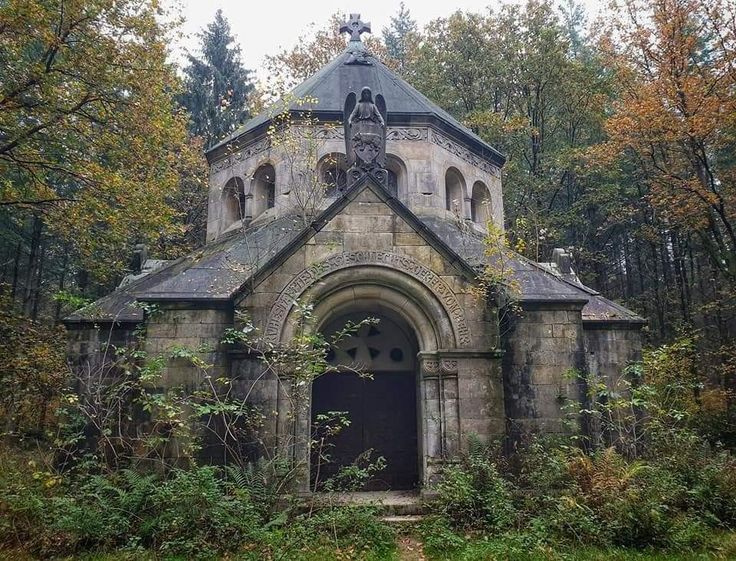
The Helvit family tomb is a simple stone mausoleum atop a lonely hill with a view of the distant Castle Helvit. It is situated, unfortunately, in what was once the edge of the Helvit hunting park but is now an overgrown part of that forest.
This area is also the domain of a couple of wereboars and their wild boar allies. The wereboars have relatives in Thuster, the town below, and will warn the heroes about wild boars.
The Helvit Mausoleum
Once past the wearboars, the mausoleum can be found easily enough among the trees and undergrowth. It is about 40×40 feet, surrounded by weeds and brush. A few statues of animals stand nearby: a horse and two hounds, apparently monuments.
Amongst the brush is a ceramic duck that may be a decoration rather than a monument. The horse’s grave has the label “Kirgardus, valiant friend”, concealed by weeds (revealed by a search). The hounds graves are likewise labeled “Lanwell” and “Ibert”. The duck is not labeled.
The mausoleum is magically sealed, so the lock cannot be picked normally. At anyone’s approach, a magic mouth will say “Name my friend and enter.” The door is also protected by a glyph of warding (5d6 hp fire damage, if any use force).
The password is “Kirgardus”, the name of Giothrey’s horse, which has its own grave with a fine statue of it nearby.
If any name other than “Kirgardus” is uttered at the door, beautiful but fierce spirit guardians (per the spell) will issue forth to confront the intruders. If the heroes fail to give the correct password quickly, the spirit guardians will deal their damage.
M1: The Interior
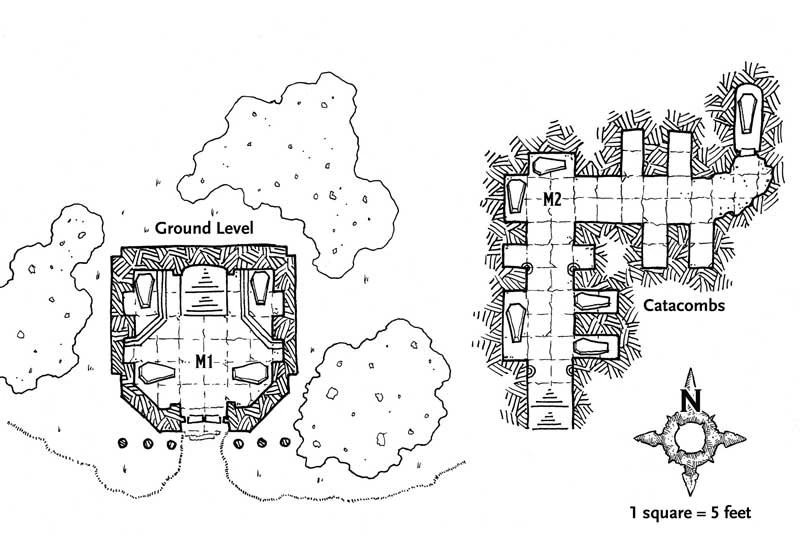
Inside the tomb, a family emblem is inlaid on the floor between four marble sarcophaguses, each labeled with the occupant’s name and sealed with lead:
- Lillivet
- Clarutia
- Vabert
- Dongost
All the sarcophaguses include miscellaneous grave goods (ivory comb, ring, etc.) worth 1d6x10 gp each, but the current lord’s servants will not tolerate outright grave robbing.
The tomb of Dongost, the first Lord Helvit, which is up on one of the platforms, is not fully sealed. Inside, the skeleton of Dongost lies in disarray, having been looted. If it is opened, his ghost will appear and demand “Whoooo has disturbed me again?!” Otherwise, his ghost will appear only when someone starts to go down into the crypt below, and he will demand, “What do you want here?” He may try to terrify.
Dongost can be mollified with sound explanations (especially if the heroes didn’t open his tomb). His robbed tomb is his focus; someone stole his grave goods some time ago (When? Time means little to a ghost), and he wishes to have them back. (Answer: It was his own wife, Lillivet, altho the possessions were not buried with her in her coffin.) One piece that remains, his holy symbol, is his spirit anchor.
Dongost is powerful enough to manifest by phantasm, poltergeism, and possession. If he takes control of a player character, he will declare the need to return Helvit Manor to greatness and order people to do so (improve fortifications, raise an army, buy supplies and horses, etc.). But he’ll be loath to reveal that his holy symbol must be taken to the manor house for him to travel there, since it could simply be destroyed.
Dongost was gradually poisoned over time, and a lore check upon examining the corpse could detect signs in the remaining skull and jaw of the effects of the poison. This could give him solace.
M2: The Crypt
Giothrey’s tomb is among those in the underground passages. Leaf and dirt debris on the floor hides the fact that a giant trap door spider has burrowed under the back of the mausoleum and has trap doors on the outside and inside (pick an empty niche). All in one round, it will seize and bite a character without armor and flee with its prey. Only if the heroes are particularly careful should you give one a check (nature lore or search) to detect the trap door.

In the roughly-excavated end, where the workers hit a natural void, there are actually stalactites hanging from the ceiling. Two of these are actually piercers.
The tombs here are labeled:
- Twion
- Hangert
- Namest
- Fild
- Phalcus
- Giothrey
In Giothrey’s sarcophagus is his desiccated corpse, his ring of feather falling, and the goblet. Giothrey’s ghost is also trapped on the material plane, but he’s only powerful enough to manifest by phantasm and seems dazed and oddly agreeable. His skull was crushed by a mace, and he lingered for weeks. His spirit anchor is the mace, which was mistakenly buried with him. Removing it and resealing his tomb will give him solace.
 zarban.com
Leave a comment