


Unlike a computer game, you can make a prediction on a real-life piece of paper and set it before your players, then you can have a trick in an encounter turn out to fulfill that prediction. Because the paper is real, you can’t have manipulated it, and the result is baffling.
The Statuary Garden
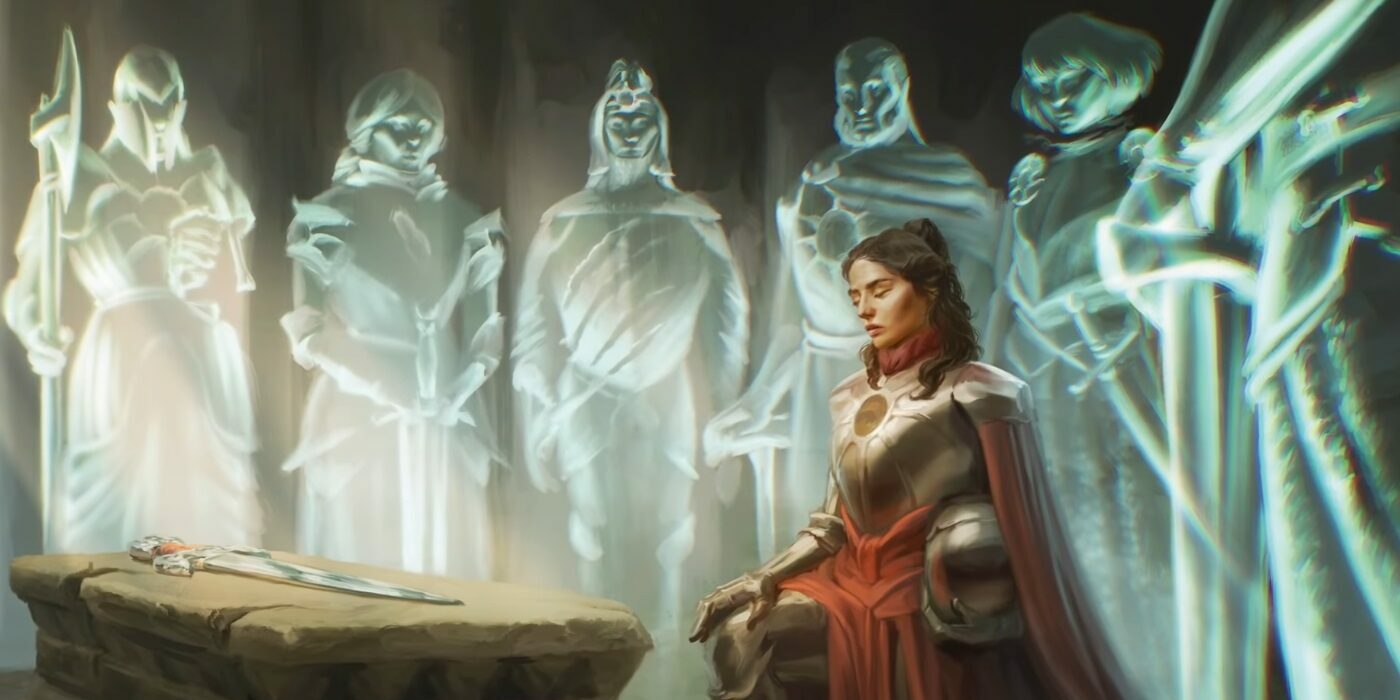
The heroes find themselves in a courtyard or garden where eight small statues stand on pedestals. Each one is labeled: Peace, Honor, Fate, Glory, Power, Wisdom, and Strength.
Magical energy swirls around them, and a mysterious voice in their heads tells the heroes that it has read their minds and knows what they have come for and the choice they will make. If you want, pretend to search their minds, then write down the name of one of the statues–the one that you want to give the heroes–and put it face down in front of the players. Let’s say it’s Strength, which will give all the heroes maximum human strength until dawn, which they’ll need for some specific reason in the adventure ahead.
The mysterious voice chooses two statues, and they begin to glow. It then tells the heroes that they must choose one of the two glowing statues to eliminate. The heroes should make a choice (or else be punished), and that statue disappears.
Then, the voice tells the heroes that they must choose two statues that may be eliminated, those two glow, and one of those disappears as the mysterious being makes its own choice.
Now, two statues have been eliminated, leaving five. Do the same thing twice more to eliminate two more statues, leaving just two. Both of these begin to glow, and the final choice leaves only one, which is always Strength. Proceed to reveal that your note predicted the heroes would choose Strength.
How does it work?
This trick is a force, meaning the players think the result depends on their choices, but it’s actually determined by you.
Obviously, when you make your first choices, you won’t choose Strength. Perhaps choose Fate and Peace instead. Let’s say the players choose to eliminate Peace. They then choose, say, Wisdom and Honor. You’re free to choose either and decide on Honor. Five remain.
Then you select two more that aren’t Strength–say Power and Fate. The players like power, so they choose to eliminate Fate. For their turn, the players choose Strength and Glory. You, of course, choose Glory, so that Strength isn’t eliminated. Three remain.
In the third round, you choose the remaining two that aren’t Strength: Power and Wisdom. The players choose to eliminate Wisdom. With only two remaining–Strength and Power–you choose to eliminate Power.
This leaves only Strength, and you allow the players to turn over your note and find it does indeed say “STRENGTH”. You can leave off this reveal, and the players won’t even realize you’ve performed a magic trick; they’ll think this force was a result they came to legitimately.
Fairness
Since this is a trick and not a free choice, you have to use this sort of thing very sparingly. Using tricks of this sort regularly would railroad the players into a predetermined course of action in a game that’s supposed to be all about player choice. Use it to amaze your players once or twice, not to force them into a storyline of your choosing.
Variations
Instead of choosing statues that provide enchantments, the idea could be applied to choosing the champion of a nature spirit to fight: three dire wolves, two cave bears, two giant lions, two giant snakes, or a dragon. The players and spirit choose creatures to eliminate, and the final result is the dragon, which is what you planned, because it’s only a faerie dragon.
Note that if you want to use an even number of things, then you need to switch it up and let the players choose the first pair and you eliminate one. That way, the DM still makes the last choice.
 zarban.com
Leave a comment