

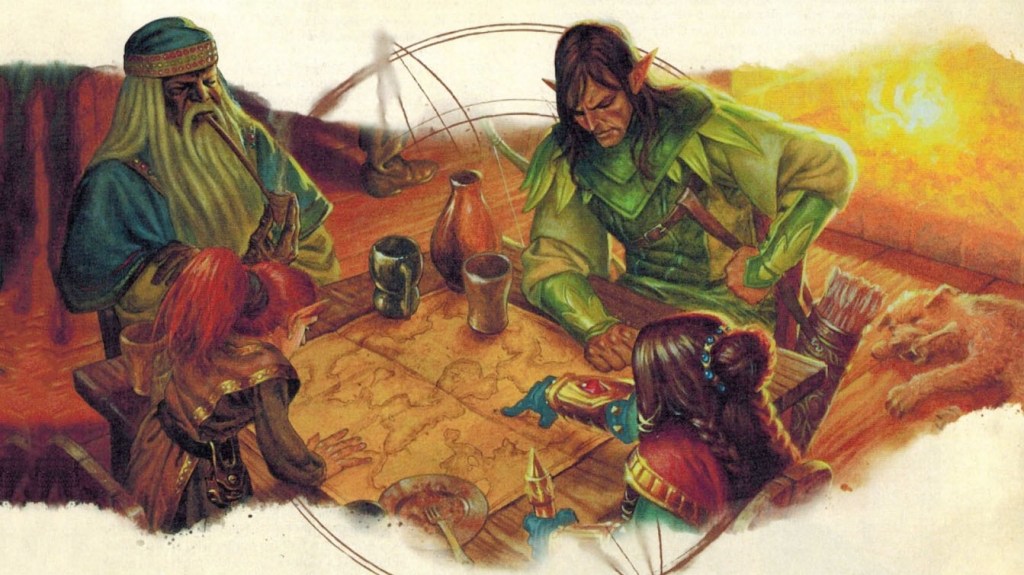
Get your campaign started by intriguing your players with a short tale of a treasure, a yarn about a mystery, a rumor of monsters, and dark news about a plot.
Once you’ve decided on the nature of your fantasy world, it’s time to populate it with points of interest. Focus on the things your players will want to engage with:
- Interesting cities to visit
- Treasures to be recovered
- Mysterious places to explore
- Monsters to slay
- Villainous plans to foil
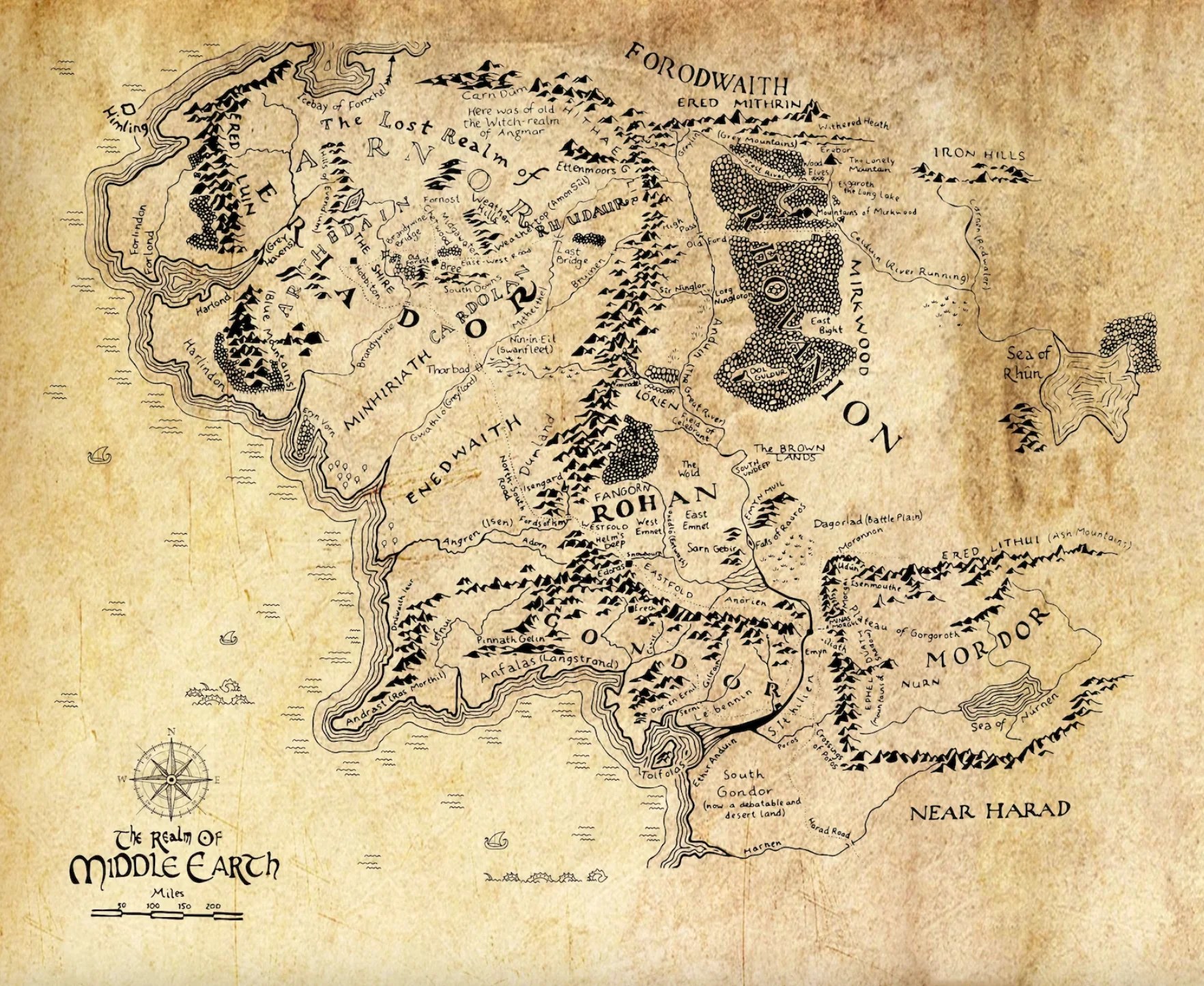
Many of these are things that should go right on your map, so players see them as places to visit in order to have interesting adventures. Create major points of interest on your map that are tied to these things.
Points of Interest
You can start at a small scale: a 1-mile hex local map with your home-base city (which also appears on your realm map). The hazards around the starting city are goblins in the hills, bandits in the lord’s woods, and an evil cult with animated dead.
On your 9-mile hex realm map, there may be territories controlled by orcs, a ruined abbey inhabited by a vampire, and a notorious cavern system full of perils of the darkest sorts. If the Wand of Alnor was carried by Master Calcus, who was lost in the Dark Pit of Vonox, then the Dark Pit of Vonox should be on your map (unless its location is a mystery to be solved). There should, of course, also be various cities, each with its own claim to fame.
You can just make up a bunch of locations and then create rumors about those locations holding certain treasures as well as monsters. Then, a later hook can be that the heroes need to bring the heart of one of those monsters to an alchemist. Or they can decide they want some rumored treasure.
In short, don’t just create the culture and history of a world. That’s merely the framework. Populate it with challenges and treasures that are enticements to adventure. That’s what real world-building is.
Rumors & Research
You can make a master list of rumors and facts and roll on it to see what various people (innkeepers, officials, sages, etc.) know. Some should merely be tidbits about the local NPCs and location (things you want the heroes to know about the area), while others are full adventure hooks. These should be all (or nearly all) true. Sages and other learned sources should know more specific and detailed information; and old tomes may be available for the heroes to do their own research.

For example, one innkeeper knows the girdle of giant strength worn by Dame Peppis was lost was she fell in a running battle with ogres, but the location of that battle is unknown. Elsewhere, an old storyteller at a tavern tells all about the fall of Dame Peppis in a battle with several ogres not far away, in the hills of Boroll–but his story doesn’t mention any magic belt. Now the heroes have enough information to seek out the remains of Dame Peppis in the hills of Boroll and recover the belt–and they’ve earned it by gathering information.
Treasures
Consider what kind of treasures you want to make available to your adventurers, especially early on. At low level, this will probably be limited to the first four:
- Valuable goods seized from traders (foodstuffs, spices, etc.)
- Monster body parts (bounty & potion ingredients)
- Silver and gold
- Exotic plants and minerals (potion ingredients and material components)
- Jewelry
- Clues to greater treasure (maps, information, keys)
- Magic items
- Secrets that will change your understanding of the world
These should generally be things that were seized by bandits and monsters or lost by travelers and adventurers. But your rumors should also mention a few lost magic items, relics, and such. Their whereabouts should often be unknown, to be linked to a place later, when you’re ready for the heroes to go after them.
These are things that generally can’t be added to the map directly. They have to be part of rumors about the places they were lost or placed and the characters who did the losing or placing.
Mysterious Places
This includes all manner of ruins, abandoned sites, dungeons, cave systems, portals, sacred groves, pilgrimage sites, famed cities, seats of power, and so on. Most of these can be added to your map, altho some will be lost and only hinted at in rumors and research.
These should have colorful names that spark interest and hint at intrigue.
- Twin Towers of the Wind Wizards?” Who were they?
- Bones of the Great Behemoth? What is that??
- Well of Ancients? What went on there?
- Broken Temple of the Albeth Knights? What’s that about?
Add more places to the map as the heroes explore and learn about new points of interest, whether or not they visit them.

Monsters
The type of monsters in various locations can itself be a draw. For one thing, certain monsters have value for their parts. They can be sold for their hide or fur as well as bits for potions and spells. But they can also be attractive merely for the challenge.
Give monsters homes and ranges. Orcs and hobgoblins should control territory–or skirmish with elves over it. Each realm should have a named dragon or two. Put these things on your map to both entice the players to the challenge but also to indicate where they might one day carve out a fiefdom for themselves.
Generally, these should be “wild lands” owned by no civilized group or “the king’s wilderness” technically owned by the monarch but not really under his control. Perhaps it was once settled but was abandoned after a war or plague, and now the ruins are occupied by monsters. After all, where else did all these dungeons come from?
Villains
Don’t forget that every realm needs an evil overlord. If he or she rules the dark realm next door, the heroes can engage in espionage and raids on evil temples, monster lairs, and the towers of witches and necromancers that wouldn’t be tolerated in their own peaceful realm.
If the overlord rules their own realm as a tyrant, the heroes can fight his evil minions and live in shadow and disguise. And perhaps one day they can destroy the evil overlord and take control of the realm themselves.
Either way, the tyrant should always be scheming to seize more power, putting down uprisings, forming shaky alliances, and building an army of men and monsters. His henchmen should be tearing down the churches of kindly gods and planning evil rituals to summon demons and such, perhaps in a maniacal quest to become a god.
 zarban.com
Leave a comment