

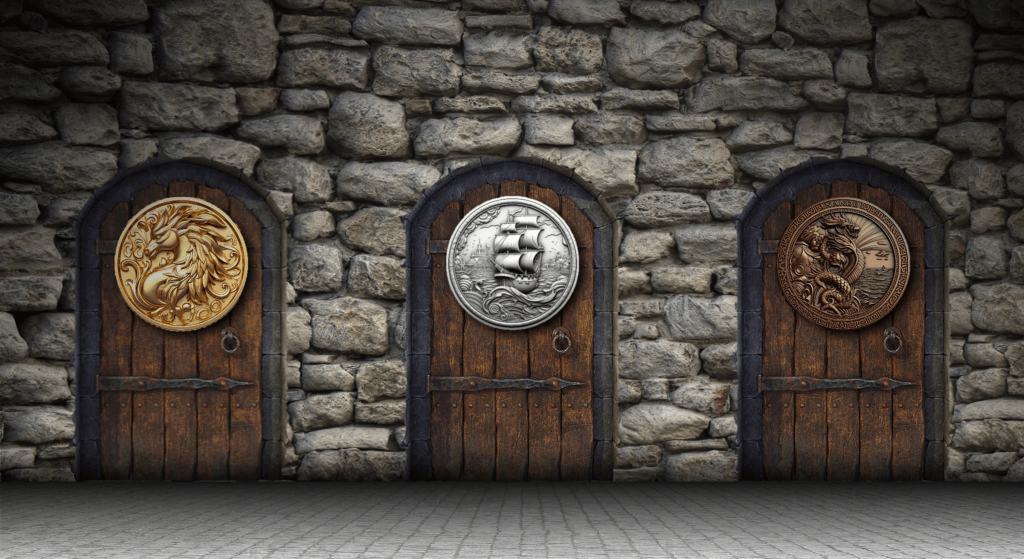
There is a quandary in mathematics called the Monty Hall Problem that famously blew up in 1990 as the result of a Marilyn Vos Savant column in Parade magazine. (It had already been solved in 1975, but even many mathematicians weren’t familiar with it.) You can use it as the basis of a dungeon puzzle.
The Idea
Monty Hall hosted the Let’s Make a Deal game show in the 1960s and ’70s. He would commonly offer contestants a chance to choose from three doors, one of which had nothing (or a booby prize) and another of which had a fabulous prize.
In the puzzle (but not actually in the show), the host then opens an unselected door with nothing behind it and asks if the contestant wants to change their choice. The great majority of people stick with their choice… but they shouldn’t.
The first choice was a completely random selection, so it’s only right one out of three times. Being offered the chance to switch after an empty door is opened is like being offered to keep the first guess or switch to both of the other two doors.
The Adventure Problem
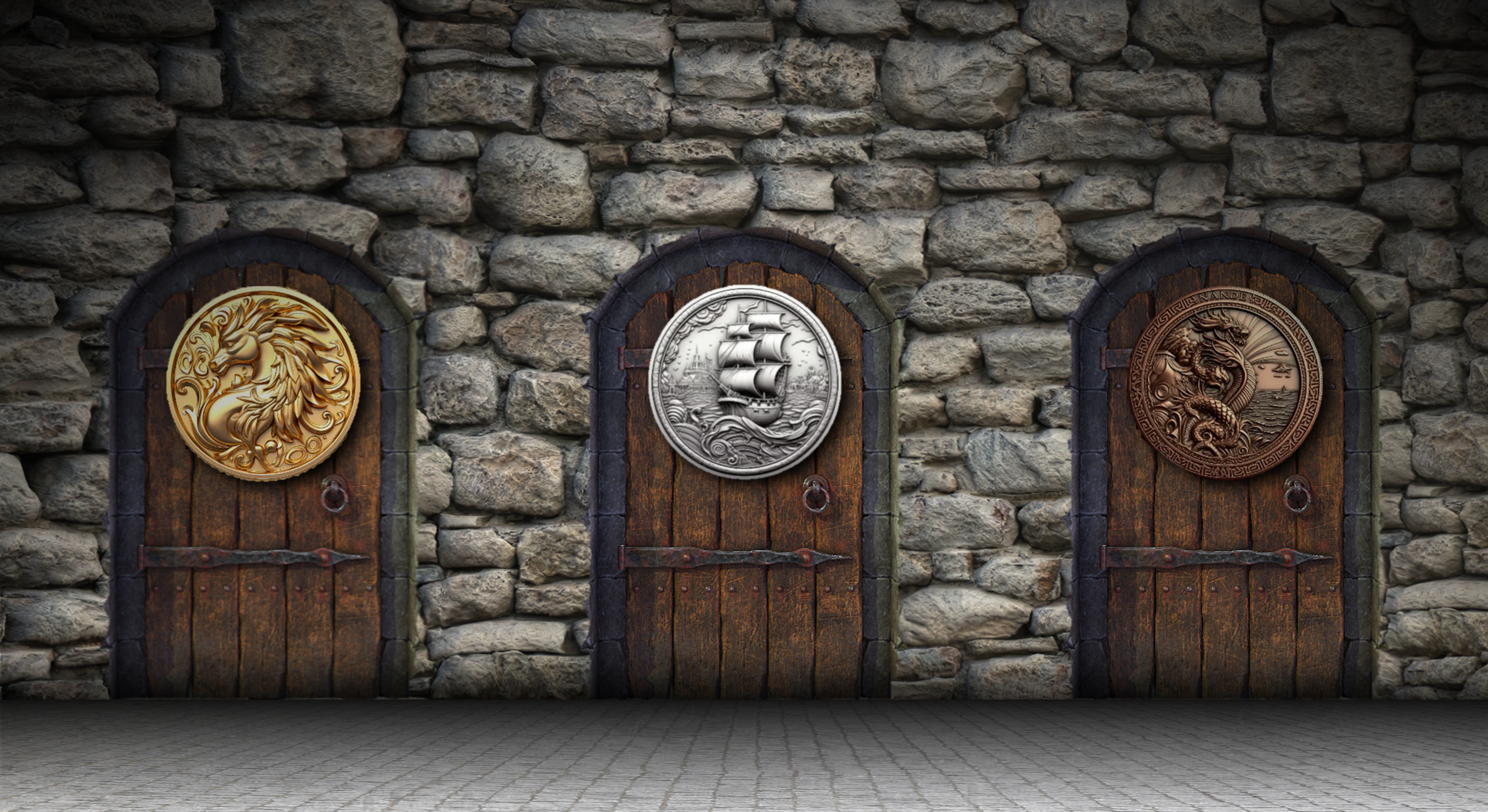
While dungeon delving, the heroes come upon a trio of doors and are offered a choice by an illusion or spirit of the dungeon’s creator. If they select incorrectly, the treasure will disappear. They select a door, and one of the other doors that is empty is opened for them. And now they are offered the chance to choose again. Make it clear that the choice is real and fair by, for example, printing the above image and hiding a token under one of the doors. (Cut the doors so they swing open, but leave a little tab by the locks, so they stay closed until it’s time.)
- Let’s say you chose the door marked with the gold horse medallion, and the prize is behind that door; you’re better off not switching.
- But maybe the prize is behind the door with the silver ship medallion. You were better off switching.
- Or maybe it’s behind the door with the copper serpent. You were better off switching again.
So, you were better off switching in two of the three cases.
You can’t make this a life-or-death puzzle, because there’s a fair chance the players will get it wrong. Either they’ll convince themselves to stick with their original guess, or they’ll switch but it will turn out (33% of the time) that they were right the first time.
Variations
The fun here is that it’s a gamble. Do not rig it so the players win.
To make it less random, you could offer 10 doors; choose 1, and 8 of the other 9 get opened to reveal nothing. Switching now gives a 90% chance of success.
You could create a whole dungeon where each room has three doors, and choosing correctly gets the heroes one step closer to the treasure, but choosing incorrectly presents them with a guardian construct or harmful magical effect.
 zarban.com
Leave a comment