


Your campaign should be a series of layers of challenges. It’s a set of potential adventures and a series of points of interest along the way and the specific challenges within.
Four Layers
You can think of a good open-world campaign as a whole series of challenges the players face at four different levels.
- Adventure Hooks
- Hex Crawl or Point Crawl
- Dungeon Crawl
- Encounters, Traps, and Puzzles
Layer 1: Adventure Hooks
The first thing your players have to do is sort thru the various legends, news, and rumors they hear from taverners, innkeepers, bailiffs, sages, and shepherds (not to mention the things they witness for themselves). They need to put the pieces together to get three adventure hooks that consist of…
- What do we need to do? The basic goal of the adventure.
- What’s at stake? The treasure or other reward that serves as a motivation.
- Who will try to stop us? The villains, bad guys, and monsters they’re likely to meet.
- Where does it go down? The location of the principal events, such as the ruins or lair.
Once the players have made their choice, the heroes can start on their way. It’s typically only then that you need to build the adventure. The heroes may get down the road and into the wilderness, but a minor travel encounter and a wandering monster encounter ought to hold them until the next session.
Make sure these are tied to–or at least themed to–the overall adventure. And random encounters are best when they’re not combat. Use creatures seen from afar to foreshadow; use eccentric NPC travelers to give clues or directions.

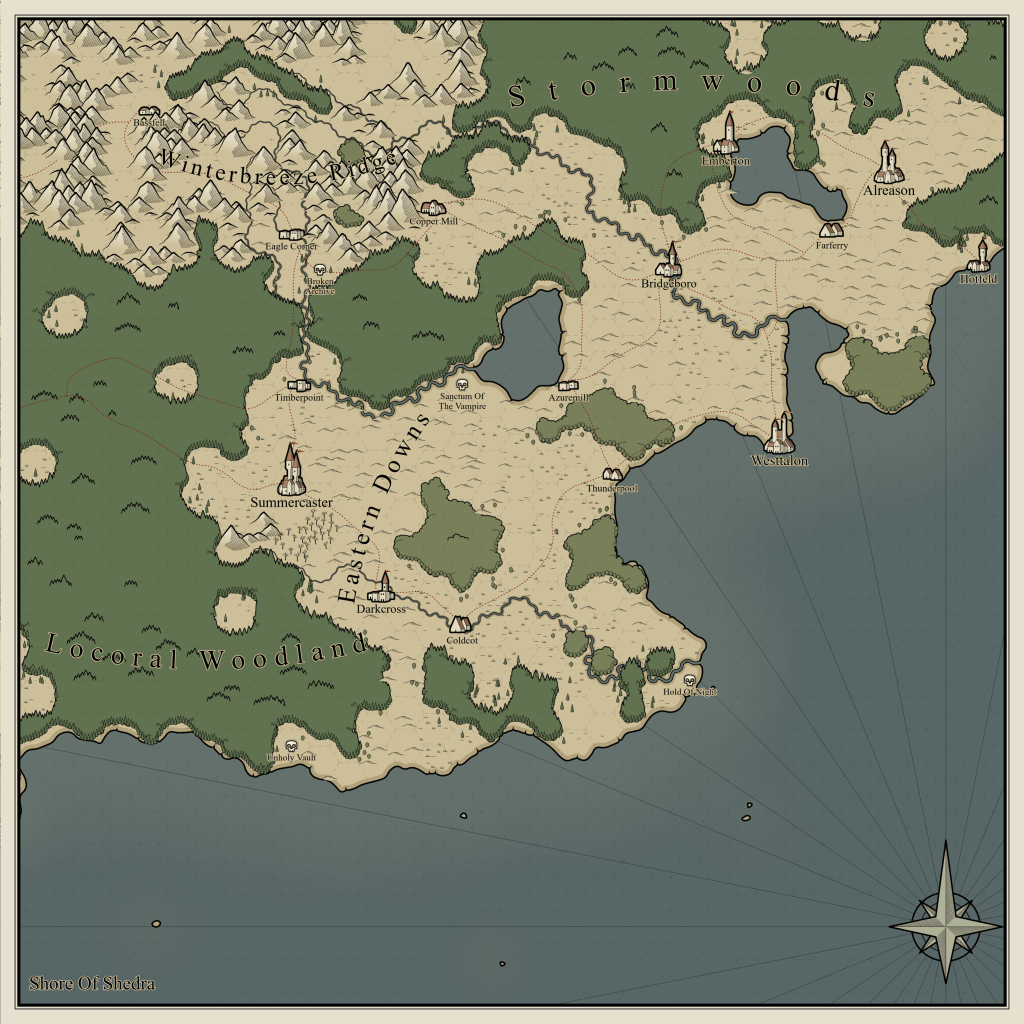
Layer 2: Hex Crawl or Point Crawl
With the heroes committed to particular adventure, you can work with confidence to build an adventure with the four pieces described above. Typically, the heroes will need to do a little travel to an area where they have to search for the ruins or dungeon entrance.
Either they search hexes, and you populate them almost randomly with major points of interest and minor points of interest, or they follow one of two or three specified routes, which takes them automatically thru one point of interest and past another. (Traveling a road is the quintessential point crawl.)
Regardless, the players will need to navigate these challenges, and reaching their destination (or stumbling across it randomly) is satisfying in itself.
Layer 3: Dungeon Crawl
The heroes’ destination is likely a ruin or abandoned structure, a cave complex, or perhaps the manor house of a lord or district of a city. Whatever it is, they’ll then explore that specific location that you’ve mapped out. In doing so, they’ll learn, and probably map, the layout.
Random encounters here should be the denizens of the dungeon–the creatures that live there and which the heroes would necessarily encounter elsewhere in the adventure anyway. This makes hanging around in one place dangerous, because the inhabitants are finding you–they’re investigating weird noises/smells and are more likely to be armed and hostile.
Layer 4: Encounters, traps, & Puzzles
The final layer of challenges is the specific tricks, traps, puzzles, and secret doors, as well as predicaments and encounters you planned in the dungeon crawl. Each one is a challenge in itself and a small obstacle to overcome.
The Base: The Base
The base of the four layer cake is, if you’ll pardon the pun, the heroes’ home base. While not a challenge, this should feature options, new skills, and satisfying encounters that make it all worth doing.
And the base is likely where there is some connection to an overarching story.
 zarban.com
Leave a comment