

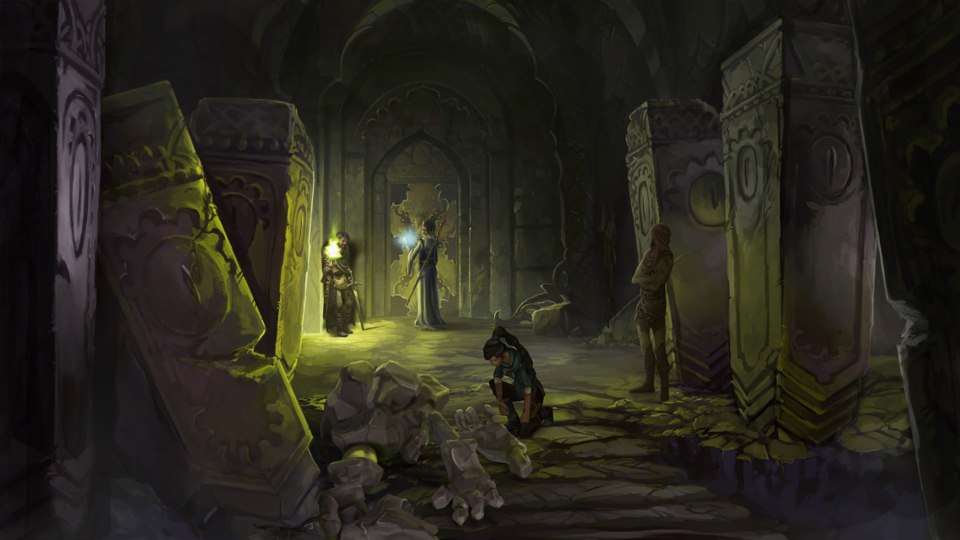
I’ve written before about searching in old-school fantasy RPGs. I’ve also written about the clues you can give players when they find a trap or secret door in their searches. In this post, I’ll explore how to incorporate traps and secret doors–and anything else that’s hidden–into your game.
In the old days, it was never made very clear how to handle searches for hidden things. The implication the example dungeon crawl from the AD&D 1e DMG was that the DM should give players hints. But it’s more than that.
Traps and secret doors should be puzzles.
This is never really spelled out in the old rule books–so much so that modern D&D abandoned (forgot?) the idea and instituted “perception” and “investigation” checks instead. The way the game stays fresh and interesting and not just a series of d20 tests until it’s time to roll initiative for a bunch of different d20 tests is to ensure that exploration is interesting.
Design for Discovery
When you design a room with a trap or secret door, you should include a note about what the trigger or mechanism is like, so that, if it’s detected, you can walk the players thru the puzzle of that trap or secret door.
- The secret door is operated by pushing a stone in the wall next to it.
- The crossbow trap is triggered by stepping on a pressure plate in front of it that blends in with the floor.
- The pit trap is a light weave of reeds covered in dirt, sand, and leaves, like the rest of the passage floor. It will feel spongy if tested and collapse almost immediately when walked on by any creature larger than a rat.
- The chute to the chamber below opens when someone steps on the stair that has a mark on it.
- The secret door to the tomb is a stone slab that looks like part of the wall but is balanced on a vertical axis in its center. Firm pressure will turn the whole thing (the pushed side going in and the other side coming out). If left open, it will slowly swing closed on its own.
This reminds you how the thing works and gives you ideas for how to deliver clues to the players when they find something. If the heroes are moving slowly and searching, they should nearly always get a clue about the existence of a secret door or trap.
Be sure to make the mechanism simple. The players will have little patience for playing with a secret door or trap mechanism to figure out how it works.
- Push it
- Twist an object
- Turn an object around
- Rearrange objects
- Press a panel or button
- Pull a lever (including one attached to an object)
- Pull a rope nearby
- Speak a magic password (prominent elsewhere)
- etc.
Triggering Traps
A good way to confound players without pedantic details is to make the triggering of the trap something they’d quite like to do, if only it weren’t for the effects of the trap.
- Removing the gems from the eyes of an idol triggers the trap.
- Entering the treasure room triggers the trap.
- Removing treasure from its enclosure triggers the trap.
- Setting levers or other controls to accomplish one thing also triggers the trap.
The trigger should be found on any search, so it only affects heroes who are careless. But a careful hero should usually see a clue that there’s a trap and so have an opportunity to defeat or avoid it.
Often, you won’t need a solution per se or a specific way to defeat these traps. The players will come up with some creative solution you’d never have thought of. But there needs to be some way to avoid the majority of the traps effects–so at least you can later say, “Well, you could have submerged the chest in the water. That would have stopped the gas.”
 zarban.com
Leave a comment