

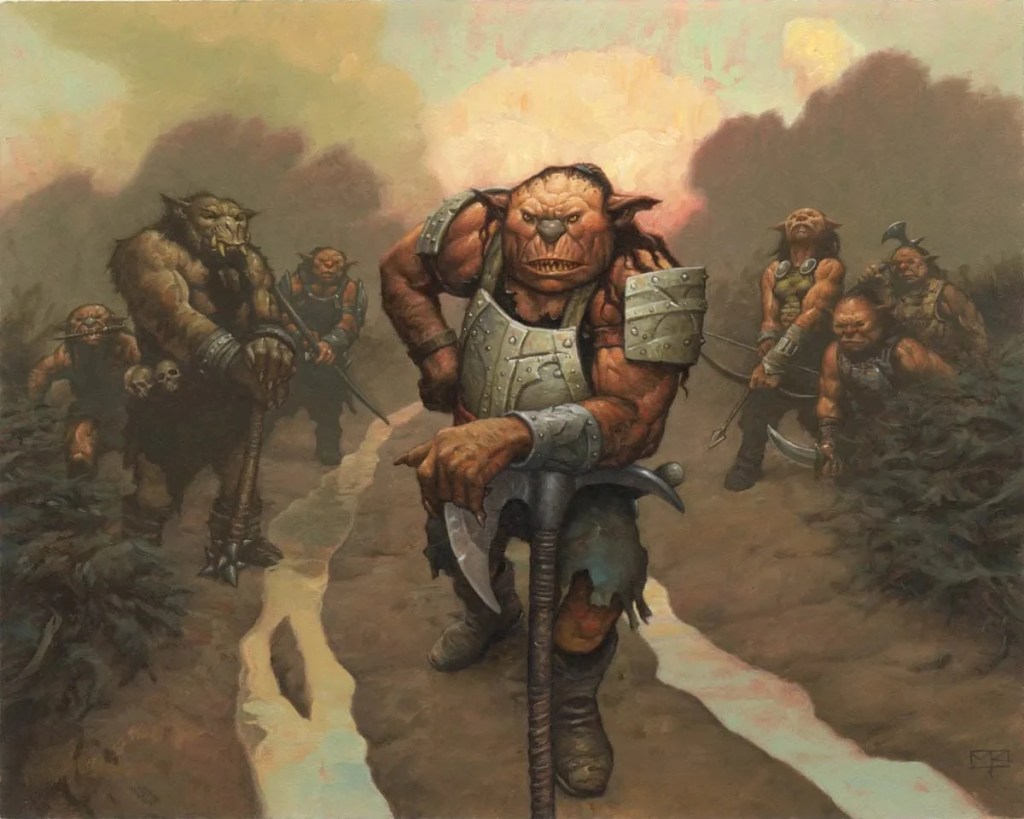
Not all goblins or orcs should be the same. Give your humanoids some variety.
Runt
A runt is a smaller-than-average specimen. They include juveniles, females, and males stunted by malnutrition from early failures (victors eat better). They have minimum hit points or slightly more and often run away at the first sign of defeat. Frequently used as scouts, messengers, and lookouts and to fill out a hunting party short of warriors.
A runt is very slippery as well as stealthy.
- Slippery: Their movement doesn’t provoke opportunity attacks. When hit in melee, they can choose to evade damage but end up in a random spot around the attacker. This can sometimes result in them going into a pit, etc.
- Vanish in Shadow: They can disappear into the shadows in most wilderness or dungeon environments (intelligence check to catch the direction they went).
Warrior
A warrior is a typical specimen. They include most males and some females. They have roughly average hit points and check morale when they’ve lost half their number and always run away when they’ve lost their leader. They’re used as entrance guards, hunting and war party members, and so on. They are typically assigned to a specific hunting party.
Warriors may be assigned to ride steeds, such as dire/giant wolves, wild/giant boars, or even ponies, in the case of hobgoblins, or giant hyenas, in the case of gnolls.
Smaller types, like goblins and kobolds, may have a feature like 5e “pack tactics”.
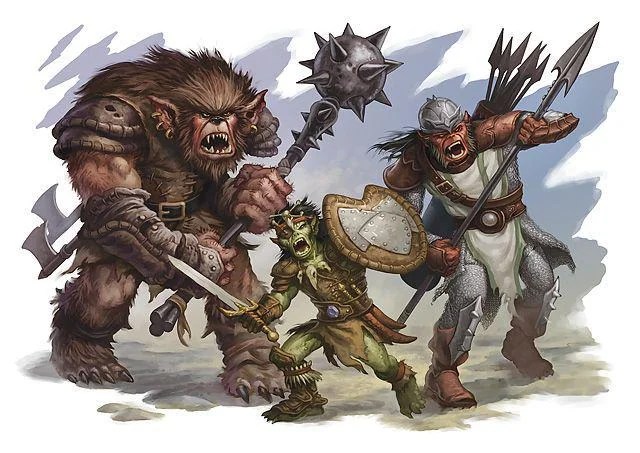
Guard
A guard is a male of the largest size. They have maximum hit points, +1 armor class, and +1 to attacks compared to warriors. They often wear trophies, such as severed heads or hands. They check morale when half their number is lost again if they lose their leader.
They’re used as interior guards, bodyguards, and hunting party leaders, and tend to be blacksmiths. There is typically one guard per 10 members of the band.
Shaman
A shaman is a typical specimen that has magical capabilities. They may be male or female and have roughly average hit points. They dress a bit differently from the others, often wearing decorative bones or skulls. They check morale when two thugs or guards are lost and run away when half their number are lost.
They have powers of a druid of level 1d4. There’s typically one shaman for every 20 members of a chieftain’s band. They occasionally accompany a hunting party and always accompany a war party but mainly attend to the band’s divine needs, overseeing the sacrificing and cooking of captives, for example. A war party is assembled from hunting parties.

Chieftain
A chieftain is the leader of a band. They have maximum hit points plus an extra hit die, +2 armor class, +2 to attacks, and an extra attack each round. They dress in more armor and furs and may wear decorative skulls and such. They are always accompanied by one or two guards, and a shaman is often nearby.
- Bodyguard: When hit in combat, a chieftain can choose an ally within 5 feet to shield him and take the damage instead.
- Seize Them!: A chieftain can call for all band members within earshot to charge, moving their full movement and making a melee attack with advantage. But attacks against those band members that round also get advantage. Members with ranged weapons attack normally, shooting into melee without regard for the safety of their allies. The chieftain doesn’t participate in the charge and will likely use it to make an escape if it doesn’t immediately seem successful.
Chief
A chief is a leader of chieftains. They have all the traits of a chieftain but maximum hit points plus two extra hit dice. A chief is always accompanied by a shaman of 4th-level druid caliber and two or three guards.

 zarban.com
Leave a comment