

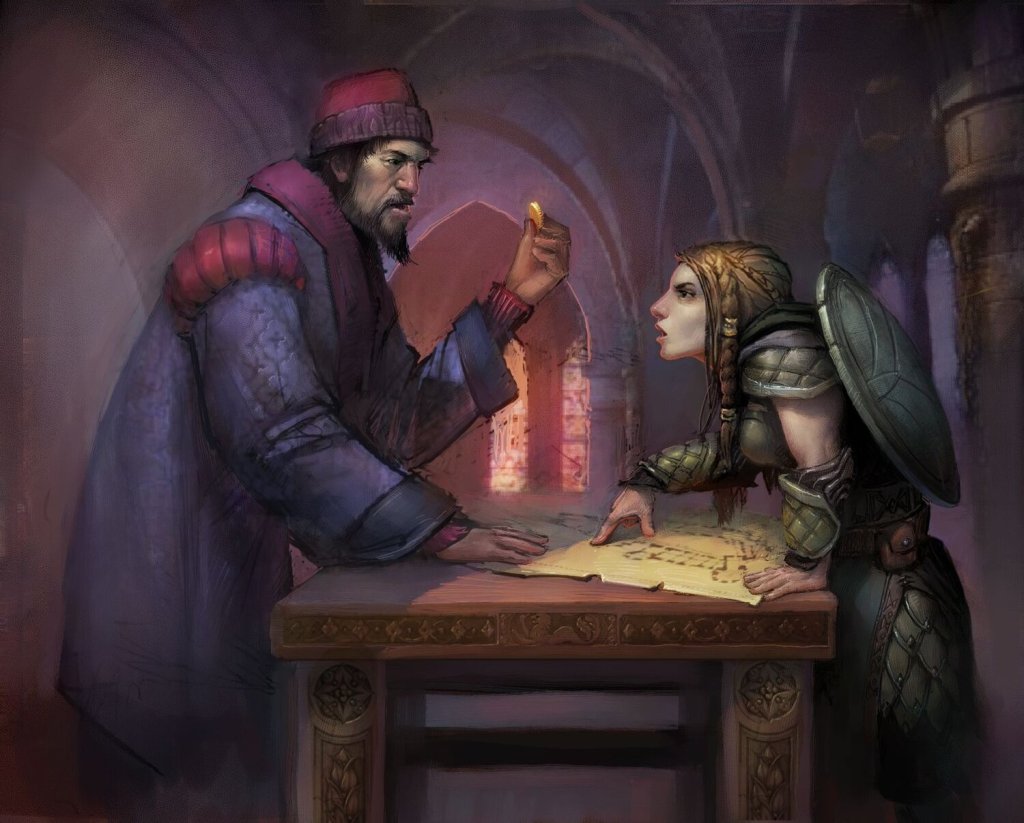
Role-playing social interactions is a crude kind of improvisational theater about feelings, which is not always easy or even welcome . The solution is to gamify things a bit.
This mechanism is good for ordinary NPC encounters of some import. But others may be real negotiations or even a battle of wits. And any meaningful NPC encounter can be a kind of puzzle.
Note that “NPC” here can refer to humans, elves, dwarves, halflings, and such but can also refer to any intelligent creature the heroes can communicate with and even some they can’t.
NPC Encounters
Any fantasy world with peasants and nobles is a highly stratified one, and social status will play a significant roll in interactions. Treat peasants a bit like skittish beasts, not NPCs to be flattered. Townsfolk (especially innkeepers and local officials) are more used to adventurers, mercenaries, and knights and will almost always seem pleasant or better, but it’s not necessarily a reaction that’s honestly held.
Hero Renown
NPCs of stature may regard the heroes as more or less important by their renown. They should get a bonus to reaction rolls with NPCs if they’re obviously wealthy, heroic, and important. If you use my renown system, they get +1 if known around the shire, +2 if known to nobles by tales of troubadours; and +3 if so famous even the monarch has heard of their deeds.
Hero Approach
Each NPC should respond better to a certain type of interaction. This could change from day to day and from one person to another, so the heroes can’t entirely rely on tapping the same NPC the same way over and over.
Consider what one approach will work best on the NPC and what one approach will viewed negatively (in parentheses below). Hint at it by the NPC’s demeanor and how his or her allies/servants act. The players can choose one approach to try first and, if the result is neutral, one to try second. If the heroes hit on the best approach, give them advantage on the reaction roll. If they guess wrong and take the worst approach, give them disadvantage. The heroes can also apply the charisma modifier of the main speaker.
- Charm (may be viewed as patronizing)
- Directness (may be viewed as rudeness)
- Expertise (may be viewed as pomposity)
- Friendliness (may be viewed as deceitfulness)
- Humility (may be viewed as sniveling)
- Power (physical, magical, or political–may be viewed as threatening)
This guessing doesn’t take the place of role-playing, of course. Players should explain how they apply their choice. For example, if the players have heard that the baron likes admires power, they might act very subservient to their leader and mention some of his or her great deeds to the baron.
The GM should apply any bonus or penalty to the roll and modify the result on the table below. Clever roleplay might warrant an additional +1 or even +2. On the other hand, surly-looking thugs backing a smiling sweet-talker or open disagreement among the heroes might warrant a penalty.
And, of course, some people are just naturally more helpful or more sour than others and may lend an automatic modifier because of it. Perhaps the NPC had poor dealings with druids before, and the party’s druid does the talking. Or the NPC is just a disagreeable sort.
NPC Reaction
| 2d6 | 1d20 | Result |
|---|---|---|
| 2-3 | 1 | Hostile: Will actively try to thwart. |
| 4 | 2-3 | Aggressive: Will oppose, if it’s not too much trouble. |
| 5 | 4-6 | Dismissive: Will not engage; may be rude. |
| 6 | 7-9 | Wary: Unlikely to help; suspicious of incentives. |
| 7 | 10-12 | Indifferent: Needs a good incentive to become favorable. |
| 8 | 13-15 | Pleasant: Could be persuaded to help, if it’s a good deal. |
| 9 | 16-17 | Interested: Could be persuaded to help, if it’s easy or advantageous. |
| 10 | 18-19 | Amiable: Could be persuaded to help. |
| 11-12 | 20+ | Friendly: Willing to help. |
An official might be impressed by a show of power but view friendliness from a stranger as deceitful. A foolish lord might respond best to charm and view plain-spoken directness as rude. A shrewd noble might respond best to boldness and regard an attempt to charm as frivolous flattery.
Requests
Typically, the heroes will have a request of the NPC–money, aid, information, etc.–usually with a reciprocal offer. Depending on the result of the initial roll, the NPC may be willing to help, but perhaps only if the heroes offer a good deal–one the NPC views as more favorable to them than to to heroes.
Future dealings should depend largely on the success of past dealings.
Hints
An example of hints would be for a lord to mutter about “toadies and sycophants” before the heroes enter, hinting that he hates false friendliness, so trying to act friendly straightaway would likely be misinterpreted. Or maybe the servant bringing the heroes in remarks about an official’s appreciation of “the niceties of civil discourse”, which hints that directness might be misconstrued as blunt and rude.
Be subtler with hints about the best approach: a lord saying “Here’s a fellow who knows himself, I’ll wager!” might suggest he likes boldness of one sort or another (expertise, directness, or power). Or the heroes might notice that the bishop seems to be surrounded by yes-men, suggesting she likes friendliness even when agreeableness descends into toadying, except maybe those yes-men are really just being humble towards her wisdom and not overly agreeable, so it’s really humility the bishop likes.
Hints can be clearer if the heroes seek out others who know the NPC they need something from. A merchant might say plainly that the baron is susceptible to flattery (so use charm) or that the noblewoman “admires stories of daring exploits”, implying that she’s impressed by power. Just keep in mind that being susceptible to flattery doesn’t mean flattery always works; perhaps the NPC has just gotten fed up with an overly flattering rake and tossed him out on his ear.
Monsters
Previously, I wrote up a system for determining what creatures are doing when encountered, which included a reaction table for each category of creature. This is a simpler system using d20 rolls.
It’s very unlikely that even intelligent monsters have heard of the heroes, so their renown doesn’t count; but some non-people might be approachable as NPCs, such as vampires. And their charisma would rarely matter to monsters. But the heroes can approach in one of four ways:
- Hostile: Roll a 1d6 for the reaction instead. This entails being actively threatening in hopes of scaring off the creature or something. No modifier to initiative if combat follows, because their hostile intentions are clear.
- Wary: Apply -2 to the roll, but the heroes get +1 to initiative if combat ensues. This entails having weapons ready and appearing ready to use them.
- Reserved: The roll is normal. This entails having weapons idle and not appearing to want to use them.
- Amiable: Apply +2 to the roll, but the PCs get -1 to initiative if combat ensues. This entails having weapons put away, showing empty hands, turning on the charm, etc.
Apply these modifiers:
- +1 for good-aligned creatures
- -1 for evil creatures
| 1d20 | Result |
|---|---|
| 1-2 | Hostile: Acts threatening and is willing to fight. |
| 3-7 | Wary: Acts threatening but hopes to avoid a fight. Checks for an escape route, guards food/treasure/young. Tries to determine the heroes’ strength to decide whether to fight or flee. |
| 8-11 | Skittish: Checks for an escape route, guards food/treasure/young. Will prefer to withdraw rather than fight, if threatened. |
| 12-15 | Apathetic: Will share the space but casually avoid. Will change to wary if threatened. |
| 16-18 | Curious: Will approach neutrally to judge if friend, foe, or food. |
| 19-20+ | Peaceful: Assumes goodwill. Willing to bargain. May be in need of help (injury or enemies). |
Certain monsters will react according to their own nature regardless of what the heroes do–a construct challenging the heroes for a password; a swarm obeying its master; skeletons attacking on command; a non-intelligent ooze attempting to absorb and digest, etc.
 zarban.com
Leave a comment