

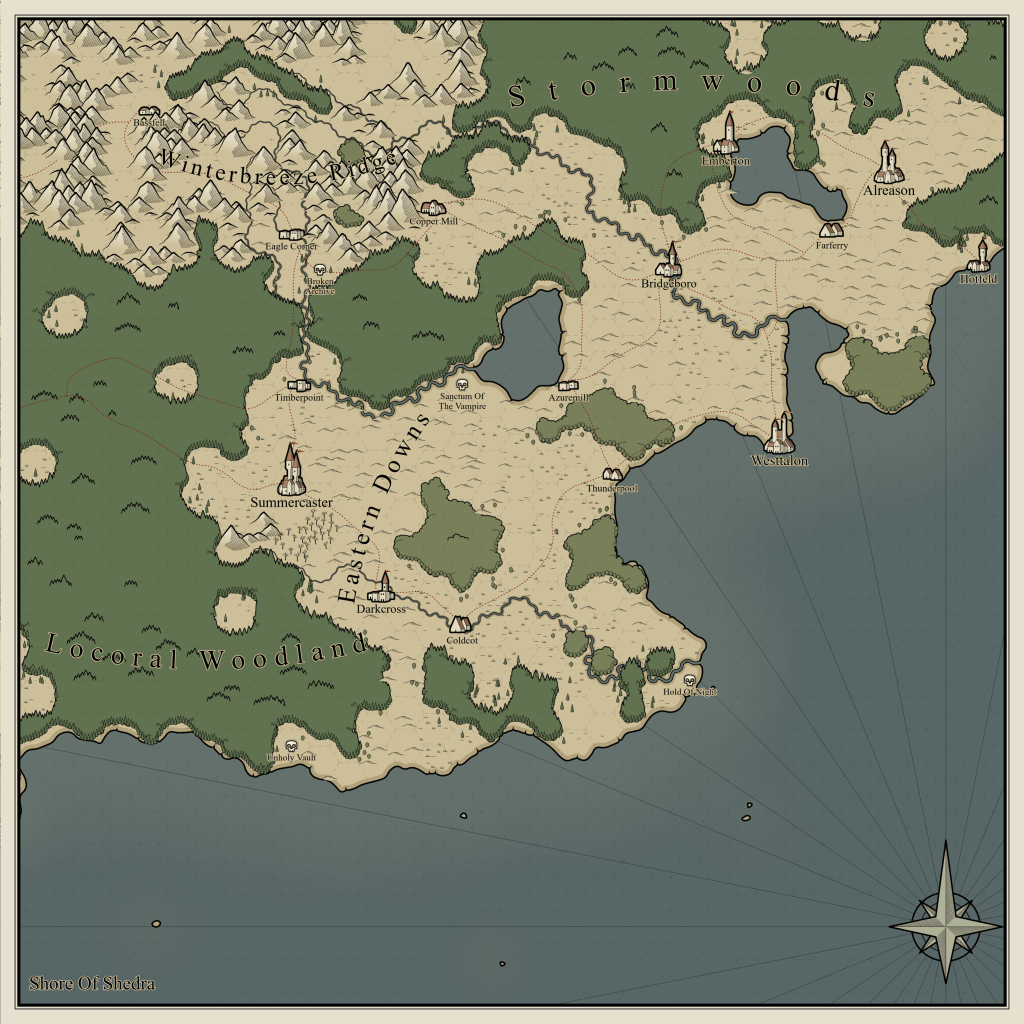
Previously, I created a list to help you populate your hex map with things likely to be found there. Those weren’t tables meant to be rolled on, but these are. The idea is that you’ve created a small-scale map (1-mile hexes) for an adventure. Find the terrain type in the categories below and roll for what might be found there.
- 100 Towns & Cities
- 100 Major Points of Interest
- 100 Minor Points of Interest (including things found in a town or city)
Try to populate hexes with purpose (or at least randomly ahead of time), and remember that on flat ground the horizon is 3 miles away and considerably further on a hill, so the heroes should often (outside of forests) be able to see across the map and decide to go see what that thing on the horizon is all about. Rolling randomly for what’s in a hex only when they enter that hex robs them of agency, because the decision to enter one moorland hex over another is meaningless.
Keep in mind also that most features found in a hex don’t fill the hex. A rocky outcropping, pond, or grassy glade within a forest hex, for example, could be just a 100-150 yards across (a football pitch), while a 1-mile hex is 1760 yards across (1.6 km).
In each hex, the leader should roll a check against the pathfinder skill using their intelligence modifier with a difficulty determined by the terrain (roll with advantage on a trail). On a failure, rolling a recovery means there was just a bit of time wasted re-finding the way; total failure means you are lost… (1d6: 1-2=you travel in a circle and remain in the hex; 3=N; 4=NE; 5=SE; 6=S). If you’re on a trail, you lose the trail and know you’re lost; otherwise, you don’t.
Categories
- Manorial Land
- Forest
- Wetlands
- Scrubland/Moorland
- Hills
- Mountains
- Desert
- Grassland
- Lake/Sea
- Volcanic Hotspot
1. Manorial Land
Manorial land is settled land that contains lordly manors. This is usually land that was once forest but was cleared long ago for farming and grazing. It’s typically found in lush valleys between mountains with rivers running thru them. You should manually site towns, cities, monasteries, and colleges on your local (1-mile hex) map, which should always be surrounded by manors that feed them. The assumption when traveling thru manorial land is that the heroes are on a road, which costs 1 point per hex.
If you roll anything other than “just manors”, roll for the possibility of a random encounter.
| 1d20 | Feature |
|---|---|
| 1 | Sacred place: roll on the Sanctuaries table. (Next manorial land roll is +2.) |
| 2 | Monument: roll on the Monuments table. (Next manorial land roll is +3.) |
| 3 | Marker: roll on the Markers table. If on a road, replace 12 with nothing. (Next manorial land roll is +3.) |
| 4 | Ruins: roll on the Ruins tables. (Next manorial land roll is +4.) |
| 5 | Deer park (much of the hex is fenced woodland, go around or risk encountering a ranger). |
| 6 | Stream (easily crossed; if on a road or trail, it even has a bridge or stepping stones). |
| 7 | Water feature: roll on the Waters table. |
| 8 | Gamekeeper’s gibbet (string or fence row of dead weasels, moles, stoats, foxes, crows, and/or hawks meant to show the local lord that the gamekeeper is actively controlling pests). |
| 9 | Rocky, hilly wasteland area (any encounter is likely a shepherd and sheep). |
| 10-20 | Just manors: Roll for a minor travel encounter. |
2. Forest
A forest is any large woodland area–sparse, thick, or dense–and may feature leafy trees in temperate zones, evergreens in mountains, or palms and rubber trees in tropical lands. Ancient forest is wild woodland that was never conquered and settled. New forest is woodland that was once settled and later abandoned due to plague, war, or other disaster. Exploring a forest costs 3 points per hex, or 1 if on a trail.
Regardless of what feature you roll, also roll for the possibility of a random encounter.
| 1d20 | Feature |
|---|---|
| 1 | Sacred place: roll on the Sanctuaries table. If ancient forest, roll on the Secret Places table. (Next forest roll is +2.) |
| 2 | Monument: roll on the Monuments table. If ancient forest, treat as “just woods”. (Next forest roll is +3.) |
| 3 | Marker: roll on the Markers table. If not on a road, replace 1-5 with Secret Places. If ancient forest, treat as “just woods”. (Next forest roll is +3.) |
| 4 | Overgrown ruins: roll on the Ruins tables. If ancient forest, treat as “just woods”. (Next forest roll is +4.) |
| 5 | Cave in a rocky hillside: roll on the Cave table. |
| 6 | Stream… (1d6: 1-2=with a little waterfall; 3-4=cascading down rocks; 5=filled with mossy rocks; 6=with stepping stones) you can easily ford. |
| 7 | Water feature: roll on the Waters table. |
| 8 | A grassy glade. |
| 9 | Rocky, hilly outcropping. |
| 10 | Elven orchard (fruit and nut trees, berry bushes, root vegetables, herbs). |
| 11 | Cottage of an NPC with some minor authority (ranger, warden, druid, or witch). If ancient forest, this is instead an encounter with elves of the territory. |
| 12-13 | A large fallen tree that is… (1d6: 1=fresh; 2=withered; 3=mossy; 4=hollow; 5=hollow & covered in mushrooms; 6=a decayed lump of mushrooms and moss). |
| 14-20 | Just woods. |
3. Wetlands
Wetlands in settled areas are considered “waste”. Marshes are wetlands surrounding slow, shallow rivers with lots of low vegetation such as reeds and surface algae and lily pads. Swamps are forest wetlands, with water-loving trees often covered in hanging moss. Roads thru wetlands twist and turn to stay to high ground and sometimes cross soggy areas via wooden causeway or just fording a shallow spot. Exploring wetlands costs 3 points per hex, or 1 if on a trail, which keeps to the high ground as much as possible.
| 1d20 | Feature |
|---|---|
| 1 | Monument from a time when this land was less wet: roll on the Monuments table. (Next wetlands roll is +2.) |
| 2 | Ruins from a time when this land was less wet: roll on the Ruins tables. (Next wetlands roll is +2.) |
| 3 | Marker: roll on the Markers table. If not on road or trail, replace 1-5 with nothing. (Next wetlands roll is +3.) |
| 4 | Wet cave in a rocky area: roll on the Cave table. (Next wetlands roll is +4.) |
| 5 | A peat bog or mire. |
| 6 | Rocky, hilly outcropping. |
| 7 | Boardwalk across the watery land to reach an old watchtower or wizard’s tower. |
| 8 | Cottage of an NPC with some minor authority (ranger, warden, druid, or witch) on a hillock. |
| 9-20 | Just soggy grassland with occasional trees on high ground. |
4. Scrubland/Moorland
Scrublands have poor soil not good for farming and are considered “waste”. They tend to be low, rolling hills and are mostly moorland or heath, covered in flowering evergreen shrubs (heather, gorse, and berry shrubs in Britain) and grasses. They have scattered trees around water sources. Grazing is good enough for sheep and goats. Exploring a moor costs 2 points per hex, or 1 if on a trail.
| 1d20 | Feature |
|---|---|
| 1 | Sacred place: roll on the Sanctuaries table. (Next scrubland roll is +2.) |
| 2 | Monument: roll on the Monuments table. (Next scrubland roll is +2.) |
| 3 | Marker: roll on the Markers table. If not on road, replace 1-5 with Secret Places. (Next scrubland roll is +3.) |
| 4 | Ruins: roll on the Ruins tables. (Next scrubland roll is +4.) |
| 5 | Cave in a rock outcropping or sinkhole: roll on the Cave table. |
| 6 | Stream (easily crossed; if on a road or trail, it even has stepping stones). |
| 7 | Water feature: roll on the Waters table. |
| 8 | Shepherd/traveler shelter. |
| 9 | Watch tower (inhabited or ruined). |
| 10-20 | Just shrubs on rolling hills. |
5. Hills
Hills that aren’t suitable for settlement may be rocky, grassy, shrub-covered, or wooded but tend to be rockier and more sparsely covered than flat lands. There may be broad, flat areas and steep, gravelly areas. And they may be grassy, bald, or capped by a rock outcropping. These are good places for fortresses, markers, standing stones, and burial grounds, since they aren’t good for farming but are quite visible in the landscape. The higher the elevation, the more evergreens, as opposed to leafy trees. Exploring hills costs 3 points per hex, or 1 if on a trail, which keeps to flatter land.
| 1d20 | Feature |
|---|---|
| 1 | Sacred place: roll on the Sanctuaries table. (Next hills roll is +3.) |
| 2-3 | Monument: roll on the Monuments table. (Next hills roll is +3.) |
| 4 | Marker: roll on the Markers table. If not on road, replace 1-5 with Secret Places. (Next hills roll is +4.) |
| 5-6 | Ruins: roll on the Ruins tables. (Next hills roll is +4.) |
| 7-8 | Cave in a rocky hillside: roll on the Cave table. |
| 9 | Water feature: roll on the Waters table. (Replace 3 & 8 with easily-crossed stream.) |
| 10 | Cottage of an NPC with some minor authority (ranger, warden, druid, or witch). |
| 11 | Dangerous rockslide area. |
| 12 | Hollow with a stream… (1d6: 1-2=with a little waterfall; 3-4=cascading down rocks; 4-5=filled with mossy rocks; 6=with stepping stones) you can easily ford. |
| 13-20 | Just hills. |
6. Mountains
Mountains may be low and gently sloped, with many evergreens, or steep and rocky, with cliffs and rockfalls. Lower spaces between them are mountain passes that often become trade and travel routes. There are often flat or bowl-shaped areas, which allow for some small lakes, and even long, narrow, but very deep lakes, depending on the geology. Exploring mountains costs 4 points per hex, or 2 if on a trail, which keeps to flatter land.
| 1d20 | Feature |
|---|---|
| 1 | Sacred place: roll on the Sanctuaries table. (Next mountains roll is +4.) |
| 2 | Monument: roll on the Monuments table. (Next mountains roll is +4.) |
| 3 | Marker: roll on the Markers table. If not on road, replace 1-5 with Secret Places. (Next mountains roll is +4.) |
| 4-5 | Overgrown ruins: roll on the Ruins tables. (Next mountains roll is +4.) |
| 6-8 | Cave in a rocky hillside: roll on the Cave table. |
| 9 | Water feature: roll on the Waters table. (Replace 3, 6, & 8 with easily-crossed stream.) |
| 10 | Rope bridge over a crevice. |
| 11 | Dangerous rockslide area. (If on a trail, the trail is blocked.) |
| 12-20 | Just mountains. |
7. Desert
Deserts are arid places that may be sandy or rocky or even frozen. Stands of trees may exist around water sources, but desert water holes can be salty, brackish, acidic, or poisonous. Exploring desert costs 1 point per hex, but a trail makes it less likely to get lost.
Note that cactus (saguaro, barrel, cardon, etc.) is a New World plant. The only cactus in the rest of the world is the vine-like mistletoe cactus.
| 1d20 | Feature |
|---|---|
| 1 | Oasis (pond with vegetation and couple of trees). (Next desert roll is +1.) |
| 2 | Monument: roll on the Monuments table. (Next desert roll is +5.) |
| 3 | Skeleton or mummified carcass of giant beast. (Next desert roll is +5.) |
| 4 | Ruins: roll on the Ruins tables. (Next desert roll is +5.) |
| 5 | Sacred place: roll on the Sanctuaries table. (Next desert roll is +5.) |
| 6 | Cave in a rock outcropping or sinkhole: roll on the Cave table. |
| 7 | Bad water hole (can literally be poison or acid); very little vegetation, maybe some bones. |
| 8 | Dry lake bed with one tree (alive or dead). |
| 9 | River (dry unless it’s the rainy season). |
| 10-11 | Rocky gorge. |
| 12-13 | Rocky plateau. |
| 14-15 | Gravel plains. |
| 16-17 | Salt flats. |
| 18-20 | Sand dunes. |
8. Grassland
Grasslands (prairie and steppes) are semi-arid with shorter or taller grass, according to rainfall. They tend to have trees only near rivers, ponds, and lakes. Some are natural, but some results from the clear-cutting of trees in areas not suitable for farming and subsequently abandoned. Grazing is good, so this land is often heavily used for raising sheep or cattle. Exploring grassland costs 1 point per hex, but a trail makes it less likely to get lost.
| 1d20 | Feature |
|---|---|
| 1 | Sacred place: roll on the Sanctuaries table. (Next grassland roll is +5.) |
| 2 | Monument: roll on the Monuments table. (Next grassland roll is +5.) |
| 3 | Marker: roll on the Markers table. If not on road, replace 1-5 with nothing. (Next grassland roll is +5.) |
| 4 | Ruins: roll on the Ruins tables. (Next grassland roll is +5.) |
| 5 | Watch tower (inhabited or ruined) on a hill. (Next grassland roll is +5.) |
| 6 | Rocky, hilly outcropping. Roll on the Cave table; 13+ is no cave. |
| 7 | Water feature: roll on the Waters table. |
| 8 | Skeleton or desiccated carcass of giant beast. |
| 9 | Stream (easily crossed; if on a road or trail, it even has stepping stones). |
| 10 | Shepherd’s hut |
| 11 | Stand of trees around a water hole. |
| 12-20 | Just grassland. |
9. Lake/Sea Coast
Lakes are mostly freshwater, and seas are mostly saltwater. They may be quite shallow or very deep. Only very large lakes have much wave activity. The shore may be rocky or sandy. Such places are very often populated, so if there’s no settlement, there is likely a very good reason (lake too salty, too many monsters, etc.). Exploring a shore costs 2 points, altho there may be a road or trail along it that costs 1 point. Exploring the water itself requires a boat or some other method, of course.
| 1d20 | Feature |
|---|---|
| 1 | Monument on the shore: roll on the Monuments table. (Next coast roll is +3.) |
| 2 | Ruins on the shore: roll on the Ruins tables. (Next coast roll is +3.) |
| 3 | Marker: roll on the Markers table. If not on road, replace 1-5 with Secret Places. (Next coast roll is +3.) |
| 4 | Wet cave in a rocky area: roll on the Cave table. |
| 5 | A marshy area around a river mouth. |
| 6 | Rocky, hilly wasteland area. |
| 7 | Abandoned/sunken boat or ship. |
| 8 | Floating log. |
| 9 | Washed up carcass of an aquatic animal. |
| 10-20 | Just rocky or sandy shore. |
10. Volcanic Hotspot
Wherever heat from the core of the planet rises to the surface, weird results will occur. Those results may be surprisingly pleasant warm springs for centuries or horrible volcanic eruptions that destroy the surrounding countryside. Volcanos and calderas (extinct or active) should be mapped. Exploring volcanic terrain costs 2 point per hex, or 1 point on a trail, which keeps to flatter, less dangerous terrain.
| 1d20 | Feature |
|---|---|
| 1 | Sacred place from a time when this place was habitable: roll on the Sanctuaries table. (Next volcanic hotspot roll is +4.) |
| 2 | Monument from a time when this place was habitable: roll on the Monuments table. (Next volcanic hotspot roll is +4.) |
| 3 | Skeleton or mummified carcass of giant beast. (Next volcanic hotspot roll is +4.) |
| 4 | Ruins: roll on the Ruins tables. Replace Rural Buildings and Lonely Places categories with ruins of a bathhouse. (Next volcanic hotspot roll is +4.) |
| 5 | Cave in a rock outcropping or sinkhole: roll on the Cave table. |
| 6 | Warning sign to turn back. |
| 7 | Brilliant turquoise crater lake that is deadly acid. |
| 8 | Geyser, mudpots or tar pits. |
| 9 | River (dry unless it’s the rainy season). |
| 10 | Hot springs or warm springs. |
| 11-20 | Just lava flow fields, ash-covered grass, and thermal vents. |
 zarban.com
Leave a comment