

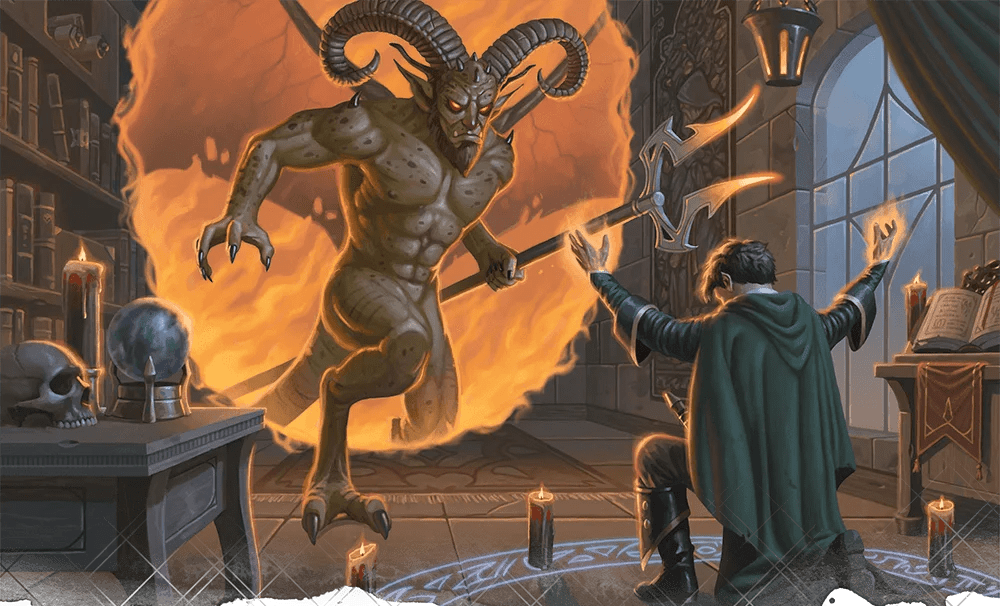
Infernal creatures shouldn’t just be evil bags of hit points. They should terrifying, powerful creatures that arise out of the Underworld to do the bidding of some evil god or powerful witch or sorcerer. Let’s change them up.
Goals
Demons use their powers to further their own ends, the ends of a master they serve (a god or a mortal who summoned them), or the ends of a mortal they’ve corrupted into making a deal Depending on your system, a demon may act as a patron for a sorcerer, granting arcane and/or unholy/druidic powers. (I like this for witches, who can use both.)
Powers
Demons are corporeal in the Underworld, but can be incorporeal on the material plane at will and so normally are. When corporeal, they have substantial unholy magical powers as an evil cleric or druid and wizard (at a level matching their hit dice).
Demons do their evil business by:
- Possessing people to do their dirty work. (Resist: difficulty 5+demon’s HD; recover to suffer terror.)
- Enthralling people into agreeing to do their bidding. (Resist: difficulty 7+demon’s HD; recover to suffer shock.)
- Making deals to corrupt people into doing their bidding.
- Taking physical form when the victim is too weak to hurt them.
Enthralled persons often appear distracted, distressed, or even crazed. A demon may hold any number of people in thrall an any time. Possessed heroes are effectively charmed and won’t do something fundamentally against their personality, like kill an ally. Enthralled persons get a save each full moon to break the enthrallment.
Take the player aside and give them a command the demon wants to them to accomplish. But if they accomplish the goal, the spirit leaves their body, and the player gets a substantial XP bonus. If they fail, they can be exorcised and get a small experience point bonus. If they refuse to play along, allow the hero to “self-exorcise” by force of will, but they get no XP bonus.
Possessed persons often appear distracted, but under stress, their features twist demonically, and they appear monstrous. If the demon voluntarily relinquishes control, it can regain control more easily (disadvantage on saving throw); but if a possession attempt fails, any later attempt is easier to resist (advantage on saving throw). Possessed heroes are effectively NPCs in the demon’s control. But possession can’t last long; the possessed mortal gets a saving throw to self-exorcise each day. On a success, the demon can’t possess that character again.
Some people (NPCs at the GM’s discretion) come to welcome demonic possession, reveling in the power and freedom, and are effectively the demon’s permanent lackey.

Clerics vs Infernal Creatures
In AD&D, paladins had the ability, starting at 3rd level, to turn not only undead as a 1st-level cleric but also demons and devils. The part about demons and devils was never mentioned anywhere else, including the cleric class features and the section on turning undead, but some DMs extended the feature to clerics. And that’s the way it should be.
Compel Fiend
The traditional turn undead feature can instead be called “compel fiend” and include undead as well as infernal creatures: demons, devils, and any other evil spirits you have in your campaign.
Below is a good system for turning undead from Dyson Logos, the fine fellow who makes excellent dungeon maps.
Compel Fiend: You’re able to call upon your deity to compel undead and infernal creatures to turn away and avoid you, and perhaps even to destroy them. Turned creatures will leave the area and won’t approach you again but may harm others. Destroyed creatures will collapse to dust and bone (corporeal undead) or cry out and be banished to their own plane (infernal creatures and incorporeal undead).
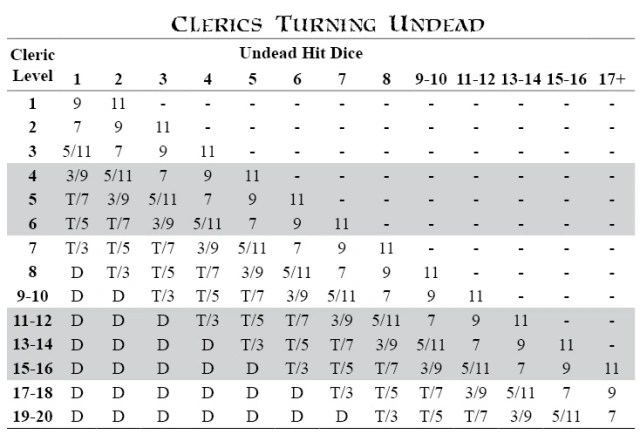
On the table above, find your level down the left side and the hit dice of the highest HD creature you’re trying to affect across the top. (Skeletons that are with a wraith are harder to turn.)
- A dash means you haven’t attained high enough level to affect that creature type.
- A number indicates the minimum you need to roll on 2d6 in order to successfully turn.
- When two numbers are indicated, roll once. If the result meets or beats the second number, you successfully destroy. If the roll meets or beats the first number but not the second, then you successfully turn.
- T means you automatically turn, and the number after the slash is what is needed to be rolled on 2d6 to destroy.
- D means you automatically destroy.
If you successfully turn or destroy, roll 2d6 again and add half your cleric level to the result. This is the number of total hit dice of creatures turned or destroyed (but always at least one creature), starting with the lowest hit dice creatures. Evil characters can, instead of destroying can compel the creature(s) to serve them.
 zarban.com
Leave a comment