

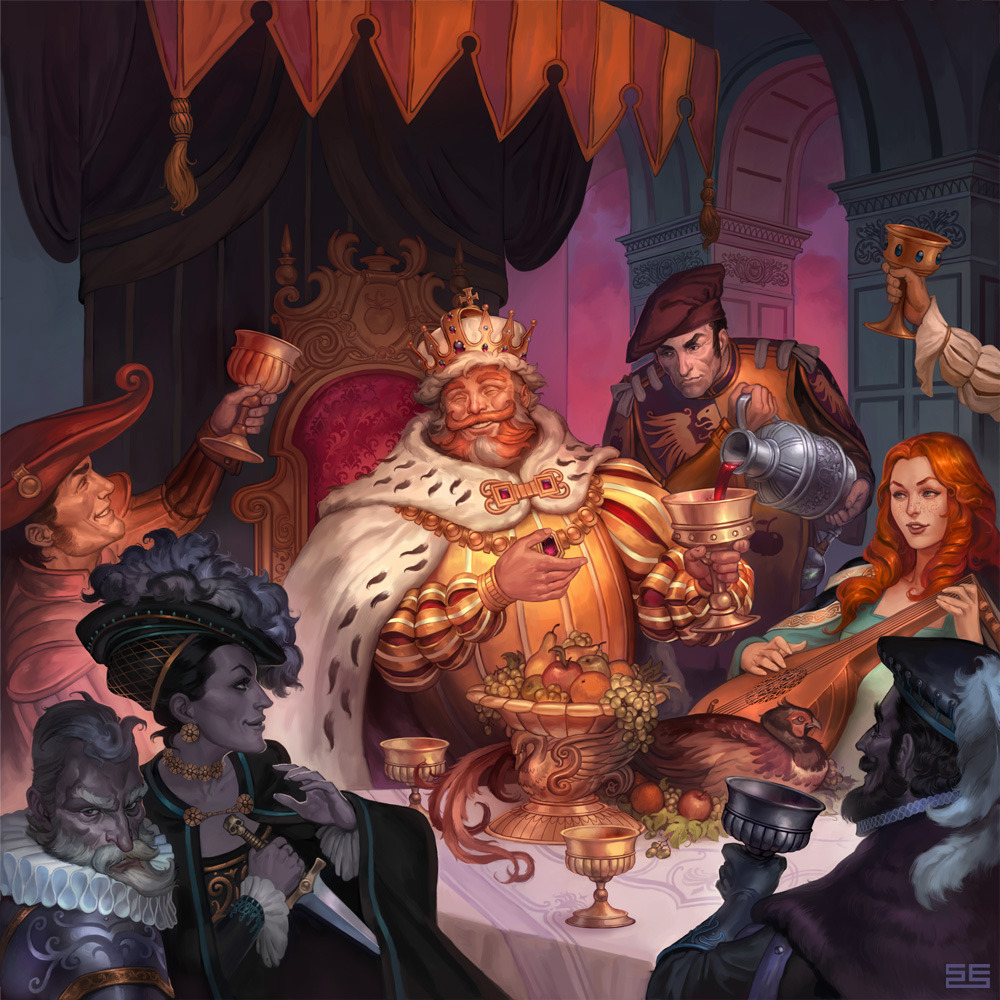
For most dragon games, only the most basic understanding of feudalism and manorialism is needed. But it’s helpful to define how it differs from the cultures of dwarves, elves, and halflings.
Feudalism
In (fantasy) feudalism, the royals (king, queen, prince, princess) are at the top, then come…
- nobles, who have their own hierarchy
- earls, who possess a county/shire
- barons, who possess many manors
- possibly others, such as counts and dukes
- landed gentry (non-noble lords and ladies), who typically possess several manors, and knights, who typically possess one manor
- landless gentry (gentlemen/gentlewomen) and knights errant
- commoners, who have their own hierarchy
- county/shire officials, who preside over cities, courts of law, prisons, forests, etc.
- yeomen, who possess land (typically 80 to 120 acres) directly of the king and may be fairly wealthy
- local officials, preside over manor workers, towns, and guilds
- professionals (educated folk like sages, tutors, apothecaries, scribes, and such)
- merchants, who may be quite wealthy but include common taverners and such
- craftsmen (skilled workers like blacksmiths and jewelers)
- tradesmen (semi-skilled workers like bricklayers and roof-thatchers)
- laborers (unskilled workers of all sorts, like ditch-diggers)
- peasants, who work the fields and tend the herds on a manor
- serfs, who are bound to labor on a manor (left out of many realms)
- slaves, who do all sorts of work and are not free at all (left out of most realms)
Manorialism
In (fantasy) manorialism, a manor is about 1500 acres (less if the land is very productive; more if it’s poorer quality, such as part of it being marshland or rocky). A manor has a manor house (usually fortified), a church, and a village (where the peasants live). The peasants work the fields and tend the livestock of the manor, some of which is designated as their own, some as supporting the church, and some as belonging to the lord of the manor. Certain parts may be held in common, like the village green, where a designated goose girl herds all the village’s geese each day.
The villagers train with weapons as footmen, in case of war. If the manor itself is attacked, the villagers–usually numbering 75 to 150–all run to the manor house, from which they can defend themselves.
The lord of a manor may or may not live in the manor house. Lords typically possess several (and, if noble, many) manors and live in a fortified manor house or castle where some of the lord’s holdings are clustered. (Their possessions are usually scattered, so that lords don’t have a large base from which to challenge the nobles.) Manors may also be possessed by an order of knighthood, a university or college, or an abbey, monastery, or other religious institution. A knight that is given land usually possesses a single manor (known as a knight’s fee or a fiefdom).
The manor house is run by a bailiff. The manorial land is managed by a reeve selected by the villagers. These are both commoners; the reeve might even be a serf. Waste is used on fields.
Manors typically include some woodland, which is heavily managed by coppicing, gathering fallen trees for firewood and lumber, pannaging hogs, and so on. A big part of its use is as a hunting ground for the lord of the manor. A gamekeeper would police it for poachers, to ensure commoners only take squirrels and hares. Knights (which included gentlemen, lords, and royals) did extensive camping/hunting expeditions for pleasure and as training for war.
Non-Manorial Land
Apart from manors, yeomen possess land directly from the king, usually amounting to 80 to 120 acres, which is all a single family can typically farm. They traditionally trained as archers.
Humans who don’t live in villages live in walled towns and cities. These include craftsmen and merchants, tradesmen, professionals, some gentry, and many peasants who work surrounding fields. Settlements are technically a part of a manor and pay rent to the local lord, who also acts as a judge in local disputes. Waste is collected by gong farmers to fertilize fields in the country or dumped in the nearest body of water. The very largest human cities have sewer systems that dump waste further away.
There are also forests, which are managed by a woodward and policed by rangers. (In ancient terms, a forest was any nature preserve.)
And (in a fantasy world), there is wilderness, which is wild and unmanaged land that is typically on a border with some other kingdom or otherwise untamed. This may be wasteland (marsh, swamp, desert, treeless badlands, etc.) or might have once been settled but later abandoned as a result of war, plague, or being overrun by barbarians or monsters. Some might even exist at the heart of the kingdom, separating certain counties/shires and serving as a hunting ground and adventuring land for nobles and commoners alike.
Courts of Law & Assize
Unique to humans are courts of law and assize. Serious crimes are taken to the county/shire court of assize, where a sheriff brings a criminal suspect to trial in front of a judge and jury, and the jury(!) investigates the case. The sheriff is also the aggregator and reporter of taxes. Serious civil disputes are taken to the county/shire court of law, where three judges decide the case as presented by the litigants. In both criminal and civil cases, an attorney may assist a defendant/litigant in making their case.
In many cases, a defendant or litigant may opt for trial by combat instead of trial by jury or judge. In some cases, trial by combat among nobles can verge on warfare, with the king approving a full-scale battle to settle the dispute.
Dwarves
Dwarves have their own realm, usually mountain and highland territory not favored by humans and held for all of known history. There, they graze livestock and do a little farming, but mostly they mine. They may live in walled towns, but their fortresses typically front great underground halls, the lower reaches of which are (or once were) their most productive mines. Such halls also include large chambers for the cultivation of mushrooms and other low-light foodstuffs that were the traditional fodder of ancient dwarves (in addition to some hunting and fishing). Waste is generally gathered for use in fields or in underground mushroom halls.
Commoners answer to dwarf lords, who answer to the King of the Dwarves. His realm is not not limited to his physical lands but includes dwarves in human lands, even tho they pay their taxes to their human overlords. So dwarves in a human city may join their king’s army in a war and call upon his judgment in a great dispute.
Some dwarves are more clannish and answer to a chieftain, who answers to a chief, who may or may not recognize a king. Criminal and civil disputes are handled by the court of the local authority (lord or chieftain), with tradition dictating when they need to be escalated higher. These courts may appoint a small group of capable people to carry out an investigation and, sometimes, trial and sentence; dwarves maintain small prisons, and execution is somewhat rare; hard labor that benefits the victims (including a dangerous quest) is somewhat common.
Many dwarves leave their native land and make their way in the realm of humans. They tend to be mercenaries and adventurers or else merchants of mining operations.
Elves
Elves have their own realm, usually a great forest they’ve held for all of known history. They don’t farm but rather cultivate orchards and gardens and game animals. The elves have only one permanent city, where the council resides. Elven “towns” are encampments of a year or so, often in the form of treehouses around an orchard. Waste is buried in shallow pits, later to be dug up and used to enrich the soil of the orchards and gardens. But at times in the past, elves have built (or employed others to build) with stone, and some of their ruins remain standing in their forests.
Much of the elven realm is wilderness, by human standards. It’s not so much ruled as it is policed by bands of elves in constant battle with goblins, orcs, and such over territory and game. Elves answer only to princes, who council together, with the most powerful among them designated the King of the Elves. Some elves (sylvan or wild elves) are more tribal and answer to a chieftain, who answers to a chief, who councils with elven princes. Disputes of authority are common and usually solved democratically (each warrior laying a spear in a pile behind their chosen leader), with close “elections” determined by battle. Elf courts are noble courts that deal only with matters of great import; local disputes are solved by local power-brokers and revenge-justice; elven criminals aren’t tried and executed so much as hunted.
Some elves leave their native lands and make their way in the realm of humans, usually for adventure but occasionally because they prefer the stricter order of human society.
Halflings
Halflings occupy and farm isolated valleys, usually in elven lands. Halflings have local councils, who ostensibly answer to the nearest elf prince but in practice are virtually independent. Halfling disputes are resolved by local councils, which can be fairly ineffectual. Punishment for halfling outlaws is subject as much to public opinion as to common law and usually takes the form of corporal punishment or banishment as an outlaw (and outlaws usually end up being killed as bandits).
Some halflings seek adventure or safety in the realm of humans.
 zarban.com
Leave a comment