

Dave Arneson created a game, Gary Gygax perfected it, and John Eric Holmes wrote it up. Their game was propagated across dozens of players, some of whom went on to DM their own tables, meaning at least a couple of hundred people played that game.
But pretty much no one else did.
Once the printed game went out to newbies who learned strictly from the book and not from others who had played with Arneson and Gygax, they played a whole different game. What we think of “OSR” is actually a revival of the second school of dragon games, and one that didn’t always jibe with the first school.
1. They Had Many Players
Their gaming groups were huge—as many as 50 players. Each session, 6 to 8 showed up. But which ones? No one knew. Adventuring parties were always a semi-random mish-mash of character classes and class levels. They had so many many players at the table, they had to designate a “caller“.
Your table probably sees the same four or five faces at every session. The characters do everything together, especially level up. Parties are often tailored to be able to work together and cover all the bases. Gygax’s table was a series of pick-up games; yours is the A-team.
2. Their Adventuring Parties Were Big
A lot of players means a lot of characters in a party. Plyus, their player characters had hirelings and henchmen. An adventuring party might be 10 or 12 characters. That’s a lot of characters looking for secret doors. So, even at a 1-in-6 chance (2-in-6 for certain ones), they were very likely to find every secret door (or, at least, the clue pointing to them).
Now, your table is probably the same three or four PCs. And they probably don’t hire a carter, porters, or shield-bearers, let alone bring henchmen. Consider having the more experienced players play two characters. Then, when a player’s character dies or is paralyzed, that player can take over one of the extra characters for a while. And they have a decent chance at finding those secret doors. Otherwise, just bump up their search chances.
3. Many Hands Made Light Work
Big parties mean having plenty of attacks per round to deal damage, so fights could be rather big. It’s easier to take on a dozen orcs if you’re dealing several attacks per round.
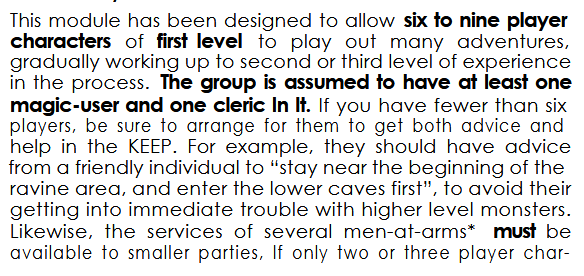
It also means having a lot of characters to carry treasure. So the treasures could be big. Too big. 2nd Edition AD&D toned down the treasure quite a bit. 5th Edition D&D is actually kind of stingy, because D&D designers have still not figured out how to make spending loot fun. There are ways to fix this, tho.
4. PCs Often Sat out Sessions
Because there were so many players, most PCs would only find their way to the table once a week or so–more, if the player had multiple characters. Giving 1 hp per day as “healing” seemed adequate; your character would often get 7 hp back at the beginning of the new session. Sitting out sessions was punishing for characters that were off crafting magic items or building a stronghold; these things took weeks or months—in-game and out-of-game—so it meant you couldn’t play your character during that time… but he or she would eventually come back with something cool.
Nowadays, every character features in every session. Overnight rests are dictated by the story, not by Gygax’s need to get enough sleep for his job. Less downtime means the PCs need more healing (and boy does 5e give it to them!). Taking weeks off to craft something doesn’t mean anything, because it will happen between sessions, so the next adventure won’t start without your character. So crafting has fallen by the wayside to keep players from saying “We take a year off, and I craft a couple dozen scrolls, potions, and wands.” (There are still ways to allow crafting, tho.)
5. Every Session was a One-Shot in a Megadungeon
In the early years, every session started with the heroes in town, gathering a few supplies, and hiking to the nearest megadungeon. A lot of early advice assumes the DM will design several levels of a dungeon, with various factions and wacky predicaments. And at the end of the night, the party traipsed back to town… every time. They didn’t stop in the middle of a dungeon level, because there was no telling which players would show up next time.
Since TSR didn’t really publish any megadungeons (even Descent in the to the Depths of the Earth just had a one-level map), most later gamers kept their adventures to one or two levels. And when the candles burned low, they just… stopped. Since they knew they’d (pretty much) all make it to the next session, the DM and players could just make a few notes and pick up next time where they left off. This changes things greatly, because there’s far less passage of time in later games; modern 5e gamers sometimes complain that their campaign is so tightly plotted that, when they think about the calendar, only a few game weeks passed between the heroes first starting out at 1st level and finally reaching 20th level.
Because there’s so little downtime in 5e campaigns, PCs will level up in the middle of an adventure or even in the middle of a session, with no logical way to absorb their experiences and learn new spells or combat techniques—they just… get them. That’s one of the reasons for playing OSR-style sandbox campaigns with shorter adventures with weeks or even months of downtime between them.
6. They Didn’t Use All Those Rules
When Gygax wrote 1st Edition AD&D, he was trying to make it different from Basic & Expert D&D, so he could stop paying Dave Arneson royalties for creating the game. (Arneson had gone off to found his own game design company.) As a result, Gygax included many rules that he didn’t much use or even playtest; it’s unclear exactly which ones these were, but they included things like weapon speed factor and weapon-vs-armor-type modifiers, and probably chance of contracting a disease or parasitic infection, the pummeling, grappling, and overbearing tables. Gygax stated that he tried to create a rule set that covered nearly anything that might happen in the game, so that tournaments relied less on DM rulings, but it’s not a very realistic idea.
Most DMs just skipped all the fiddly rules and adjudicated rare events on the fly and still do to this day. 5th Edition has largely done away with them for that reason (altho it filled their pages with loads of character options nonsense). Retroclones like Old-School Essentials (true to its name) avoided things like disease contraction rolls like, well, like the plague.
7. They Remained Wargamers at Heart
Because the early designers and players of Dungeons & Dragons were wargamers, they had a certain patience with clunky rules, index matrixes, and bookkeeping that later gamers didn’t usually have. It also gave them certain expectations that later gamers didn’t share, namely that fighters would eventually become lord of a manor, build a stronghold, and raise an army. This would result in domain-level play. When the time came for raising an army and fighting large-scale battles, Gygax and company simply reverted to a wargame system. But the idea of domain play was critical to the balance of the game: fighters got armies; wizards got powerful enough to fight armies.
Later gamers barely dabbled in domain play—partly because the only rules for it were the prices for building parts of a stronghold and hiring a garrison. Without followers, strongholds, and armies, fighters have nothing to look forward to at high level other than magic items—and they quickly get overwhelmed by the power of wizards—who, of course, also get magic items. To address this, spellcasters need to be curtailed at high level, and fighters need something to even them out, like 5e feats, 4e exploits, my heroic exploits, or DCC’s mighty deeds of arms. Of course, 5e also gives feats to wizards, because of course they do.
8. We’ve Figured out Better Ways
Dungeons & Dragons was the first role-playing game with clearly defined rules. There’s no way they got it right right out of the gate. There’s no way Moldvay Basic and Cook Expert are the Renaissance masterworks some portray them as.
We know that attack tables and THAC0 indexed to descending armor class can be replaced with simple attack bonuses to hit ascending armor class. We know that d20, roll-high mechanics are cleaner and more easily calculated than using whatever dice Gary Gygax had nearest to him when he came up with a mechanic and more fun than trying to roll a 1 with roll-under mechanics.
Takeaways
So, yeah, don’t play old-school games RAW, because you’re not going to play them the same way Gary Gygax and friends did, so they’re not going to work quite right, and they were more convoluted than necessary anyway. That’s why everybody house-ruled their games.
But don’t play 5e either. It’s worse.
 zarban.com
Leave a comment