

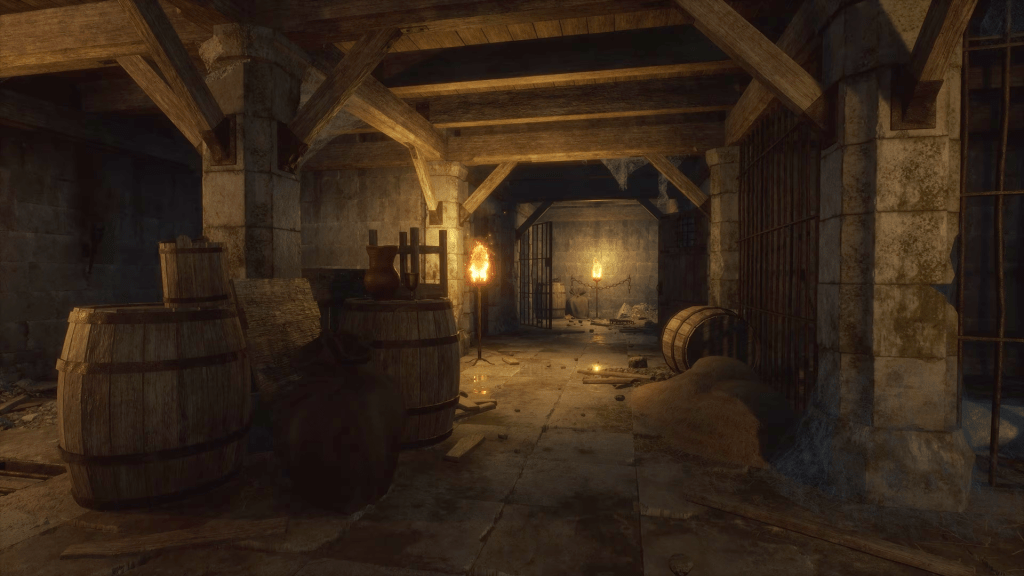
Having a little trouble coming up with how to populate your lonely ruin, abandoned chapel, spooky crypt, or cavern complex? Roll some dice.
Generally, you should plan out the major rooms of your dungeon and the encounters that make sense in them. Is this a lair? It should have a common room, food storage, a leader’s chamber, etc. Is it a temple? It should have a sanctuary hall and inner sanctum, as well as a treasure vault. These should have your pre-determined encounters, like various cultists, guards, and evil priests.
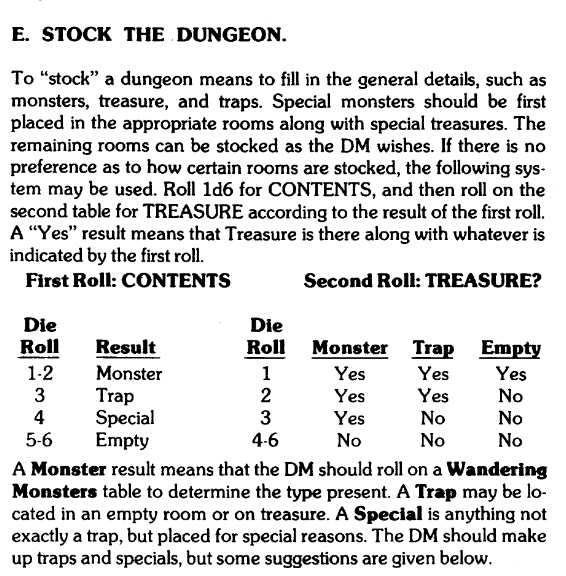
For the various other rooms to fill out the map, roll for a random category and use the category’s list. (This is, after 45 years, a return to the Moldvay Basic method. ☺️)
Categories
- Water or Debris
- Level Change
- Creature to Fight
- Creature to Talk to
- Creature to Deal With
- Guardian to Get Past
- Something Weird
- Trick
- Trap
- Puzzle
- Predicament
- Secret
Bonus: There’s an Exit Here
1. There’s Water or Debris Here
Water is very common underground and in ruins, as is debris, having fallen from the ceiling and walls when the earth shifted or when mortar started to crumble, etc.
1d20
- Rocks and wood debris partially cover the door you need to exit thru. Move some to be able to open the door.
- It’s partially flooded with a pit covered by the dirty water. Any who can’t float/swim are in serious danger.
- The remains of a fire have left ashes and charred debris.
- Water drips from the ceiling constantly.
- There’s a refuse pile, which likely harbors nuisance creatures, like rats or rot grubs.
- There’s a well here… (1d6: 1-2=flat and open; 3=covered by an iron grate; 4=covered by a wooden lid; 5=surrounded by an iron railing; 6=surrounded by a wooden frame).
- Bones of the ancient dead litter the floor.
- A small underground river flows thru here, easily crossed.
- A pile of debris includes a good deal of personal items: shoes, pottery, tools, etc.
- There are harmless puddles here and there, where there are depressions in the floor.
- The remains of a wooden staircase lie below a door up on the wall or hole in the ceiling.
- A once-fine fountain bubbles perpetually, kept clear by harmless blue ooze.
- Sand, filtered down thru cracks, stands in discreet piles.
- There is a once-fine bathing pool here… (1d6: 1-4=now stagnant and scummy; 5-6=kept fresh and clear by the constant flow of water [or magic]).
- The debris is (1d6: 1-2=giant snake skins; 3-4=giant lizard skins; 5-6=giant insect exoskeletons) and other evidence of monstrous molting.
- There is an underground lake with… (1d6: 1-2=a fine yacht with seating for up to eight oarsmen; 3-5=an island in the middle; 6=both a yacht and an island).
- It’s littered with sticks, leaves, and such: the remains of the nest of some large creature.
- You might use fallen rocks to block a passage to keep a monster from entering the room.
- It’s littered with the broken-down remains of furniture.
- In addition to one of the above (roll 1d12 on this table), there’s an exit.
2. There’s a Level Change Here
Level changes are important to creating an interesting dungeon.
1d20
- A… (1d6: 1-2=straight; 3-4=double-back; 5-6=spiral) staircase leads up.
- A… (1d6: 1-2=straight; 3-4=double-back; 5-6=spiral) staircase leads down.
- A ladder allows access up to another level.
- A ladder allows access down to another level.
- The space, or part of it, is sloped up to another level.
- The space, or part of it, is sloped down to another level.
- A spiral staircase up unfolds or telescopes down from the ceiling when triggered.
- A spiral staircase down opens in the floor when triggered.
- It has an… (1d6: 1=open ledge; 2=balcony; 3=catwalk; 4=platform; 5-6=mezzanine) that looks down on this room, accessible by a spiral staircase in the room.
- It has an… (1d6: 1=open ledge; 2=balcony; 3=catwalk; 4=platform; 5-6=mezzanine) that looks down on this room, accessible only from another room.
- There’s a manual elevator in decent working order. Pull on one of two chains on pulleys to make it go up or down. The pulleys allow you to lift 3x your max lift stat.
- At the bottom of a natural crevice, passages lead to more chambers.
- A natural sinkhole descends into darkness; only oozes, fungi, and such live there.
- A chain hanging from the ceiling descends into a hole that leads to prisoner cells.
- Rough natural stone formation could allow you to climb up to niches or caves.
- A short set of steps leads to a dais or platform at one end of the room.
- A tall set of steps leads to a high dais or platform at one end of the room.
- The floor is far below, and bridges connect platforms.
- The ceiling is far above, and stairs up connect to platforms.
- Standing on a particular spot levitates you up to reach a platform or door.
Roll again on the categories table for what else is in the room. If the result is a level change again, it is instead an exit.
3. There’s a Creature to Fight
Apart from the main inhabitants, incidental creatures may be combative. The presence of some is obvious but others may require a little backstory.
1d20
- A refuse pile or food store conceals… (1d6: 1-2=giant rats; 3-4=giant beetles; 5=giant centipedes; 6=a carrior crawler).
- Among normal things is a disguised… (1d6: 1-2=mimic; 3=cloaker; 4=trapper or lurker above; 5=darkmantle; 6=roper).
- Hiding in a big crack in the ceiling or wall is a… (1d6: 1-2=black pudding; 3-4=gray ooze; 5-6=ochre jelly).
- Roosting in the high ceiling are… (1d6: 1=vampire bats; 2=giant bats; 3=stirges; 4=piercers; 5=darkmantles; 6=harpies).
- A disused side tunnel or chamber is home to… (1d6: 1=giant spiders; 2=A grick or two; 3=a phase spider; 4=a gibbering mouther; 5=a giant lizard; 6=giant toads).
- Prowling for prey are a… (1d6: 1=few wererats; 2=werewolf; 3=wereboar; 4=cavebear; 5=couple of grells; 6=a pair of trolls).
- A curiously fresh tunnel is result of a burrowing… (1d6: 1=xorn; 2=remorhaz; 3=umber hulk; 4=behir; 5=purple wormling; 6=purple worm).
- Rogue, summoned, or patrolling… (1d6: 1=shadows; 2=hell hounds; 3=dark naga; 4=iron cobra; 5=shadow mastiffs; 6=minotaurs).
- A magic mirror produces an evil duplicate of the first character to approach it, which leaps out and tackles the character, mixing them up.
- In the ankle-deep water, a gray ooze waits. It will pursue any life but is slow.
- In the calf-deep water, a water elemental guards a treasure for its master.
- In the knee-deep water, a water weird is trapped and could be freed by opening a valve to connect the pool to an outlet or killed by opening a drain to remove the water.
- A small group of rust monsters lurk in the shadows, attracted to whomever wears metal.
- In the waist-deep water, a giant octopus rests. 1 in 1d4 chance each of disturbing it, but it’s not overly aggressive. It can crawl on land for hours at a time.
- In the chest-deep water, a giant water snake hunts. 1 in 1d3 chance each of disturbing it.
- Animated corporeal undead… (1d6: 1-3=some skeletons; 4-5=some zombies; 6=two mummies) awaken and crawl out of the water, sand, or muck to fight intruders.
- Naturally occurring corporeal undead… (1d6: 1-2=ghouls; 3-4=wights; 5=ghasts; 6=bog bodies) awaken and crawl out of the water, sand, or muck to chase away looters.
- Incorporeal undead… (1d6: 1=wraiths; 2=specters; 3=ghosts; 4=banshee; 5=shadows; 6=ghost) haunt the location and pitilessly attack all living things.
- Corpses impaled on the spears of a “trap” are actually animated undead that attack any who try to pick their way thru the room to the other side.
- An out-of-the-way cavern with its own exit is the lair of a hungry… (1d6: 1=basilisk; 2=young dragon; 3=chimera; 4=medusa; 5=cyclops; 6=otyugh).
Whenever possible, consider giving the heroes a different objective than kill them all.
- Make the opponents flee, which should happen when they lose half their number.
- Kill the leader, because the subordinates are virtually endless but will flee without leadership.
- Get by guards quietly, so that you avoid alerting overwhelming numbers/power.
- Retrieve an item from the opponents, and when you have it, flee.
- Disrupt an action the opponents are performing (brewing a potion, sacrificing a captive, summoning a fiend, opening a magic portal, casting a spell to create undead, etc.).
- Close a portal, such as a gate, bridge, or magic portal, to stop opponents from being able to overwhelm you with numbers.
- Rescue an ally from the opponents, and when you have them, flee.
- Survive against overwhelming numbers or power, because backup is on its way or because the opponents have a limited amount of time.
- Escape with your life against overwhelming numbers or power.
- Turn opponents to persuade them to stop fighting or to change sides.
- Subdue the opponent, because it’s a good NPC temporarily mad or charmed.
- thru 20. Kill them all.
Or at least consider making the situation more complicated. Roll 1d8.
- There’s water, fire, mud, or quicksand here.
- There’s a cliff, pit, crevice, pool of water, or other drop-off here.
- There is a ledge, balcony, overhang, hillock, or other extra level/high ground to the space.
- There’s an anti-magic or wild-magic zone here.
- The opponents attack from multiple sides.
- You are attacked thru murder holes in the… (1d6: 1-2=stone wall; 3=ceiling; 4-6=wooden wall weak enough to smash thru).
- After you pass by, a secret door opens, and out come armed denizens of the dungeon.
- After a pit trap is activated by the third person to walk across it, a secret door opens, and out come armed denizens of the dungeon.
4. There’s a Creature to Talk to
Not every creature has to be fought. Some can be chatty. Try to figure out some backstory that makes a chatty creature/character make sense in the location.
1d20
- Neutral creatures (like myconids, deep gnomes, etc.) just want to be left alone.
- Other adventurers explore the same location and will talk but not combine forces.
- A captive you should set free can offer information.
- An imprisoned evil goblin is happy to talk… and try to finagle its way to freedom.
- A neutral mountain giant knows the comings and goings of the puny creatures all around and might be persuaded to tell of them.
- A medusa wants information about the outside world… and assurance you won’t kill her.
- A salamander in a lava cavern despises other denizens and so may help adventurers.
- A sphinx occupies a great cavern or ruined structure and is willing to trade knowledge.
- Only the lonely hag knows the whereabouts of the lost treasure you seek.
- A demon captive of evil priests might tell of the cult’s plans.
- A drow elf approaches you to parley; there are worse enemies in this place than she.
- A ghost you should help attain solace. It might know something… if you can get it to be coherent for a moment.
- A young, penniless dragon is frightened and only willing to talk from a distance.
- A powerful but dumb creature demands to know if you have magic items; it’s been tasked with gathering them and will go away if given one, but it can be fooled easily enough.
- An animate painted portrait/statue that can talk and offer clues, if you’re clever.
- The figure in the magic mirror is you, but its words are its own….
- It’s a corpse worm that recently ate the brain of… (1d6: 1-2=an adventurer; 3=a commoner; 4=a prisoner; 5-6=a foe of the heroes—perhaps even one they killed earlier).
- An illusory caretaker of the location was created to help travelers but speaks of the ruins as if it’s still in its heyday.
- A wild boar wearing a hat is chatty fellow; does the hat make any creature intelligent, or does being on a beast’s head simply allow the hat to express itself, or does an intelligent boar simply have a taste for headwear?
- It’s an ooze that long ago absorbed an intelligent sword and is now one with it, the sword still evident in its semi-transparent mass, glowing each time it talks.
5. There’s a Creature to Deal With
Some creatures don’t possess or guard any treasure but may stand in the way of exploration. Even creatures that can’t negotiate can be dealt with creatively.
1d20
- A colony of bats occupies a cavern or very large room and has left quite a noxious, slippery mess on the floor; they flee noisily if disturbed.
- A fair number of non-aggressive… (1d6: 1=large centipedes; 2=mice; 3=rats; 4=large beetles; 5=lizards; 6=large spiders) scatter if disturbed.
- There’s a carrion crawler minding its brood in a large animal carcass and willing to ignore creatures that don’t seem aggressive.
- There’s an otyugh happily wallowing in a pile of waste and refuse and hoping for more.
- A not-particularly-combative flail snail meanders.
- In an out-of-the-way chamber… (1d6: 1=shriekers; 2-3=yellow mold; 4-5=green slime; 6=violet fungus).
- A pixie has entered from a narrow chimney and made a little home here; it might provide information but might become mischievous.
- In the thigh-deep water, an electric eel lurks. 1 in 1d6 chance each of disturbing it, but it’s largely defensive.
- In a chamber open to the sky, a treant has cultivated a copse of ordinary (but expertly shaped) trees it guards jealously.
- In a chamber open to the sky, a shambling mound has cultivated a wet, overgrown lair filled with carnivorous plants like giant sundew and Venus flytraps.
- A pair of nothics search for magic and are willing to deal for it.
- Something you want is overgrown with grasping vines.
- A chamber filled with delicious mushrooms that restore 1 hp each adjoins a cavern of neutral mushroom folk, whose offspring are the aforementioned delicious mushrooms.
- Alarm bugs—largish, dark brown, beetles—make a loud noise when frightened or squashed, setting up a chain of alarms thruout the population in a given location.
- In a watery grotto, a beautiful water nymph sits on a huge mushroom and reacts with fear when she detects you. She’s harmless and has helpful information, but if she feels threatened her protector will surface: a huge, fierce merrow.
- Whispering whonks—snails the size of an apple—call to one another in what sounds like the whispers of humanoid voices saying, “Over here”, “Get them”, “Get out”, and “Bring me more”. They seem to mimic local humanoids primarily but occasionally mimic other creatures as well. They might whisper something useful… like a password.
- Glustuck beetles have made the area very sticky.
- Slipperwill snails have the the area very slippery.
- A small number of augury bugs—flying insects that can, if prayed over at rest, reveal a one-word message from your god—reside here. Easily disturbed.
- The chamber is home to a small number of portles—soft-shelled turtles with a magical connection to others of its kind. Touching one allows a person to teleport to the location of any other portle in sight, including areas that are otherwise inaccessible. Each portle can only teleport a man-sized creature once per day or small creature twice.
6. There’s a Guardian to Get Past
Altho guardians could fall into one of the other creature categories, they should be more common than any other type. Some creatures—even those set to guard treasure or a passage—may be avoided, tricked, or even persuaded.
1d20
- A construct is tasked with keeping intruders out but might be persuaded that you’re not intruders. A magic key needed is embedded within it, which it won’t reveal easily (and which will be very hard to remove if it’s destroyed).
- A guardian naga warns the heroes away from an area for fear they will trigger a negative effect, but the heroes later find they must trigger that effect to avoid something worse.
- There are neutral creatures who dislike strangers trespassing on their territory.
- It’s a mummy brought here in secret from a distant tomb, and it thinks it’s still guarding a royal tomb in the desert. If enlightened, it will merely leave to trek back.
- There are corporeal undead that awaken only if approached.
- There’s a gelatinous cube blocking the way that could be lured away by food.
- Spirit guardians (per the spell) are frightening and will immediately attack evil creatures but will ignore neutral creatures who don’t try to pass, and will welcome good creatures.
- Werebears guard these caves and must be convinced the heroes’ purpose is noble.
- A spectator guards a group of chambers from the main denizens; they currently have… (1d6: 1=hatred for one another; 2=regular battles; 3=occasional assaults; 4=an uneasy truce; 5=a genial relationship; 6=a friendly understanding not to trespass).
- A water weird in a pool guards a group of chambers from the main denizens; they currently have… (1d6: 1=hatred for one another; 2=regular battles; 3=occasional assaults; 4=an uneasy truce; 5=a genial relationship; 6=a friendly understanding not to trespass).
- A helmed horror guards the tomb of its master from looters, and other denizens steer clear.
- A sphinx guards a great cavern or ruin but is willing to engage in a battle of wits for passage.
- Four ogres guard the passage for their master, but they’re dimwitted enough to trick.
- An illusory guardian poses questions about the former inhabitants that any authorized soul should be able to answer; the answers may lie in documents in another room.
- The face carved into a magic door can talk and implies that it’s hungry for something other than food, and providing it will convince the door to open.
- A thirsty guardian merely wants blood—any blood—but a full flagon of it.
- An iron golem will allow you to pass freely thru one gate but fight you for passage thru another.
- An intelligent giant owl guards a treasure hidden somewhere on a ledge or in a niche up very high in this ruins.
- A banshee guards her own tomb but wants something you can offer more than she wants her tomb undisturbed.
- Enchanted crabs swarm anyone who tries to cross their master’s threshold.
7. There’s Something Weird Here
Some things are merely beautiful, strange, or mysterious.
1d20
- There’s a soaring high ceiling here.
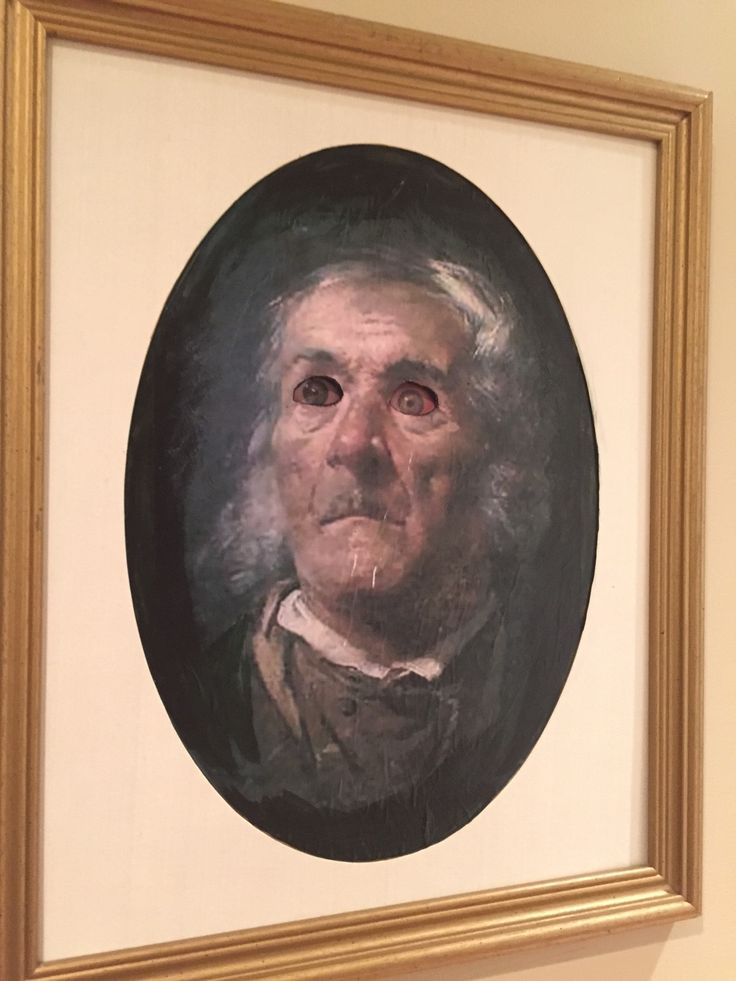
- There’s one of those portraits with removable eyes so someone can spy from behind.
- On the walls or floor are… (1d6: 1=prehistoric cave art; 2=old runes that praise some elder god; 3=arcane glyphs that tell about some event; 4-5=dire warnings from the builders; 6=a clue from previous adventurers).
- There is a… (1d6: 1-2=free-standing globe; 3-4=set of ancient standing stones; 5-6=mechanical clock).
- There is fine furniture, tapestries, and/or carpets in usable (but not valuable) condition.
- There’s a particularly grand door, gate, or staircase to another part of the dungeon.
- Weird but mostly harmless flora or fauna live here.
- There’s a geological marvel… (1d6: 1-2=geodes; 3-4=large crystals; 5-6=seam of tiny or semiprecious gemstone).
- There’s a windlass or capstan whose chain goes thru a hole in the wall. Turning it pulls something unseen on the other side. It’s a… (1d6: 1-2=drawbridge; 3-4=portcullis; 5=stone deadfall trap (sets it); 6=collar around a captive monster’s neck (pulls it against the wall, to allow safe passage).
- Something or someone is buried here in a crude grave or cairn.
- There are remains… (1d6: 1=of a creature killed by a monster; 2=of a person killed by a monster; 3=of a person killed by a trap; 4=of a creature killed by a trap; 5=so ancient that limestone water has dripped onto them and solidified; 6=of a creature too big to fit thru the door; it must have grown up here or been magically shrunken).
- The room includes the illusion of two sleeping guards or a guardian monster, but the magic has grown so weak that the illusion is see-thru.
- A wall of force holds back an underground lake or river, creating a window into it.
- A surprisingly large number of one type of mundane item is stored here… (1d6: 1=tools; 2=empty barrels; 3=chairs; 4=chain; 5=rope; 6=clay pots).
- On display here is a sizeable collection of one type of item… (1d6: 1=handsome flagons; 2=glass bottles; 3=fine candlesticks; 4=artful masks; 5=holy symbols; 6=monster skulls) of some modest value.
- There’s a strange device with gears and dials of a mysterious purpose (predicting eclipses, solstices, falling stars, rise an evil overlord, return of the true king, etc.)
- A courier snail—non-aggressive oversized snail that can deliver a letter like a homing pigeon, only much slower. Crawls on walls and ceilings with ease. Chance of carrying a letter: 4-in-6.
- Barrels full of (apparently) human bones, perhaps stolen from an ossuary/tomb and meant for some nefarious ritual or decoration project.
- There are 1d3 oddities decorating the place.
- In addition to one of the above (roll 1d12 on this table), there’s an exit.
8. There’s a Trick Here
Something about the place causes a problem. There’s no particular solution.
1d20
- When the door is opened, a great gust of wind blows thru it, requiring all to make a dexterity check or fall prone.
- Instead of treasure, the vault contains only a treasure map.
- An ally is taken with madness by some foul cursed item. He’s violent, but don’t hurt him!
- There are rocks that are so sharply pointed (or hot) that you can’t walk across them.
- Passing thru a door without speaking the password teleports you randomly to… (1d6: 1=the entrance; 2=a trap; 3=a random room; 4=the previous room; 5=a ledge over the current room; 6=the next room, as expected). Roll for each character passing thru.
- A treasure (marble or some other beautiful stone; but not sovereign material) gets heavier the closer it gets to the entrance/exit of the dungeon (but back to normal as it goes away from the entrance/exit either deeper into the dungeon again or away from it, if the heroes manage to drag the extremely heavy thing past the exit).
- When you touch an idol, gravity flips, and you fall to the (18-foot) ceiling. You can navigate the dungeon by walking on the ceiling, or touch the idol again, except it’s fixed in place, 12 feet above your head.
- If a locked chest is opened without the key, it will release Slow gas that affects everyone in the room as the spell. The key is hidden in the room.
- When you close a door, it disappears. Anyone on the other side sees it & can open it, but there’s just plain wall on the inside.
- Stepping thru a large mirror leads to a mirror-image version of the dungeon. Even words there are backwards. There are different rooms, but there’s no exit; the only way out is back thru the mirror.
- Doors lead to rooms in a magical way that doesn’t make spatial sense.
- Out of a portal comes a demon, which attacks. Each time you defeat a one, another appears from the portal. You can shut down the portal by merely covering it with a gossamer handkerchief a mysterious NPC cryptically assured you “will help you defeat even a thousand demons”.
- You enter at the bottom of a tall room and proceed up some stairs to the top, where there is a door. But a trigger causes the room to quickly fill partway with water.
- The spiders’ venom or fungus’s spore cloud slowly saps your strength or wisdom (1 point per hour), but a known antidote is available at an apothecary shop back at the city.
- The place… (1d6: 1-2=catches on fire; 3-4=begins to flood; 5-6=starts filling with smoke), requiring you to either stop it or escape.
- Touching a mystery object triggers magic that makes everything in the room levitate, making it difficult to maneuver.
- A gaping chasm in a large chamber/clearing has an invisible bridge somewhere along it. The heroes may or may not know about it beforehand, but the monsters certainly do.
- The room includes the illusion of two sleeping guards or guardian monsters.
- You move a stone, which breaks in two, and find it covered a 1-foot diameter hole about 10 feet deep. When you leave the room, the hole slowly follows, eventually catching up when you stop. To get rid of it, fill it in completely with rocks and dirt or find a new stone large enough to cover it. This is a failed attempt to make a portable hole.
- This is an anti- or wild magic zone. 1d6:
- 1-2=Anti-magic: No magic functions here, including magical bonuses.
- 3-5=Minor: Any use of magic (spells, potions, item features, natural magic abilities, etc.) works but results in a minor wild magic effect on the caster.
- 6=Major. Any use of magic (spells, potions, item features, natural magic abilities, etc.) results in a major wild magic effect on the (1d3: 1-2=caster; 3=target).
9. There’s a Trap Here
Some things capture or injure, if you’re not careful.
1d20
- Step in the wrong place, and… (1d6: 1=a net scoops you up; 2=a cage falls on you; 3=rocks fall on you; 4=the ceiling collapses on you; 5=the trap door opens under you; 6=a crossbow trap is triggered).
- Step in the wrong place, and… (1d6: 1-2=you’re shrunken to 1 foot tall; 3-4=the doors disappear; 5-6=you’re enlarged to 12 feet tall) until you step in the right place.
- A pit trap is covered by a light weave of reeds covered in light debris, like the rest of the floor. It will feel spongy if tested and collapse under anyone larger than a halfling.
- There’s an open pit that can be jumped… and a camouflaged pit just beyond it.
- A camouflaged pit trap leads to the lair of a creature on the level below.
- Upon touching the sacred object, any metal you carry or wear is subjected to Heat Metal.
- The floor is smooth flagstone. A powerful magnet drags armor-clad characters toward it across the slippery floor toward a dark pool of swirling liquid….
- Touching a small, bejeweled statue labeled “DRINK DEEP” causes a powerful thirst that causes 1 hp damage per round until you drink a pint. Luckily, there’s a bottle of demon ichor immediately at hand, altho that does have unwanted side effects….
- A character who touches a painting/tapestry is transported into the pocket dimension it depicts with no obvious way out.
- Moving “debris” to get thru a narrow passage triggers a deadfall trap.
- Taking a treasure triggers a collapse that seals you off from the exit, but a portal trap that earlier teleported one hero outside the dungeon (forcing them to trudge back in) can get you all out.
- One or more paintings each depict a different room, one of which includes a treasure. If a painting is touched, the character is transported into a pocket dimension of the scene (where he or she can take the treasure, if it’s in that one). But on its wall are paintings of different rooms, which each have their own paintings… only one of which has a painting of the real world room (the way out of the pocket dimension maze).
- The chute to the chamber below opens when you step on the stair that has a mark on it. (Or the middle part of the staircase is an illusion.)
- Passing by the statue’s all-seeing eye triggers a huge blade. The denizens are short enough that it swings over their heads harmlessly, but you’re in mortal danger.
- A chest is fixed to the floor. Trying to move or open it releases the trap door in front of it, dropping anyone there into a pit. The only thing inside the chest is the trap mechanism.
- Your actions trigger a cave-in, which makes it impossible to exit the way you came in. You must continue on and find another way out.
- The hall is lined with armored skeletons. Passing by one triggers it to attack unless a secret password is spoken. But they might be bypassed or destroyed from a distance.
- The vault door stands wide open, and all its treasures are in plain view… as are a handful of (inanimate) skeletons. When all creatures in the corridor have entered, the door closes and magically locks, opening again when all living things in the vault are dead.
- Opening the vault destabilizes the chamber. It will take a few rounds to gather the treasure. Your chance of being trapped is 1d6% per round. (If trapped, roll again to dig your way out; add all your strength modifiers to this roll. You can try once per day.)
- The ceiling of the room begins grinding slowly downward. Roll a natural 20 to throw a rock into the mechanism, halting its descent.
10. There’s a Puzzle Here
Some things are puzzles with a proper—but not necessarily sole—solution.
1d20
- Setting levers to lower a platform with treasure and open a door at the same time will clearly trigger a gas trap; but loading the platform with debris and raising it again will allow you to open the door afterward without triggering the trap.
- A treasure is protected against all attempts to remove it as long as light is touching it. If in darkness, it can easily be taken.
- In the course of the adventure, the heroes find a brass key, an iron key, and a silver key, which correspond to the brass, iron, and silver locks on a vault door.
- A mirror reflects things just as they are, except that a key the heroes need appears in the reflection but not real life. Grasping for it while looking at it in the reflection enables the character to hold it in real life and carry it away to be used.
- A magically locked door opens when… (1d6: 1-2=the dials are correctly set; 3=a certain symbol is traced on it with a finger; 4=figurines are arranged as they are depicted in a mural on the wall; 5-6=sliders are manipulated correctly).
- It takes a key in the shape of a cat to open a certain lock, but it’s animated and won’t go in the lock (twisting, stretching out paws to keep from going in, etc.) unless treated well, as one would treat a pet cat.
- A numerical combination lock can be opened by remembering the cryptic clue found elsewhere: “Nine knights brought five bags of gold to the sorcerer, who bought seven magic tomes to enable him to create six new enchantments.” (9576)
- Pulling a lever to raise a portcullis also raises the drawbridge. Remove a pin to separate their movement.
- Arrange letter tiles to make a password, which is hinted to be “TOHITO”—a name you’ve encountered elsewhere. But another hint that “the mirror will tell” was meant to remind the faithful that the real password is “OTIHOT”.
- The key to opening a door is solving a tile arrangement puzzle (on very easy mode).
- The room is partially flooded, but open a valve or clear a clogged drain to empty it.
- You find three keys but learn from a clue that one key will work, while the other two will trigger an injurious trap. Another clue suggests which key is the right one.
- Something you want is at the bottom of a pit or well with a broken winch. You can repair the winch and haul it up.
- Open a door by adding stones to the statue’s bowl to reach the sacred number of 39. The stones are sized and marked in indicate their value/weight as 10, 5, 2, and 1.
- A door opens (or magical bridge across a gap appears) when you stand on a pressure plate but closes (or disappears) when you step off. Put a heavy weight on the plate to keep the way open.
- A scroll of Speak with Dead offers the chance to gain insight into what happened in this ruins—and how to avoid certain traps.
- Depictions of a ritual suggest that filling a stone bowl with water (normally done as a ritual) will trigger a mechanism to open a door, etc.
- A magical door remains open while in darkness, but closes tight when light falls upon it. You must pass thru in darkness.
- Sunlight on a panel triggers a door to open, but you can bounce sunlight from a hole in the ceiling at the plate with a mirror.
- A trap may be disarmed or vault door opened only by speaking a name that is nearly unpronounceable by the heroes. But elsewhere you found magical ink that causes the voices of ancient monks to sing whatever is written.
Bonus: Riddle me this
- When the Tower of Tar-Kaht had stood 31 years, King Zareff was 8 summers old. When the tower fell, it was twice as old as King Zareff. How old was the tower when it fell? (The tower was 23 when Zareff was born, so Zareff was 23 when the tower fell in its 46th year.)
- When you don’t know what I am, I am something. When you do know what I am, I am nothing. (A mystery.)
- What turns everything around but does not move? (A mirror.)
Note that while riddles are traditional in heroic adventure and you might want to use one now and then, they often aren’t very fun to play. That’s because riddles are not usually meant to be solved. They’re meant to seem clever when the answer is revealed.
11. There’s a Predicament Here
Something makes it difficult to get what you want. There’s no particular solution.
1d20
- The treasure consists of many valuable—and fragile—glass goblets, all sitting out on shelves and pedestals.
- Opening a door carved with intricate fiendish designs causes 1 hp of necrotic damage to the opener—for numerous doors in the dungeon.
- A passage (in a natural cavern, between bars of an immovable portcullis, past a door that won’t open fully, or deliberately carved by small humanoids) is such a tight squeeze that you can’t wear armor.
- A treasure lies at the bottom of a rather deep pool, pit, or well. Descend to it, try to hook it with a grappling hook, use magic, or find a control that will drain the pool.
- The key you need is deep inside a niche that is very hot. Grabbing it with your hand would cause 4 hp damage or, with gauntlets/heavy gloves, 1 hp—but it’s too tight for human gauntlets or heavy gloves.
- A cavern once had a bridge over the crevice, but the bridge is in ruins now. You can bridge the gap, swing across it, use magic to fly across it, navigate a narrow ledge around it, or perhaps find a concealed route that goes around it.
- A captive in imminent danger from a death machine cries out, “Stop! It’s a trap!”
- A dead giant spider’s prey remains wrapped up in silk, hanging from the ceiling. The silk itself is valuable to weavers, and the corpses might have treasure.
- There’s a trap door in the ceiling or high on the wall. You could pull a lever to open a valve to flood the room, if you remove heavy items so you float up to get to it.
- The smoky worship room of a water god is partially flooded with magical water. The air is noxious, but the water is breathable.
- You’d like to cross the bridge, but creatures on the other side are prepared to spring from cover and swarm whomever crosses first.
- There’s a hand-operated elevator here, but it’s in need of some repair if it’s going to take you anywhere.
- Depictions of a ritual suggest that making a blood sacrifice will trigger a mechanism to open a door, etc. It could be a messy slaughter or just one drop of blood.
- There are two buttons that must be pressed simultaneously to open a door, but they’re inside separate little chambers. But the chambers are affected by magical silence, meaning communicating with a character in the other chamber is impossible.
- The treasure—10,000 silver coins worth 1000 gp—is held in cracked clay pots that will fall apart with little harm. Coins are 50 encumbrance items. 5 pots hold 10 items each.
- The treasure vault is a snake pit. Venomous snakes crawl all around this mating ground and in and out thru small holes.
- A weapon hanging oddly on the wall betrays a seam of natural lodestone (magnet stone) that could pull an armored character to it, requiring a max lift value to get free of 300 pounds for medium armor and 400 pounds for heavy armor. (Max lift is the maximum weight you can carry and can be combined from multiple characters.)
- There is a small doorway here just 18 inches high—too small to crawl thru. Touch the 1-foot tall statue and be shrunken to 1-foot tall; touch the full-sized statue and be enlarged again. Do you dare see what lies thru the tiny doorway?
- Numerous delicate treasures lie strewn on the floor of the vault on the other side of a gap too large to leap. You just need time to span it. With a sickening grinding, a great stone cylinder, like a tree trunk lying across the room, begins rolling slowly toward you, crushing treasure. Your only hope: throw a rock into the guide rail to stop it. There are many around. But it’s a difficult throw: only a natural 20 will succeed. Each round, 10% of the treasure is lost.
- Cross a small but somewhat swift river. Make strength or dexterity checks to make progress—four successes each allow you to reach the opposite shore. A failure means you make no progress for the round. A natural 1 means you lose your footing and get swept downriver—another challenge….
12. There’s a Secret Here
There’s something hidden to find.
1d20

- A foe wears a ring inscribed with strange runes that match those found here and there in the dungeon, while another wears a ring inscribed with Common letters that might lock together with the first to create a cipher key….
- A scrap of parchment on which there is drawn a square labeled “treasure vault” with what may be a secret door fits neatly into a torn map discovered elsewhere.
- A personal journal or letter includes… (1d6: 1=the identity/plans/special abilities of the villain; 2=the location/nature of the treasure; 3=the key to a code; 4=a hint about a puzzle; 5=a password for a magic door; 6=incriminating evidence needed to convict an enemy).
- There is evidence that answers some nagging mystery for locals (a disappearance, conspiracy, shape-shifting monster attack, secret identity, etc.).
- The password for the magic door is the name of the denizens’ god, which appears in several places near the entrance of the dungeon. Did you bother to write it down?
- A mysterious tome reveals a dark secret about the world.
- Coded writing offers clues, if the code key can be found elsewhere.
- A door is painted on the wall, with a lamp appearing to be mounted on it (with a smudge of real soot on it). Touch a flame to the lamp, and the door and lamp (now lit) appear.
- A secret door is operated by… (1d6: 1=pushing a stone in the wall; 2=pushing a stone on the floor; 3=speaking a magic word; 4=inserting a strangely flat key into a crack; 5=pulling a lever in the form of a book/sconce/statue; 6=knocking in the right place).
- A secret door is a stone slab that looks like part of the wall but is balanced on a vertical axis in its center. Firm pressure will turn the whole thing (the pushed side going in and the other side coming out). If left open, it will slowly swing closed on its own.
- A useful document is concealed by being… (1d6: 1-2=slipped into a book; 3-4=tucked under the pillow on a bed; 5-6=stuck to the underside of a table with wax).
- A trap door is concealed under a… (1d6: 1-2=rug; 3-4=piece of furniture; 5-6=pile of refuse).
- The inscribed name of a magic item—used to activate it—can be revealed by Detect Magic.
- Nonsense symbols are inscribed on a monolith, but meaningful runes are scattered among them, made to stand out by a Detect Magic spell.
- There’s a clue on a torn-up letter, broken stone tablet, or broken statue that can be reassembled.
- A hidey hole of valuables is concealed behind a… (1d6: 1-2=tapestry; 3-4=painting; 5=curtain; 6=mirror).
- A secret passage or door is hidden behind… (1d6: 1-2=a bookcase; 3-4=a chest of drawers; 5-6=a painting) on hinges, but you have to find the latch.
- A blank piece of parchment has mysterious traces of writing, as if once inscribed with ink that is now invisible….
- Roll 1d3 for a rare secret:
- The ceiling is a permanent illusion, with a whole mezzanine space above.
- A old coin with a hole, set in place on a map, reveals an important location thru the hole.
- Across the cavernous chamber, the villain conspires with a certain shady merchant
- A… (1d6: 1-2=concealed; 3-4=blocked; 5-6=secret) door leads to an exit.
Bonus: There’s an Exit Here
Exits can allow natural light to enter.
1d20
- There is a rising slope to a cave open to the outside.
- There is a exit door or gate… (1d6: 1=magically locked; 2-3=locked; 4-5=unlocked; 6=ajar).
- There is a hole in the ceiling or skylight.
- There is a stairway up and out to a hidden exit.
- There is a window looking outside or down on a large hall or cavern.
- There is an arrow loop too small to squeeze thru looking outside or down on a large hall or cavern.
- There is a chimney, which might be big enough to crawl up.
- There is an air vent to the surface, not big enough to crawl up (without shrinking, gaseous form, etc.).
- There is a magic portal in the form of a… (1d6: 1=statue of a tree; 2=figure of a door; 3=bird in flight; 4=large ring you step thru; 5=doorway you must activate; 6=lamp you light).
- There is a tight squeeze thru a narrow passage out.
- There is an a hill, mountain, or cliffside dungeon, a crevice leads down to an exit out the side.
- There is a underground stream that eventually emerges as a spring from a small cave.
- There is a chasm or sinkhole here, leading down to another level and perhaps up and out.
- There is a partially blocked passage that can be dug out.
- The chamber is the bottom of a well on the surface, with the well being a spring-fed pool.
- A door opens into the cellar of a roofless ruins.
- The chamber is the base of a huge hollow tree, with a window and door up some stairs.
- The chamber is the base of a huge statue or other monument, with stairs up to an exit.
- The chamber is the skull of an ancient creature, with an exit thru the mouth.
- Via a long passage, the dungeon connects to another dungeon you’ve been in before.
 zarban.com
Leave a comment