

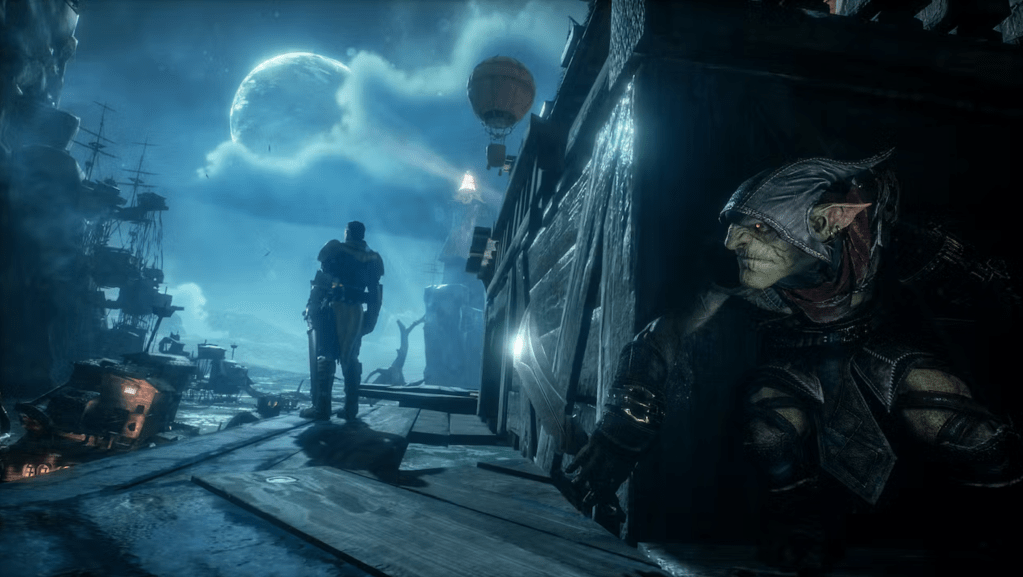
Let’s say one of the heroes wants to move silently or hide in shadows in a location where that’s reasonable. You can have that character do a simple stealth check. In my game, stealth is a skill, and one that anyone can try—assuming they’re not wearing heavy armor. Roguish characters probably have expertise in it, and so get a bonus. And, in my game, if you fail at most skill checks, you can roll again to recover. Successfully recovering means you succeeded less well than you hoped or partially failed or encountered some kind of complication.
- You’re successful, but it takes longer than you thought.
- You break something, like a window or part of a fence.
- You leave evidence of your passage behind, like footprints or damaged foliage.
The difficulty for these checks needs to be low—especially if it will require multiple checks. After all, if you require several stealth checks, even with very low difficulty, it’s likely the character will fail one of them—and the character would probably never have attempted such a fool-hardy endeavor.
That’s where a stealth challenge comes in.
The Courtyard
Let’s say this character is trying to go over a wall into a courtyard, move across the courtyard to a door, pick the lock, and go inside. You should require a stealth check for going over the wall undetected but then offer two choices for crossing the courtyard to the door.
- One option is direct and gets the character right to the door. It has a low difficulty of 9, because it’s fast. But it requires crossing open ground, and anyone—not just a guard—would be suspicious if they happened to glimpse that. So, if you fail, the guard (or whomever spots you) will also roll to beat a 9 to confirm their suspicion and raise the alarm.
- Another option is to skirt the wall for a while and remaining in the shadow of the wall and some vegetation there, cross shadowy ground to a tree, then to the opposite wall, then skirt the wall to the door. That has a higher difficulty of 13 because it takes longer and leaves more time for you to be spotted. But, if you fail, the guard will also roll to beat a 13, because you’re always in shadow, so it’s hard to confirm their suspicion.
Now let the player choose an option and make the check. If they fail the initial roll, they can try to recover, freezing in the nearest shadow. But even a complete failure doesn’t mean getting caught. (After all, the character could fail utterly, making all kinds of noise and landing flat in the moonlight, but if there’s no one there to notice, it doesn’t matter.) It only means a guard has a chance to detect the character.
Now the guard (or whatever) needs to make a search check using his or her intelligence modifier to try to detect the source of some noise or fleeting movement the stealthy character made. The difficulty is the same as what the hero rolled against. Only then should the guard be confident that it wasn’t just the wind or leaves or a cat.
The idea is that the two routes are a trade-off, and trade-offs make for meaningful choices.
Of course, there are bad routes where it’s hard not to be noticed and easy for guards to confirm their suspicions, but a good sneak wouldn’t consider them. And you as GM could invent a route where it’s pretty easy to avoid being spotted and hard to confirm if glimpsed, but a game needs challenge.
The Cavern
Now let’s say our roguish friend needs to move thru a large cavern without attracting the attention of some hobgoblins. Rather than predetermining the difficulty for each option in such a varied location, you can simply say there are two routes and roll 1d10+5 for each.
Again, whichever route the hero takes, any possible detector (creature, guard, whatever) has to roll against the same difficulty to actually be sure that there’s an intruder.
Other Cases
If the player has a sufficient grasp of the environment, he or she might even suggest a route themselves. This is great, because, both you and the player start with the assumption that whatever difficulty the route has for the hero, it will have the same difficulty for a guard if the hero fails, so it’s easier to agree on a difficulty.
You want to go across the roofs? It’s going to be very hard not to make noise or be spotted against the sky, so the difficulty is 17. But anyone who hears you is likely inside the building and will have a hard time being able to confirm your presence. And anyone who sees you is by necessity away from the building and will have a hard time getting anyone’s attention inside the building—if they even care to try. (They might just shout, “Hey, you! What are you doing up there?!” and leave it at that.) So they also have to beat a 17 to raise the alarm.
You want to sneak across the common green to the manor house at night covered in a sheepskin? Sure, who’s going to look twice at a sheep on in a pasture? Difficulty 7. But if someone does notice that you’re not a sheep, they’re going to raise a hue and cry like you’ve never heard, because you’re obviously up to no good, so difficulty 7 that you get caught out.
 zarban.com
Leave a comment