

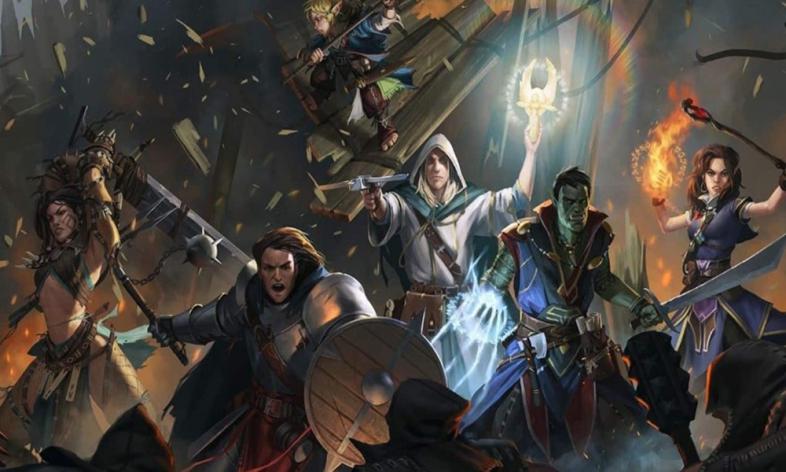
You can make combat dynamic by a few simple tweaks to your system’s rules. The key is encouraging movement.
- In old D&D (before 3e), you could move half your movement rate and still get your melee attack or one of its two bow attacks. Now, you can instead attack and then move up to half your movement rate. But you can’t split your move (except maybe 5 feet).
- Change opportunity attacks to only occurring if the creature tries to get past another creature in its personal space (that is, if you use a grid, the square it occupies).
- Make it possible to interrupt a spellcaster.
These ideas are inspired by Pointy Hat (Antonio Demico) and his “Battlefield Actions” rules.
Old-School Reactions
When a character declares an action, other characters may be able to react to it. These rules make it possible to move or attack to avoid magical effects and certain other attacks. The key is that magical spells and abilities take effect at the end of the round.
- Spell or Spell-like Effect: If you can see a spellcaster starting to cast a spell or a creature about to use a spell-like effect, and you have a ranged attack left, you can immediately attack with the ranged weapon. You have to be looking in the direction of the spellcaster to notice. If you hit, you stop the spell from being completed, and the spell is wasted.✽
- Area-of-effect: You can try to move out of the area of effect of a spell or magical ability or an action that causes rocks or a net to fall.
- If you move out of the area of effect, you’re safe from the spell’s effect—no saving throw needed.
- If you move but still end up in the area of effect (because the area isn’t clearly defined), you still get the normal save.
- If you had already moved, you get the normal “save for half vs full damage” (or whatever) save. If successful, you end up at the nearest edge of the area of effect.
- If the spell or ability doesn’t allow a saving throw, the GM may say the casting or ability is too quick to avoid or locks onto targets regardless of where they move.
- Visually Targeted: You can take action to avoid being visible to a spell or magical ability that requires eyes on the target, such as a gaze attack or breath weapon.
- This is the normal “save to avoid vs suffer the affect” sort of save, but it requires you to leap away or take a simple action like ducking behind adjacent cover.
- If it’s a gaze attack, the target may merely turn away, but this makes the target vulnerable to a pounce attack. The target could also hide or become invisible.
- If the spell or ability doesn’t allow a saving throw, the GM may say it’s too quick.
- Interception: If you haven’t moved yet, you can immediately move to intercept a creature that’s moving and even, if you can reach them and have a melee attack left, attack them.
- Sweep: You can make a dexterity save to move out of the way of a sweep attack, if you haven’t already moved.
- A sweep targets all the creatures within reach around the attacker with a single blow doing half damage to each. This typically means those within 5 feet of its front and sides; 10 feet for giants and others with long reach.
✽ This is in keeping with Gygax’s personal rules, which said that if a spellcaster gets hit before his or her turn comes up in initiative, the spell he or she was casting is lost.
As GM, you may want to regard certain spells that don’t allow saving throws as being cast instantly, so no reaction is allowed. Others you may judge to allow reaction movement to close to attack.
Boss Actions
Reactions can also work for special boss abilities. Bosses typically have 2 or even 3 attacks per turn, so certain abilities may take effect not at the end of the round but just before the boss’s next attack. Bosses and their minions—and all opponents—should move around quite a bit (hence the removal of opportunity attacks).
- Summoning Rings: The boss begins magically summoning minions, so 1d3+1 summoning rings appear. They will dissipate when a living creature occupies them; this can be the summoned creature or a hero, if a hero moves onto one (or throws an opponent onto one). Any ring that remains unoccupied at the end of the round generates a summoned creature to fight for the boss. (You might demonstrate it by having a boss’ minion accidentally cross over a ring and dissipate it.)
- Target Switching: The boss targets the last hero to attack it with a melee or ranged attack (magical or not). If another hero attacks it before its next attack or the end of the round (whichever comes first), the boss changes its target to the new hero.
- Hazardous Presence: Being within 10 feet of the boss for more than one round causes damage, induces fear, or has some other effect. So heroes need to hit and run (remember that you can split your move in this system)… but the boss can follow them.
- Confusing Aura: Creatures within a 40 foot cone of the boss’s front must save or become confused. Even those who save are muddled enough to require an extra action to cast a spell. The boss moves and turns around frequently, changing where this cone is.
- Self-Destruct: When brought below 10 hit points, the boss (a construct or weird monstrosity) becomes enraged and self-destructive, with a clear indication (bulging, reddening, steaming, shooting off limbs for damage, etc.) that it’s going to explode in a couple of rounds. Altho still mobile and able to fight, it then does explode for heavy damage to all within 20 feet.
Results
Being able to dodge spells or attack to stop them helps even out the disparities between martial/rogue characters and spellcasters. It makes it advantageous to cast spells from concealment, from behind a few minions, or from a balcony, so that targets can’t dodge or attack you while you cast.
However, since more spells will be defeated by opponents, GMs should be more generous with low-level spells (and low-level spells only) than traditional old-school systems.
 zarban.com
Leave a comment